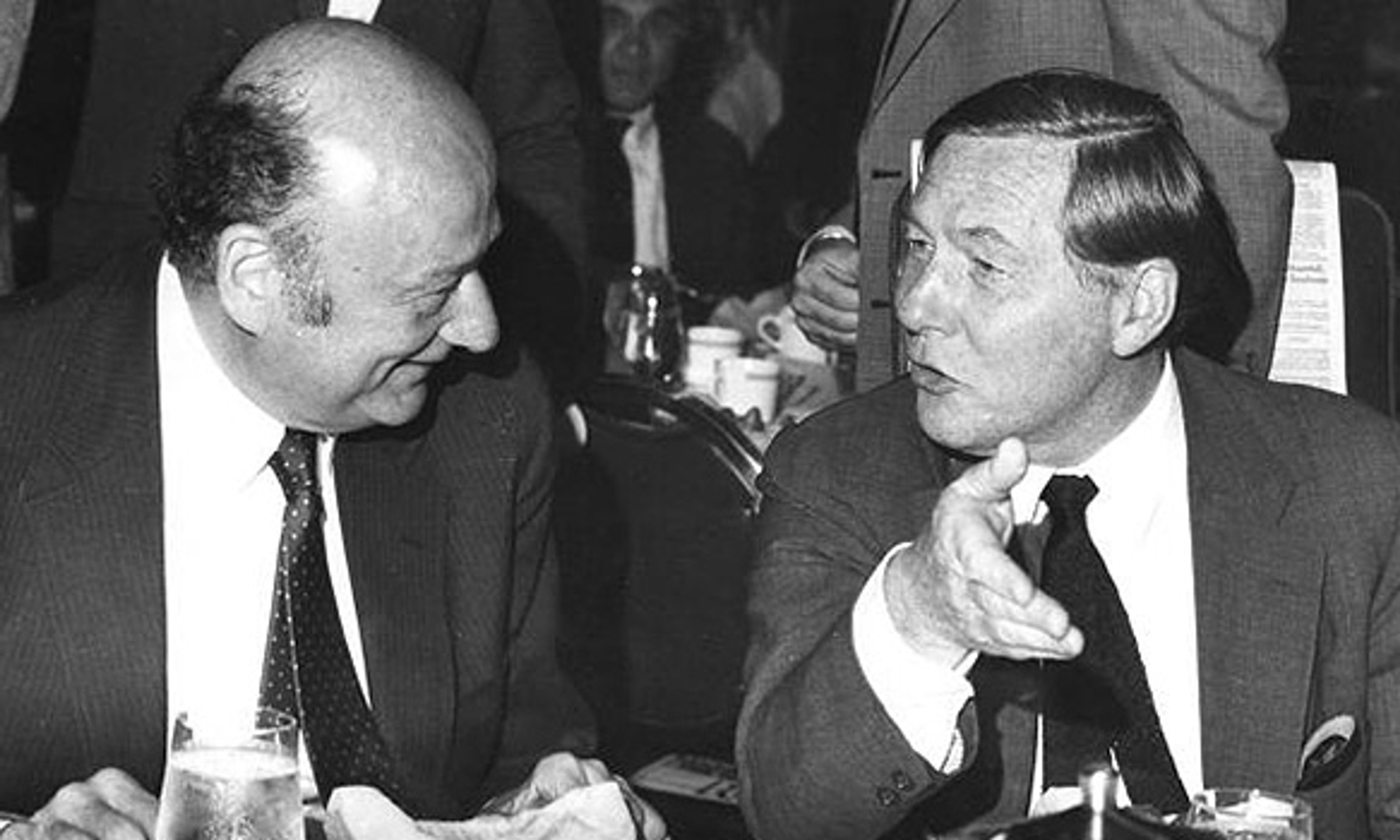
Roger Wood, who died last November and whose memorial service will be held this morning at St. Thomas’s Church on Fifth Avenue in New York City, was the editor of the New York Post in the 1970s and 1980s who more than doubled his newspaper’s circulation and made the city’s journalism brasher, livelier, braver, and better.
His editorship was the era of the Post’s famous shock-horror headlines: “Headless Body in Topless Bar,” “Boy Gulps Gas, Explodes,” “Gadaffy Goes Daffy,” and “Eleven Dead and the Band Played On.”
Though these headlines were described as “neo-expressionist poetry” and worse, Roger would point out that they were no more than the literal facts of the case vividly expressed. It was just that he was an editor who pressed his reporters to pursue the facts of the case where other papers quailed or got squeamish. He was indeed the equal in imagination and drive of a Hearst or a Pulitzer.
Yet he looked anything but the part.
Always dressed in a blue blazer, fawn or grey slacks, and a white shirt (occasionally supplemented by an odd Victorian shawl), usually smiling amiably as he padded around the newsroom, addressing men as “dear boy” and women as “lovely one,” Roger would have seemed perfectly at home at the 19th hole of some suburban golf club in southern England.
Roger was indeed English, though born in Belgium and not speaking English until he was seven. He had a very English career to start with: wartime service in the RAF, Oxford, early journalistic training in the provinces, then a rapid rise on the Daily Express to the deputy editorship under the original press lord, Lord Beaverbrook.
One morning he received a summons to join Beaverbrook in the south of France. Arriving at his host’s villa, he was invited to join him on the terrace even before he could unpack. Beaverbrook greeted him with a copy of that morning’s editorial. It attacked one of the old man’s favorite politicians, but had fortunately been written not by Roger but by his editor.
“Do you know what I think of that editorial, Mr. Wood?” Beaverbrook asked.
“No sir,” Roger answered.
By way of reply, Beaverbrook threw the offending paper on the ground, jumped onto it, and began kicking it in a prolonged little dance that eventually reduced the editorial to tiny pieces of newsprint that drifted off in the breeze.
“Good morning, Mr. Wood, you are now the editor of the Daily Express,” Beaverbrook concluded. “Enjoy your trip back to London.”
Thus Roger became one of the youngest ever national-newspaper editors in history. Not surprisingly in these circumstances, however, he was also a short-lived editor. The period was known to classical scholars as “the year of the four editors.” He went on to head magazines and publishing enterprises in England and Australia.
By the time he arrived in America as editor of the Star, he had accumulated a great deal of journalistic and political experience. Outwardly he still seemed the amiable golf-club charmer. Only the piercing quality of his blue eyes and a certain crocodile quality about his smile indicated that here was a creature far more formidable even than the average graduate of the Fleet Street tabloids. Appointed editor of the Post just six months after Rupert Murdoch bought the paper, Wood very quickly stamped his authority on it — and within a year or two he was forcing other editors to scramble to keep up with him.
How so? Well, Roger saw three things about the New York journalism of the mid-1970s.
First, it was lazy, timid, conformist, and therefore spoon-fed. Coverage of both City Hall and Albany, let alone Washington, was reliant upon leaks by officials and politicians whose reward was favorable treatment. If New York had been well-run and successful, there might have been at least an excuse for such coverage. But it was actually sliding towards bankruptcy, crime, and chaos — and the people knew it even if the journos did not.
Roger appointed some first-class, aggressive reporters to the main political slots and then proceeded to harry them unmercifully. Within a very short time, the Post was getting scoops and pols were going to jail. Other papers had to follow suit.
Second, New York journalism was apparently ignorant of the vibrant, multifaceted, buzzing city it was supposed to be covering. The joke then current was that the New York Times had appointed a brilliant new foreign correspondent and that he would be arriving in the Bronx just as soon as he got a passport. Roger’s instructions were that every aspect of the city’s life from crime to Broadway should be covered in the Post — and the more dramatically the better. Thus, contrary to the lazily hostile caricature of tabloids, the Post had excellent sections on Wall Street and finance, Broadway and Hollywood, foreign affairs (especially the Middle East), and, of course, gossip.
Page Six, like the Post itself, was the joint invention of Roger Wood and Rupert Murdoch. It was a new and more ambitious sort of gossip journalism. It regularly broke stories that in any other paper would have been a page-one lead. And it meant that the Post was required reading everywhere, including by those people who sententiously deplored the paper’s “sensationalism.”
Third, Roger Wood saw that New York journalism was far too liberal for its own good. It had become massively conformist and avoided certain stories, generally stories about crime, that didn’t fit the liberal worldview or that implied a failure of liberalism. Sure, New York was a liberal city, but it wasn’t 100 percent liberal. And there were many New Yorkers — cops, construction workers, Irish Catholics, Orthodox Jews, Asian immigrants — who either had conservative views or were interested in the topics from which liberal journalists shrank. Above all they wanted honest coverage of crime.
Putting together a paper rooted in these insights, Wood produced an aggressive conservative tabloid with a cheerful upbeat personality, no respect for liberal taboos, and a strong sense of humor. The paper soon made its own market. For some it was an addiction; for others it was a shameful addiction. But they had to buy it. And its circulation rose from 400,000 to more than 1 million.
Well before I arrived there as editor of the editorial and op-ed pages in late 1984, it exercised enormous influence in the city and the state. On the morning my first editorial appeared, I had a very early call from Mario Cuomo to welcome me to New York and to reassure me that he knew that Roger, not I, had written the dreadful nonsense that had appeared in the column. That wasn’t true, as it happened, but it might have been.
Roger had brought together a very talented team of reporters, editors, and critics to cover every aspect of New York. It might have been a tough team to control. And he drove them hard.
According to a generous obituary in the New York Times, Roger had once rung up Clive Barnes, the Post’s theater and ballet critic and a friend of John Lennon, to tell him of Lennon’s death.
“Something odd has happened,” he said to Barnes, gave him the news, and told him to be ready to begin dictating an obituary within five minutes.
Similarly, Steve Cuozzo, one of his editors (who wrote a history of the Post as lively as its subject — It’s Alive!: How America’s Oldest Newspaper Cheated Death and Why It Matters), tells of an occasion when Roger hauled four editors over the coals: “He loudly berated the three other editors in turn — ‘These pictures are rubbish. Take new ones’ — and saved me for last. Then he demanded: ‘What are you doing here?’ When I quaked that he’d called me in, too, he roared, ‘Get the hell out of here!’”
People took these occasional tantrums for a lot of reasons. Roger was in fact very fair-minded. He gave praise generously where it was due. He helped struggling writers to improve their work. He got better work out of us and we knew it. Above all, we felt that the Post was an incredibly exciting place to work — it had the esprit de corps of a first-class pirate ship.
But the main reason was that everyone in the newsroom knew that Roger could do every job in the paper as well as they could. Very often he did. Roger would invite a reporter who had arrived with a hot story into his office to edit the piece alongside him. Then Roger would add new (and more timely) information to the “hot” story that had been written only minutes before. He especially enjoyed demonstrating to Page Six reporters that he had better social contacts than they did. He was a walking sense of mischief, a Lord of Misrule.
Roger lived journalism; he had the first edition of the Post delivered to him wherever he happened to be dining. And he would be immediately on the phone to the office, dictating changes and improvements, to wrong-foot rival presses. He combined this extraordinary life with a happy marriage of more than 40 years to Pat Miller, perhaps because Pat too had ink in her veins, having begun life as the girl who brought in the coal for the literary magazine Argosy in London and risen to become the international editor of the Cosmopolitan chain of magazines.
If you want a monument to Roger Wood, look around you at the state of mainstream-media journalism — conformist, dull, dishonest, and lacking any sense of excitement. That is what New York journalism would have been like in the 1980s and 1990s if Roger Wood had not been editor of the New York Post. R.I.P.
— John O’Sullivan is editor-at-large of National Review.




Comments