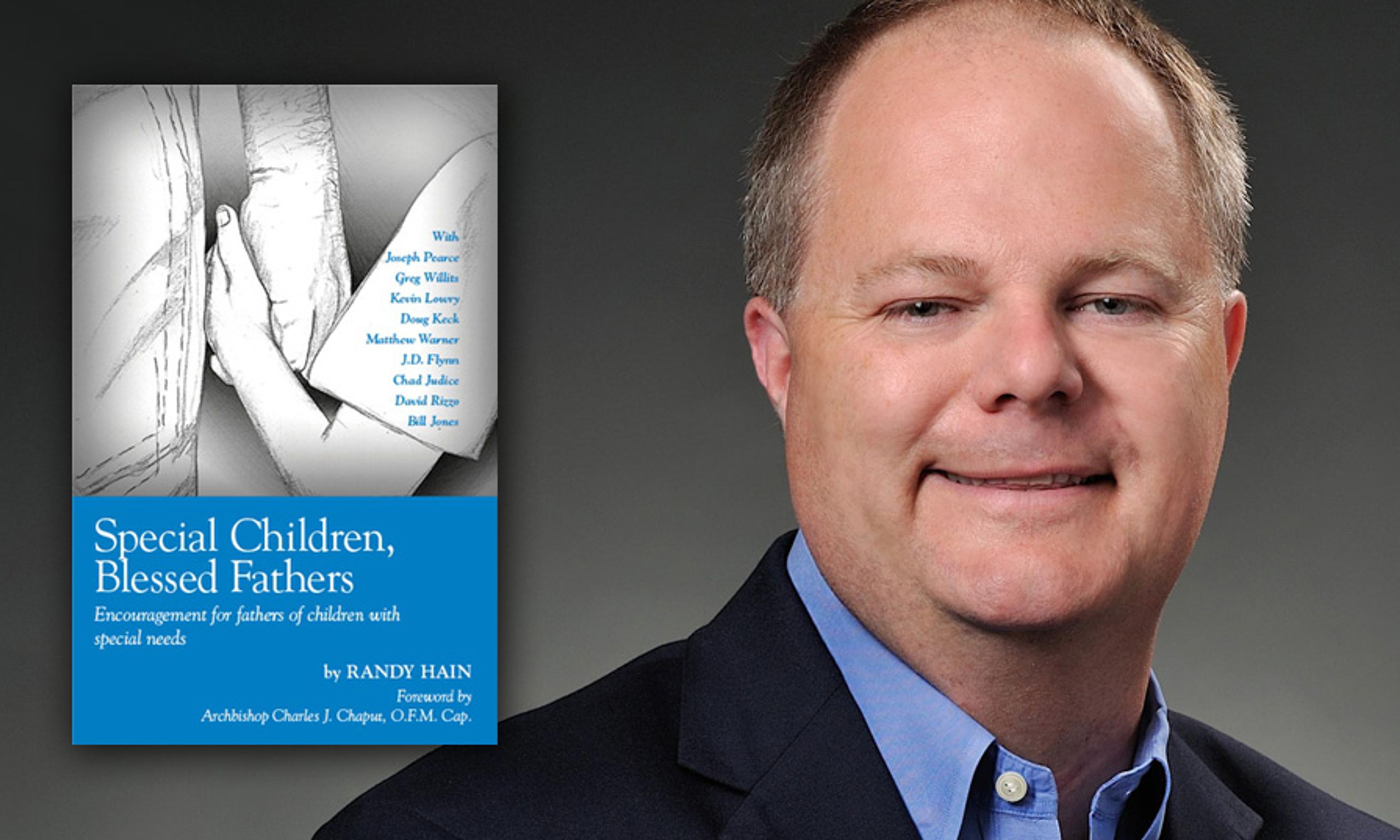
The book Special Children, Blessed Fathers: Encouragement for Fathers of Children with Special Needs is a new collection Randy Hain has put together to give hope and encouragement to fathers and to provide a window into the home-life hopes, dreams, and struggles of families with special needs. As a prelude to Father’s Day later this month, Hain talks about the book, some of the contributors, and some of the insights. — KJL
Kathryn Jean Lopez: What is the encouragement that fathers with special-needs children need?
Randy Hain: Being a father (or mother) of a special-needs child or children is a difficult role with emotional, physical, and financial pressures and stresses on the marriage that can, at times, be overwhelming. Coupled with the overall emasculation of men and their roles in the family in modern society, men in these families are often withdrawing from their responsibilities or leaving their families altogether. As one of these fathers myself, I felt led to offer my brothers encouragement, lessons from our Catholic faith, and good examples to follow of other men who are fully engaged.
Lopez: What’s so special about the special kind of fatherhood a dad with a special-needs child is called to?
Hain: Fatherhood is always a blessing. Being the father of a child (or children) with special needs calls men to something different and special. We must see our children, no matter what their challenges, as blessings and gifts from God. We have to be humble and not necessarily project our dreams onto them, but instead learn to celebrate their unique gifts and help them achieve the life God intends for them. This requires patience and strong faith in God the Father, who loves all of His children. Finally, we have to be strong for our families, no matter what obstacles or pressures we face. Our wives and children deserve nothing less.
Lopez: Is this a harsh way to put it? “Many fathers in families with special-needs children are disengaged, in denial, and not living up to their responsibilities.”
Hain: Kathryn, I have observed it myself all over the country. I see it when I am the only dad at speech therapy with my son in a room with a dozen moms. I see it when I meet an endless stream of divorced parents of children with special needs who lost their marriages because they could not cope with the pressure. I also know full well from the research I did for my 2014 book, Journey to Heaven: A Road Map for Catholic Men that men in all kinds of families are struggling to live up to their vocations as men, husbands, and fathers. The problems are real, but as you will see in Journey to Heaven and Special Children, Blessed Fathers, there are men out there standing up for courageous fatherhood.
Lopez: What’s the kind of help you credit Jeanne Lyons with, to help integrate children and families into the Catholic Church?
We must see our children, no matter what their challenges, as blessings and gifts from God.
Hain: As a mother of two children on the autism spectrum, Jeanne has spent much of her life advocating for her children to be included in all aspects of Catholic worship from Mass to Confirmation. This has become an actual ministry through which Jeanne has worked with Catholic families who find parish life and acceptance difficult because of their children’s challenges. Jeanne brings joy, understanding, compassion, and creativity in her approach that has helped countless families like mine integrate into the Church. She was actually the Confirmation sponsor for my oldest son, Alex.
Lopez: Is this crucial in helping marriages as much as the children?
Hain: No doubt. Integration into the Catholic faith helps families and marriages, not just the individual children. Anything that helps one of our children is ultimately a blessing to the parents.
Lopez: Kevin Lowry writes: “Think about your relationship with your wife first.” Agree?
Hain: In the context of his chapter I do agree. While ultimately God must come first, in families who have children with special needs the marriage is the last thing that receives attention as the children get the majority of the time and attention. If a couple does not fully love and support each other, the marriage and the family will suffer. Although the numbers are hard to pin down, the divorce rate among these families is believed to be much higher than the national average.
Lopez: He also writes that “special kids make us better fathers.” Are other fathers at some kind of unconventional disadvantage, then?
Hain: Well, I’m not sure I’d put it that way. Another way to consider this is to recognize that by raising a child or children with a special challenge, fathers are forced to dig deep and use strengths they have never fully utilized before. We are permanently changed for the better when we recognize these kids for the blessings they are in our lives. I know my son Alex has been a tremendous blessing to our family, and I can’t imagine life without him.
Lopez: Is there more that families and friends, and parish communities, can do for families with children with special needs?
Hain: It starts with love, acceptance, and inclusion. Don’t marginalize these kids and their families, but open the doors wide to all of God’s children and show true Christian charity by going the extra mile to accommodate them and help them understand as best they can our beautiful Catholic faith. We are called to love everyone, not just those who look, act, and speak like everyone else. Also, it begins with our priests and ministry leaders to set the tone for the parish.
Lopez: Why do fathers of children with special needs feel guilt?
Hain: Men I have interviewed and others I know quite well sometimes exhibit feelings of guilt because they think their child’s issues are their fault or somehow they are to blame. There is also a pride issue when they see that their child may not be able to live out their dreams on the sports field or in the business arena.
Lopez: How can prayer reasonably help, especially if a man is in a tough economic-provider role?
Hain: I can’t imagine getting through a single day without prayer. The emotional and financial burdens take a toll, and men typically try to shoulder these burdens alone. Over time, there is a breakdown in the marriage, and the family suffers because Dad may not have reached out for the help so readily available in prayer. Prayer in the car, family prayer, and a daily Rosary, perhaps while driving or during exercise, should be staples for every man to seek the Lord’s help in shouldering the enormous burdens we often experience.
Lopez: Deacon Mike Bickerstaff talks about fathers in this way – father, leader. What would you say to those who might think that an outdated way to look at it?
Hain: Not at all. Men are called to be the spiritual leaders in their homes. Our vocation is to help our families get to heaven and not sit on the sidelines. Mothers also play a critical role, and this is a partnership, not a hierarchy. Both mother and father faithfully fulfilling their calling makes for a strong family.
Lopez: How is Saint Joseph a practical guide to fathers? We don’t know all that much about him.
Hain: The beauty of Saint Joseph as a role model for fathers is that he showed through his powerful actions the way for us to live. His example is as relevant today as it was over 2,000 years ago. Men often overcomplicate their responsibilities when Saint Joseph has so clearly and simply already shown us the way.
Lopez: If you could speak to any expectant father who has gotten the news of an adverse diagnosis or a child with special needs who might have happened upon this interview, what would you like him to know?
Hain: The diagnosis is not about you or your wife and it is certainly not the end of the world. Accept God’s gift, just as he/she is, and look for the blessings you can expect from your child. Embrace your child and let joy fill your heart because you, you, have been specifically chosen to be that child’s father, and you are called to see this gift as a blessing and not a burden. “Much will be required of the person entrusted with much, and still more will be demanded of the person entrusted with more.” (Luke 12:48)
Lopez: What might you want a struggling husband and dad with a son or daughter with Down syndrome or autism or some other particularly challenging condition to know?
Hain: I want these dads to know they are not alone. I want them to know they can do this! Seek out God’s help in prayer. Love your wives and shoulder the challenges together. Don’t isolate yourselves, and make an effort to let friends, family, and other parishioners into your life. Finally, always, always, always see your child as a gift from God. What you do with His gift is up to you. Please make the right choices.
Lopez: You are donating the royalties from the book to the National Catholic Partnership on Disability. How might that money, should the book do well, make a difference in anyone’s life?
Hain: NCPD.org is a wonderful organization that provides education and training for dioceses and parishes all over the country on how to integrate families with special needs and their children into parish life and the practice of our Catholic faith. My fellow contributors and I are proud to support this great ministry.
Lopez: What are you grateful for? What can gratitude mean in the life of a father?
Hain: I am simply grateful for the opportunity to be a father to Alex and Ryan. I am grateful to be Sandra’s husband. I am grateful for the incredible difference Christ has made in my life since the profound conversion I experienced in 2005. I am grateful for our beautiful Catholic faith. When a man, especially a father, can experience gratitude like this for himself, it puts life in perspective and helps us remember to be joyful for our blessings.
Lopez: Is gratitude a challenge for the father of a child with special needs? Is it rewarding?
Hain: It is often difficult to be grateful, and gratitude is often the last thing we think about experiencing. But, as the book points out in so many ways through the stories shared by myself and the other writers, the subtle shift from resentment and anger to gratitude will transform your life. When fathers embrace this feeling of gratitude and offer thanks in prayer for the opportunity they have been given to care for their children, the fathers, their marriages, and all of their children will experience profound blessings. I have seen this in my own life, the lives of the contributing writers, and those of the numerous dads I have been privileged to meet in my travels.
Lopez: A monsignor you interviewed told you: It takes a special man to be a great father to any child. These gifts, given by God, are such a blessing to one’s spouse and to the children. It takes a really special father to see beyond a disability. He makes no judgment about his children’s successes and flaws. It is a beautiful sight indeed.
Do you believe this? How is this not saccharine or broad-brushed, as J. D. Flynn and others warn against in your book?
Hain: The good monsignor had it right. It is a difficult journey to achieve this perception, but it is a necessary goal. My family has plenty of tough days, and they can consume us if we are not prayerful, diligent, and focused. But, when we slow down enough to be grateful and see the often “little blessings” from our children with special needs that other families might discount or ignore, we get a little closer to understanding the gifts God has given us and why our lives are better (not easier) because of these children.
Lopez: What will you be celebrating this Father’s Day?
Hain: I hope on that day to be surrounded by my family doing something fun together. I will celebrate that I am a fortunate man to have such a family and be thankful that God chose me for this role, and not someone else. My life could have been much different and filled with things that don’t matter, but God has a plan for me, and I pray I have the strength to follow it.
Lopez: What do you hope your book might bring to this Father’s Day?
Hain: I want fathers to read the book and be inspired and encouraged. I hope they will find practical ways to more fully engage with their families and live up to their vocations as dads. I hope anyone who wants to better understand the challenges men face and ways to help them will buy the book. I hope parishes will embrace the book as a way to help struggling families they know. Most of all, I sincerely hope these special children will forever be seen as blessings and not burdens by the men and women who read Special Children, Blessed Fathers.
— Kathryn Jean Lopez is senior fellow at the National Review Institute and editor-at-large of National Review Online.





Comments