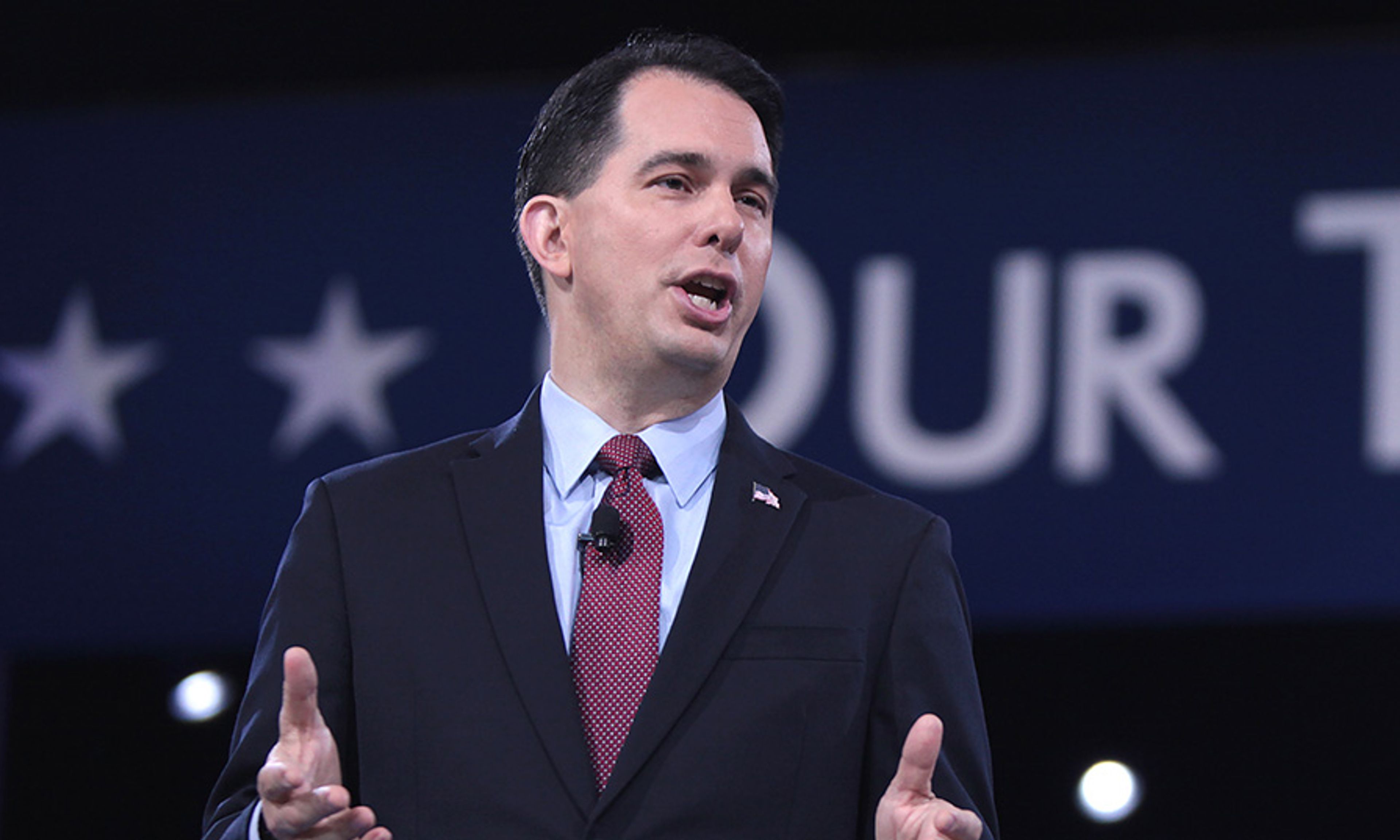
The big news out of Wisconsin’s GOP primary was Ted Cruz’s crushing 13-point defeat of Donald Trump, setting up a likely contested convention in Cleveland. But the primary also demonstrated the solid grip Governor Scott Walker has on conservatives in the state and the extent to which he has changed its politics.
Walker tried to parlay his success in passing major budget and public-employee-union reforms into a presidential run last year, but he had to drop out after some rookie mistakes and an incompetent campaign manager squandered his advantages.
But Walker is still a powerhouse among Republicans in Wisconsin, where the success of his reforms has kept his approval ratings among GOP voters above 80 percent (his approval rating among all voters in the latest Marquette University poll was 43 percent).
In a post-primary analysis of the results, Walker wasn’t shy in pointing out just how badly Donald Trump had misread the Wisconsin electorate by attacking the Wisconsin reform agenda. “This is a well-informed electorate for all that we’ve gone through over the last five years,” he told radio talk-show host Charlie Sykes. “They know what common-sense conservative, principled leadership looks like. They know what it sounds like and more importantly, they know what the benefit of it is.”
RELATED: The Anatomy of a Trump Defeat
Indeed, Trump seemed to obsess on attacking Walker even more than he did on Ted Cruz after the governor had decided to campaign actively for the Texas senator.
Last year, Trump had ripped Walker’s record by accusing him of being “divisive” in seeking changes in union bargaining power. When he first visited the state before its April 5 primary, he was much harsher.
Walker’s reforms have clearly reshaped a state that was once a bastion of both progressive politics and militant unionism.
“There’s a $2.2 billion deficit and the schools were going begging and everything was going begging because he didn’t want to raise taxes ’cause he was going to run for president,” said Trump. “So instead of raising taxes, he cut back on schools, he cut back on highways, he cut back on a lot of things.” Trump then added: “Wisconsin has a lot of problems, plus there is tremendous hatred. . . . I wouldn’t exactly say that things are running smoothly.” He also took time out to attack House speaker Paul Ryan, who is from Wisconsin and had remained neutral in the race but made a speech implying that Trump was guilty of a lack of civility.
Those were all fighting words to a majority of Wisconsin conservatives. “Trump was attacking reforms that not only are working, but attacked what conservatives have bled to achieve in this state,” Lieutenant Governor Rebecca Kleefisch told me. “The reforms were ratified by the voters not only in a 2012 recall election but when Walker was re-elected in 2014.
“So many people put time and effort into that, that attack was an affront not just against me, or my political team. That was an affront against all that we have done.”
RELATED: How Cruz Cruised to His Wisconsin Win
The reforms are now just over five years old, and while they are still controversial, they have clearly reshaped a state that was once a bastion of both progressive politics and militant unionism. Both before and after the passage of Act 10, the law that took away the right of unions to collect dues from members without their permission and gave local governments more power over union contracts, a tsunami of protesters occupied the state capitol in Madison and tried to intimidate legislators. But Act 10 supporters held firm and eventually the law survived a flurry of legal challenges and attempted recalls.
#share#The MacIver Institute, a free-market think tank in Madison, has just issued a report estimating that Act 10 has saved state taxpayers over $5.2 billion since it was implemented, allowing for tax cuts for both individuals and businesses as well as a freeze in property taxes. The state saved $3.36 billion by making government employees pitch in for their pension and health benefits and another $404.8 million by opening up employees’ health insurance to competitive bidding, among other cost-control measures. The overall savings are the equivalent of an extra $2,291 in the pockets of every household in Wisconsin.
EDITORIAL: Cruz’s Big Win in Wisconsin
The loss of automatically deducted union dues and the requirement that public-sector unions have to hold annual recertification votes have transformed the shape of state government. The Wisconsin Education Association Council, the state’s dominant teachers’ union, has seen membership decline by almost 60 percent since Act 10 passed in 2011, down to around 40,000. The union representing state public employees saw two-thirds of its members drop out, many because they didn’t believe the union was providing value for the up to $1,000 in annual dues it extracted.
Another factor fueling the decline was that a majority of the dues money that unions had collected had been plowed into political campaigns that many members didn’t support (Walker won almost 40 percent of the votes of union members in his 2012 recall).
#related#Unions that had once been flush with cash to fight conservatives now found themselves with depleted coffers. In this week’s election in Wisconsin, unions were unable to fully fund the independent expenditures backing liberal judge Joanne Kloppenberg in her bid to unseat conservative supreme-court justice Rebecca Bradley. Commercials touting Kloppenberg or bashing Bradley were completely absent from the Wausau and Green Bay media markets in the home stretch of the campaign. With the help of Wisconsin Manufacturers & Commerce, and the Wisconsin Alliance for Reform, Bradley wound up sweeping those markets and winning statewide with 52 percent of the vote. Her victory will cement a five-to-two conservative majority on the state’s highest court, which has had to rule on the constitutionality of all of Walker’s reform agenda.
So Donald Trump ran into a buzzsaw in Wisconsin, weakening his frontrunner status and demonstrating just how strongly the state’s conservative reformers will defend their gains. Governor Walker’s presidential bid may have crashed, but he has clearly cemented his hold on the state.
Grover Norquist, the head of Americans for Tax Reform, hails the Wisconsin record as a model for how to turn a liberal state back to fiscal sanity and business-friendly policies. “What Walker and his allies have done is a homerun for taxpayers,” Norquist told me. “People all over the country should be studying it because it proves that smart policies also make for smart politics.”






Comments