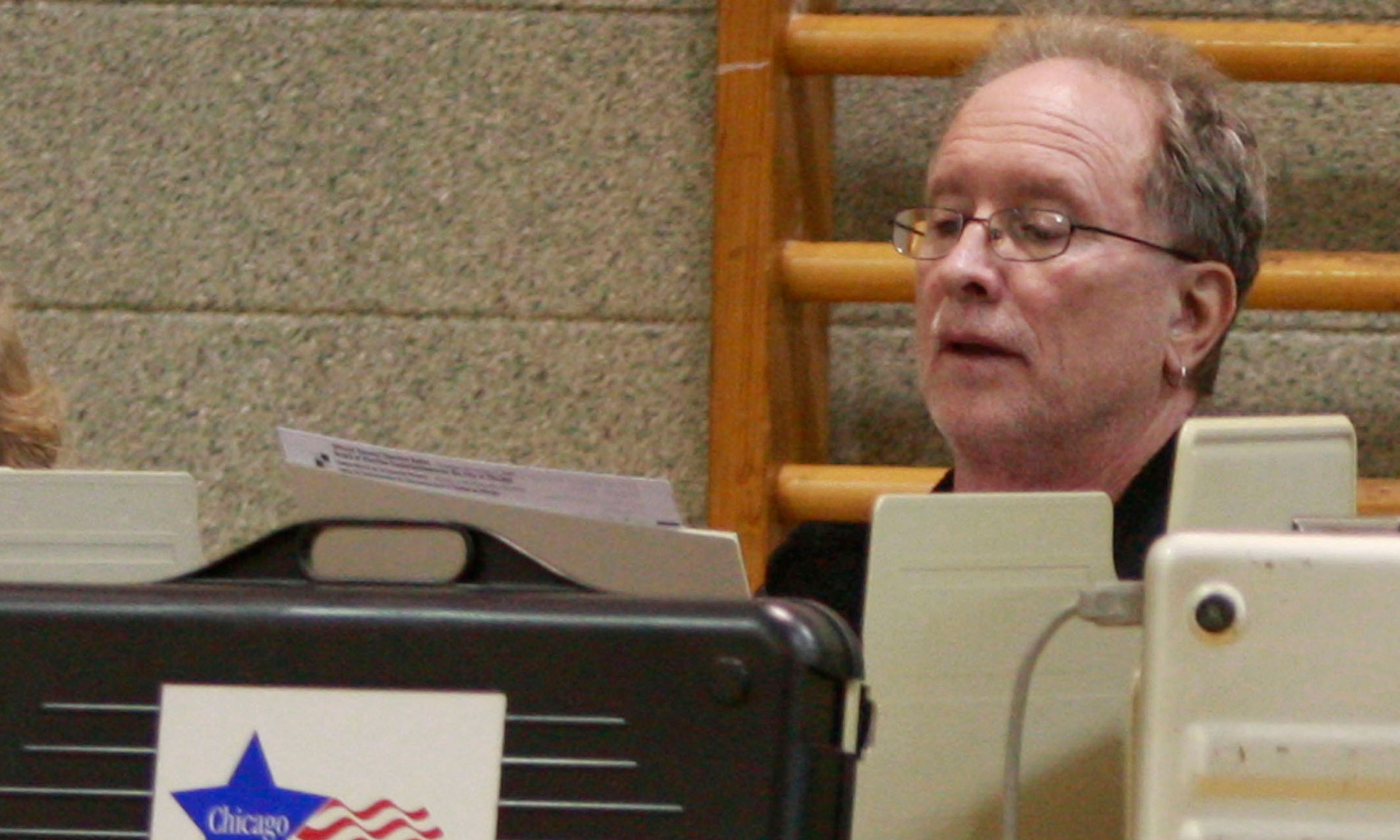
‘La educación es revolución!” Bill Ayers, the former Weatherman terrorist who is Barack Obama’s friend and “education reform” collaborator, was opening the World Education Forum in Venezuela. It was just two years ago, November 2006. As a beaming Hugo Chávez looked on, Ayers roused a throng of “invited guests, comrades,” touting the world’s classrooms as the frontline for the Left’s anti-American revolution.
Ayers has never made a secret of the fact that he is not just a man of the Left but a revolutionary. The revolution in the classroom, he repeatedly and defiantly maintains, is the same revolution he has served for 40 years, the same revolution that inspired him to bomb the Pentagon, the U.S. Capitol, and other American targets beginning in the late Sixties. On this day in Caracas, he gushed with praise for Chávez’s “Bolivarian Revolution and . . . the profound educational reforms underway here in Venezuela.” Against capitalism – which, he said, “promotes racism and materialism” and “turn[s] people into consumers, not citizens” — he contrasted Chávez’s police state: a “beacon to the world.”
In the electoral stretch-run, as concerns mount over his long association with Ayers, Barack Obama and his campaign have finally settled on a curt narrative: Obama was only eight years old when Ayers carried out “detestable” terrorist bombings. As critics of the Ayers tie append “unrepentant terrorist” to each mention of Ayers’s name, Obama partisans deftly deflect the outrage: “So what are you saying, that Obama is a terrorist?”
No one is actually saying that, so the critics are duly cowed. As they shrink from the bracing linkage of Obama and terrorist, the relieved Obamedia brush the entirety of their case aside.
Of course, Ayers’s terrorism is relevant. Americans are right to wonder why Obama would consort with such an execrable figure. But it has never been the main issue. When it comes to Ayers, it’s revolutionary Leftism that matters. The ideology that drives Ayers is what drew Obama to him.
Discomfited by the increased scrutiny over Ayers, Obama counters with elite academia’s imprimatur: Ayers is now a distinguished education professor at the University of Illinois at Chicago. Just last March, the 25,000-member American Educational Research Association elected Ayers its vice president for curriculum. These attainments, though, are no answer. Americans are inured to the non-stop excesses of what Roger Kimball calls our “tenured radicals.” Accolades from the academy do little to assuage concerns about Obama’s dalliance with a bomber whose only regret is his failure to have carried out more bombings.
And would that it were just a dalliance! Obama’s dishonesty about the relationship has slowly become obvious. First, he tried to minimize Ayers as just “a guy who lives in my neighborhood.” Obama’s campaign risibly told the credulous New York Times that he and the former terrorist met for the first time in late 1995 at the Ayers home, where Ayers and his wife, former Weather Underground terrorist Bernardine Dohrn, hosted the event that launched Obama’s political career.
Inevitably, thanks largely to the dogged research of National Review’s Stanley Kurtz, it emerged that Obama and Ayers had collaborated on a six-year, $160 million “education reform” project known as the Chicago Annenberg Challenge. The CAC was the brainchild of Ayers, who ran its operational arm. Obama was brought in to chair the board that approved program grants: tens of millions of dollars that seeded such leftist redoubts as the Small Schools Workshop — run by Mike Klonsky, Ayers’s Maoist associate — and ACORN (the Association of Community Organizations for Reform Now), a group (long associated with Obama) whose fraudulent voter-registration practices are now tainting yet another election cycle.
Obama and his allies have shifted their version of events as new facts have trickled out. In October, the Times — in an attempt to whitewash the Ayers tie — tacitly revised its prior reporting (which had neglected to mention the little matter of the CAC, the candidate’s only significant executive experience). The first encounter between Obama and Ayers was now supposed to have been “a lunchtime meeting about school reform in a Chicago skyscraper” some months before Obama’s famous debut in the Ayers living room. This, too, is implausible. At the time, Obama was an unknown, inexperienced, 33-year-old third-year associate at a small Chicago law firm. Would a committed activist like Ayers, whose allies had been hardcore radicals willing to die for the cause, entrust the goldmine that would bankroll his revolution to such a novice just because Obama made a nice impression over salad?
The origins of the relationship remain shrouded in mystery, though clues abound. Obama and Ayers walked the same path from Morningside Heights to Hyde Park. Obama was a student at Columbia from 1981 to 1983. He refuses to discuss those years; it is known only that he studied for at least some time under Edward Said, the late PLO apologist. Ayers first settled near Columbia when he and Dohrn emerged from fugitivity in 1980. Perhaps coincidentally (and perhaps not), Ayers is an ardent admirer of Said, who (like Obama) heaped glowing public praise on one of Ayers’s books. And years later, when they sat together on the board of the left-leaning Woods Fund in Chicago, Obama and Ayers financially supported Rashid Khalidi, another Arafat devotee who left the University of Chicago to become Columbia’s Edward Said Professor of Middle East Studies.
While Obama was at Columbia, Ayers studied at nearby Bank Street College of Education. After graduating from Columbia, Obama soon became a “community organizer” in Harlem before relocating to Chicago in 1985 to direct the Developing Communities Project (an offshoot of the Gamaliel Foundation, dedicated to Saul Alinsky’s principles for radicalizing society). Ayers, meanwhile, remained in the Harlem area until 1987, when he received his doctorate at Columbia’s Teachers College and went off to teach at UIC.
In Chicago, both men became embroiled in a major education controversy that resulted in citywide reform legislation in 1988. By then, though she could not be admitted to the bar due to a prior contempt citation, Bernardine Dohrn was working at Chicago’s prestigious Sidley Austin law firm, an intern position she secured with the help of Ayers’s father, the influential Chicago businessman Tom Ayers — a staunch liberal who was also enmeshed in the education-reform effort. At Sidley, Dohrn overlapped with Obama’s wife, Michelle, then an associate at the firm. Dohrn left Sidley in 1988, shortly before Obama arrived there as a summer intern after his first year at Harvard Law School.
Now, maybe it’s true that a pair of guys who, beginning in 1981, traveled the same path, admired some of the same people, drifted through Chicago’s leftist circles, and embraced the same “reform” cause really didn’t know each other until they became fast friends and partners in 1995. Pardon my skepticism. There is, in any event, enough common ground here that Obama, having failed to make Ayers disappear, is now trying to marginalize him — preposterously. So we have David Axelrod, Obama’s top political adviser, hilariously chirping, “There’s no evidence that they’re close.” (Emphasis added.) Translation: Get back to us when you have more damaging information — until then, we don’t need to refine our story further.
Yet they do refine away, as the evidence mounts. Obama first grudgingly admitted that Ayers wasn’t just “a guy who lives in my neighborhood,” but a guy with whom he sat on a couple of boards and with whom he occasionally sat on panels. Yet even this new account is impossible to square with the lengthy partnership, the dollars involved, and the fact that at least one of their joint panel appearances (at the University of Chicago) was arranged by Michelle Obama, then an associate dean — to say nothing of the rave review (“a searing and timely account”) Obama wrote in 1997 for A Kind and Just Parent, Ayers’s leftist polemic against the criminal justice system.
So Obama tried yet another tack: He didn’t know about Ayers’s terrorist past when they first became associated in 1995. But that won’t fly either. Ayers is proud of his past. For a leftist revolutionary, constructed history is a tool of the trade, so sure, Ayers falsely claims the Weathermen took pains to do only property damage, not kill or maim people. Besides that, though, he can’t stop talking about, and urging others to draw lessons from, his bomber days. (I’ll leave aside that he and Dohrn raised a child of their co-conspirators, who are serving lengthy sentences for the Brinks murders, and named one of their sons after a Black Panther killed in a shootout in which a New Jersey state trooper was murdered.)
Obama — intelligent, highly educated, and (as he has written) extremely careful about his associations — unquestionably knew exactly who Ayers was. And in the inconceivable event that he didn’t, he would no doubt have learned about it from Ayers in the first five minutes.
So now we’re on to Version Three (or thereabouts): Obama might possibly have known who Ayers was, but he thought Ayers had been “rehabilitated” as a nationally renowned educator. Ayers, however, has never been a mere educator. He is, by his own account, a leftist revolutionary, an activist who sees the classroom as a more promising battlefield — or, as he puts it, “contested space” — than the Pentagon or the Capitol.
“Do you really think Obama is a terrorist?” No. It wasn’t Ayers’s terrorism that attracted Obama. It was Ayers’s leftist revolution. We can take Obama at his word that he condemns the bombings. But Obama was front and center for the revolution.
Ayers’s revolution is Obama’s “change.” Ayers’s “participatory democracy” through “popular empowerment” is Obama’s ACORN. Ayers’s rage against the criminal justice system that paints America as an apartheid state and prison as a fading antique is Obama’s “searing and timely account.” The joint Ayers/Obama pursuit of “social justice” is seen in their joint underwriting (through the Woods Fund) of Marxist black-liberation theology at Jeremiah Wright’s Trinity Church, and of Khalidi’s Arab American Action Network — an organization that condones Palestinian terror while promoting public welfare and drivers’ licenses for illegal aliens in the U.S. Further, when it comes to “education reform,” the most significant of the duo’s shared passions, capitalism is the root cause of racism while Chávez’s Venezuela is “a beacon to the world.”
Obama may have been eight years old when Ayers bombed the Pentagon. But he was Ayers’s partner in 1995 when the former terrorist was publicly describing himself as “a radical, leftist, small-‘c’ communist.” Obama was an elected official in Illinois when, on 9/11, the Times published Ayers’s sentiments that he regretted only failing to set more bombs and (a few days later) that America still “makes me want to puke.” Obama was a U.S. senator planning a presidential run in 2006 when Ayers made his speech in Caracas — and when he gave an interview to Revolution magazine (the self-styled “Voice of the Revolutionary Communist Party, USA”) in which he decried the plight of Ward Churchill (the radical former University of Colorado professor who called 9/11 victims “little Eichmanns”): “How can we as socialists or as communists or as leftists, how can we leave him in the cold?”
Ayers is Ayers, has always been, and doesn’t pretend to be anything else. And Obama chose to be his friend and collaborator.






Comments