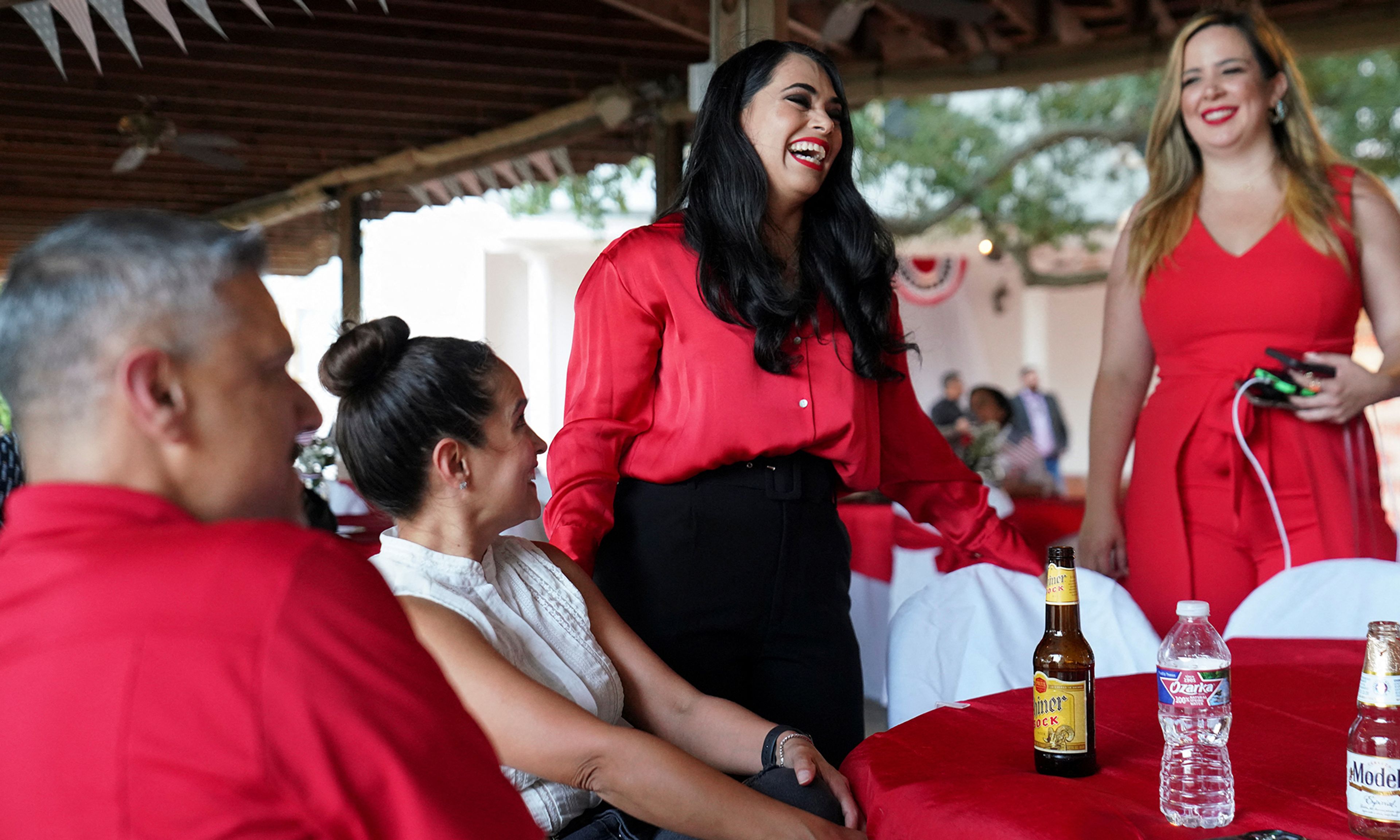
Four weeks out from the midterms, there’s a palpable political energy in South Texas. Every road, building, and car bumper is plastered with political posters, campaign stickers, and signs advertising various candidates — not just for national races but for local offices like justice of the peace, sheriff, county commissioner, and school-board member. The Rio Grande Valley (RGV) is a 91.5 percent Latino, traditionally Democratic region on the Texas-Mexico border that has shifted heavily toward Republicans in recent years, and it feels like a political battleground. The air hums with campaign energy. It’s “very, very competitive right now,” an older Latina woman at a local Republican phone-banking session tells me gravely. “I mean, the blue are very afraid of us doing the red tidal wave.”
Can Republicans keep — or even expand — their newfound voters in regions such as South Texas? As the 2020 election-night results began to pour in, and the GOP’s inroads with Latinos became evident, Republicans were quick to trumpet the emergence of a new, multiracial, working-class GOP. “The Republican coalition is bigger, more diverse, and more energetic than ever before—thanks to President @realDonald Trump. His efforts to reach every demographic has positively expanded the future of the GOP,” House GOP leader Kevin McCarthy tweeted. Senator Marco Rubio (R., Fla.) tweeted that “the future of the GOP” was “a party built on a multi-ethnic multi-racial coalition of working AMERICANS.” Within the span of 24 hours, the conventional wisdom on the Latino vote’s loyalty to the Democratic Party appeared to have been completely inverted: “We are a working class party now,” Senator Josh Hawley (R., Mo.) tweeted. “That’s the future.”




Comments