CAMPAIGN 2008
Closing Arguments
• The way this campaign is going, Obama might be able to go back to Trinity.
• Shed a tear with the bereaved — journos mourning the passing of their friend and hero, the good, old John McCain. McCain, they say, was open, honest, independent-minded. But age and the pursuit of office have turned him into a cranky, impulsive eye-gouger. National Review can speak with some objectivity on the matter, having endorsed other Republicans in 2000 and 2008. To us, he is the same John McCain: a lone wolf, driven by a sense of honor and a restless desire to do something, not just stand there — qualities that caused him to back both the surge and McCain-Feingold. Only one thing has changed. Until this year, many of McCain’s high-profile fights were with fellow Republicans and conservatives. But once he got his party’s nomination, he became the rival of The One. McCain’s erstwhile fans want him to go gentle in the good night of defeat. Since he won’t, they are friends no more.
• Bare-knuckle campaigning is as old as the hills, as are complaints about it, so when Rep. John Lewis (D., Ga.) accuses John McCain and Sarah Palin of “sowing the seeds of hatred and division,” and evokes George Wallace and the four girls murdered in the Birmingham church bombing, one might shrug and let it pass. Don’t. Lewis trashes his own past, as a wounded soldier in the civil-rights struggle: If John McCain or Sarah Palin had been in George Wallace’s place, there would have been no struggle, since Lewis and his fellows would have enjoyed their rights. But something even larger is at stake. For months, critics of Obama have been branded as racist, including Bill Clinton, formerly our first black president. Now racism is being equated with violence. Is this how Obama supporters would react to criticism of his administration? And what would they do in the face of real threats from random nuts? Gerald Ford, of all people, was shot at twice. Anglicans pray, on behalf of the queen, “Grant her in health . . . long to live.” We ask it for all our candidates, and for whoever wins — and for our body politic.
• Imagine if Senator McCain had a chum who had bombed abortion clinics. You might have heard of it. In real life, you learned, only belatedly, of Barack Obama’s political and grant-writing partner, and unrepentant terrorist, Bill Ayers. Obama’s association with Ayers ill suits a candidate whose main credential is his biography. When Obama was a young man from the provinces, he flourished in two liberal environments — the academy, and big-city politics, where he adopted a strategy of no enemies to the left (Jeremiah Wright was another consequence of it). Yet Obama is now a middle-aged senator, and party leader. More important than his past are his plans for our future. Conservatives should focus on them — and on what we propose to do better.
• Gov. Sarah Palin showed considerable moxie and talent in overthrowing Alaska’s Republican establishment. The national press has given her no credit for the accomplishment, and she has been showered with abuse, some of it quite disgusting, since McCain picked her as his running mate. But she has also done little to quell the doubts of people who wondered about her familiarity with national issues, and her assumption of the traditional veep candidate’s role as scourge of the other side has also detracted from her ability to impress the public as a serious figure. Her political future will depend on whether she can change public impressions — whether or not her ticket wins this year.
• Within seconds of John McCain’s selection of Palin, her political enemies in Alaska began spreading word about “Troopergate.” The alleged scandal is that Palin fired Alaska public-safety commissioner Walt Monegan because he would not fire a state trooper who had been involved in a messy divorce with Palin’s sister. As details emerged — often on the front pages of papers that hadn’t lifted a finger to look into the life and times of Joe Biden — it became clear that Palin did indeed want the trooper fired, in part because he had violated all sorts of rules of conduct. But there were other reasons for her to want to get rid of Walt Monegan; Palin’s lawyers made a pretty convincing case that Palin and her top aides had become exasperated with Monegan’s refusal to follow the governor’s policies. In a new report — incomplete, but rushed out in time for the election — an investigator hired by the Alaska legislature concludes that, on the Monegan issue, “Governor Palin’s firing of Commissioner Monegan was a proper and lawful exercise of her constitutional and statutory authority to hire and fire executive branch department heads.” Now, the investigator also found that Palin “abused her power” — not in firing Monegan, which had been the big charge against her, but in repeatedly expressing concern about the trooper’s behavior. Perhaps Palin and her husband, Todd, showed too much interest in the trooper’s case — he was, by the way, never fired — but by any fair-minded reading, this finding is very, very small stuff.
• Though the vice-presidential debate between Sarah Palin and Joe Biden now seems as old as the Wars of the Roses, it should not be forgotten that the moderator, PBS anchor Gwen Ifill, had an interest in the outcome. Ifill is the author of The Breakthrough: Politics and Race in the Age of Obama, due out in January. The break-out for The Breakthrough will obviously be bigger if the man in its title is being sworn in as president that month. Ifill’s defenders argued that she is a fair-minded sort, and indeed she turned in an even-keeled performance. But we avoid conflicts of interest precisely so that our fairness will not be tested. Ifill herself dropped the race card, saying to the AP: “Do you think they made the same assumptions about Lou Cannon (who is white) when he wrote his book about Reagan?” Cannon quashed that little distraction by saying that of course he would have recused himself had such a situation arisen. Race talk and media self-love: Expect a lot more of them if we have an Obama administration.
• Many media outlets publish “fact check” features during campaigns. Judging from their performance in this presidential election and the last one, we would be better off without them. They graded Governor Palin more harshly than Senator Biden during the veep debate, for example. The New York Times dinged Palin for touting her tax cuts as mayor of Wasilla without mentioning that she had raised some taxes or that some residents now complain of traffic congestion. But the Times made no mention of several actual whoppers by Biden, such as his false claim that McCain proposes a special tax break for oil companies that is worth billions of dollars. The fact-checkers do not rid our political debate of distortions; they introduce new ones.
• The McCain campaign launched a salvo of new economic proposals, the most ambitious of which is a plan to buy distressed mortgages at face value. The problem with this plan is that it cannot improve on current law without rewarding reckless lenders at an excessive cost to taxpayers. Under the Frank-Dodd housing bill that was signed into law last summer, lenders must agree to “take a haircut” — slang for writing down the value of a distressed asset — in order to qualify for federal mortgage insurance. The lender bears an initial loss but is protected if the borrower eventually defaults. McCain’s plan would transfer that initial loss to the taxpayers: The government would buy mortgage loans at face value and then reduce the principal and interest to accommodate borrowers. Taxpayers would take so many haircuts we would all look like Britney Spears after a three-day bender. We never thought we would defend the Frank-Dodd legislation. But it looks downright prudent compared with McCain’s plan.
• ACORN, the community-organizing outfit with which Barack Obama has a long and fruitful history, has put together a team of voter-registration workers drawn in no small part from that most reliable Democratic constituency: felons. Their Nevada operation alone included some threescore felons. (It is illegal to employ felons in this capacity.) The results, nationwide, have been interesting: Twenty-one separate voter-registration applications were filed for a single voter in Miami; in Indiana, signatures were forged on registration cards for names apparently pulled out of the phone book at random, and Indianapolis/Marion County’s registration now stands at 105 percent of the voting-age population; in Nevada, registrations for the starting lineup of the Dallas Cowboys were filed from non-existent addresses, and there were no records of many of the people proffered as voters. In Albuquerque, at least 1,400 registration cards are in question. Missouri (53,500 new ACORN voters) and Ohio are finding forged signatures and registrations from nonexistent addresses. These are not isolated cases; they run into several thousands already, and the investigations have only begun. It is no coincidence that they are concentrated in hotly contested swing states. Some 3 million ACORN voters have been added to the rolls since 2004. In July 2007, five ACORN activists pleaded guilty to fraud for faking voter registrations in Washington State. The time to act on this problem is today, not the day after the election.
• Under current law, in order to represent a workplace, a union must allow a vote by secret ballot — if the union wins, which it does more than half the time, it can organize the workers. Many on the left don’t like this: They would prefer to use a “card check” system, where instead of voting, at least half the workers would sign cards to form a union. This procedure makes the vote public, and enables the unions to use pressure tactics. Thankfully, at least one liberal figure, and a friend to unions at that, has seen this proposal for the assault on democratic principles it is: Former senator George McGovern appeared in a commercial opposing the Employee Free Choice Act, a bill that, contrary to what its title suggests, would enact the card-check system. He compared union votes to elections for public office, in which “we walk into the voting booth and pull the curtain, free of anyone trying to twist our arm.” We don’t get to say this often, but right on, Mr. McGovern.
• There’s a new Washington game. A cabinet department requests a “study” of some important issue by an outside group with a patina of bipartisan fairness. The group writes a report, and the media promptly spin it as an indictment of the Bush administration. The details turn out to be generally supportive of administration policy — but the damage has been done. It happened last year when a report on pre-war intelligence was initially portrayed as dismissive of Iraq-Qaeda ties, though it actually documented meaningful connections. Now it has happened with a report on data mining, a vital intelligence technique. The Department of Homeland Security commissioned a study by the “National Research Council,” and the committee that produced the study was co-chaired by former Clinton defense secretary William Perry. The study generally approved of data mining but cautioned that programs should be monitored for effectiveness and privacy protection. The New York Times published a story saying experts were worried about whether data-mining programs were “effective and legal.” Naturally the ACLU pounced: Its press release “hails [the] DHS-funded report [for] condemning data mining.” Call it the Left’s version of data mining.
• On what they call “Saviours’ Day,” Louis Farrakhan, the Nation of Islam leader, spoke to a mass of his followers. And he spoke about Barack Obama. He said, “You are the instruments that God is going to use to bring about universal change, and that is why Barack has captured the youth. And he has involved young people in a political process that they didn’t care anything about. That’s a sign. When the Messiah speaks, the youth will hear, and the Messiah is absolutely speaking.” So, Obama is The One. At least it isn’t Farrakhan.
• Sarah Palin, the world’s most famous hockey mom, dropped the ceremonial first puck before the Philadelphia Flyers’ home opener. Some critics suggested that the team should instead have invited Joe Biden, a native Pennsylvanian who represents nearby Delaware in the Senate. If they had, one can only imagine how Biden would describe his experience afterwards: “Anxiously I crouched in the Wachovia Center goal crease while Mario Lemieux raced toward the net on a breakaway. As he streaked across the blue line, I moved out to cut down the angle, then dove sharply to my left and deflected the puck with a stick save. Groping for the rebound, I felt Maurice ‘Rocket’ Richard glide past, missing my head by inches . . .”
• When California began registering same-sex marriages earlier this year, the state had to change its license forms. Instead of “bride” and “groom,” the new blanks read “Partner A” and “Partner B.” No one liked that solution much; it was anything but romantic, and gave quarrelsome couples one more silly thing to argue about. Now the state has announced that, starting in mid-November, prospective spouses can sign up as bride and groom, two brides, two grooms, or, for grammarians and those who find gender passé, “first person” and “second person.” By that point, however, a hotly contested initiative on this year’s ballot to ban same-sex marriage may have passed — which would require yet another revision from California’s endlessly harried bureaucrats of love.
• In its June Boumediene ruling, the Supreme Court dreamed up a constitutional right for alien enemy combatants to challenge their detention in court. Now the disastrous consequences of that ruling are clear: A judge has ordered that 17 jihadists be released — into the United States. The men are Chinese Uighur Muslims attached to a terrorist organization affiliated with al-Qaeda. They attended terrorist training camps in Afghanistan. Several took up arms against American forces, and some have joined other jihadist detainees in riots at Guantanamo Bay. Nonetheless, in a fit of political correctness that ignores jihadist ideology, the military reasoned that the Uighurs were not really a threat to the U.S., but only to China. Even if an appeals court would have been justified in telling the government it needed a more coherent rationale to designate the Uighurs enemy combatants, the district judge — Clinton appointee Ricardo Urbina — had no authority to release them, much less into our country. The release order, now stayed while the Justice Department appeals, violates federal law, which prohibits aliens who have received terrorist training from entering the U.S. and vests control over immigration in the political branches. It is worth remembering that Obama welcomed the Boumediene ruling while McCain panned it.
• The Bush administration removed North Korea from its list of terror sponsors. In exchange, North Korea agreed not to resume plutonium reprocessing at a facility in the city of Yongbyon — something it had threatened to do — and to allow the return of the international inspectors it had expelled from the site a few weeks earlier. Defenders of the delisting say that the Bush administration could not have extracted greater concessions from North Korea, and that rejecting this compromise would have meant scuppering the February 2007 agreement in which North Korea putatively agreed to give up its nuclear program. But a deal is worth salvaging only if it is a good deal to begin with. The concessions we have made in this one, particularly the resumption of aid and the unfreezing of the regime’s bank accounts, have greatly reduced our leverage, and the only real concession we have gotten in return is the closing of Yongbyon, whose reactor was already near the end of its useful life. The issues that matter most to us — the fate of North Korea’s nuclear arsenal, the possibility of ongoing secret efforts to enrich uranium, the implementation of a system to effectively verify that the North is keeping its end of the bargain — have been tabled, and North Korea has no reason to want to change that. More likely is that it will throw more temper tantrums, and win more prizes for assurances of its fine intentions.
• Christians are under attack in the Indian states of Orissa and Karnataka, where Hindu mobs have driven them from their homes and carried out forced conversions. Christians also are under attack in Iraq, where Islamist bombers have targeted their leaders. There are two lessons here, one religious and one political. The religious lesson is: John 15:18. The political lesson is this: India is officially a secular democracy; Iraq’s constitution declares Islam the national faith but establishes freedom of religion. India is in its seventh decade of liberal democracy, Iraq stumbling through its first. In 1765 Britain provoked its American colonies with the Stamp Act; 100 years later independent Americans were butchering each other in the Civil War. It takes time, wisdom, and luck to build a decent society. We can give the Iraqis time.
• Economic basket cases abound at the moment, but none quite so fraught as Iceland. Little country, great trouble. Its financial system has collapsed because its foreign debt is ten or even twelve times the size of the economy. There’s no chance of repaying it. Trading in the local currency, the krona, has been suspended. The IMF hovers in the background, and there is talk of adopting the euro, or pegging the krona to it. The banks that were offering all the credit that gave rise to the debt mountain have been nationalized, and the stock exchange closed for three days. Inflation and interest rates are already in double digits. The prime minister, Geir Haarde, speaks mournfully of “national bankruptcy” but asserts that Iceland will not default. That means playing a wild card: The Haarde government is seeking a $5.43 billion loan from Russia, and may get it because Russia can’t absorb its petro-dollars. As part of the deal, Russia could lease a former American air base, and may even dream of prizing Iceland out of NATO and turning it into the Cuba of the North Atlantic.
• A small movement of people wanted Hu Jia to win the Nobel Peace Prize. He is a Chinese democracy activist, now in prison. That describes a great many people. Hu was arrested in advance of the Olympics, on charges of “inciting subversion of state power and the socialist system.” In other words, he had given interviews and written articles expressing a desire for freedom. His backers thought it might be safe for the Nobel people to give him the prize, because the Chinese Communists had their Olympics, and they were extremely successful for them — hardly any Western leader, journalist, or activist stirred the waters. Instead of Hu, a former Finnish president won the prize. Perhaps there will come a day when the world deems it right for a Chinese democrat to win it. Don’t wait up nights, though.
• Venezuela’s oil production has fallen by a quarter since Hugo Chávez took over, and the country isn’t even getting market price for half of its product, which is diverted and sold at a discount to Cuba and other Chávez allies under the Petrocaribe arrangement. There is only one major market in which Boss Hugo’s oil still commands the full market price in cash: the United States of America. May we drill now?
• Reinier Alcantara tried very, very hard to make Cuba’s soccer roster, because World Cup qualifying was being played in Washington, D.C. He made it. And he had a plan to defect. It wasn’t easy, but he found a crease, and he ran like hell. He ran for blocks and blocks, until he flagged down a taxi. “Drive me far,” he said. “Go far, far, far.” They drove for nearly half an hour. Unbeknownst to Alcantara, another Cuban soccer player, Pedro Faife, was escaping too. (These details come from an excellent report in the Boston Herald.) The latest defections follow the escape of no fewer than seven Cuban soccer players last spring, in Tampa. It’s amazing that Cuba allows teams to travel at all. Escapees, and all opponents of the regime, are called gusanos, or “worms.” That’s what Cuba’s Communists call them. They are actually human beings with a desire for a decent life. They run whenever they can. Maybe someday they’ll have a country they don’t have to run from.
• Linus Pauling was a great scientist and was awarded the Nobel Prize in chemistry. He was also a quack who believed that massive doses of Vitamin C would cure cancer. Professor Pauling was a conscientious peace activist and was awarded the Nobel Peace Prize. He was also a naïf who failed to appreciate the horrors of Soviet Communism: His Nobel Peace Prize was joined by the International Lenin Peace Prize. Paul Krugman is by most accounts a very fine economist responsible for groundbreaking work on trade. He also writes a loopy column for the New York Times in which he regularly makes claims for progressive nostrums that are of similar credibility to Pauling’s claims for Vitamin C. We congratulate Professor Krugman on his Nobel and hope that it inspires him to return to his vocation.
• DEPT. OF UNFORTUNATE CONTROVERSIES: Chris Buckley, with some of his father’s genius for public controversy, wrote an endorsement of Barack Obama for Tina Brown’s new website, The Daily Beast. Not wanting to be a thorn in the side of NR’s readers, Chris offered to resign his column on the back page, where he had been writing while Mark Steyn was on hiatus. We took Chris up on his offer, but look forward to his continued contributions to NR in other capacities. He is a superior writer and a lively wit (if deeply mistaken about this year’s presidential race). Meanwhile, Mark Steyn is back to writing, and his “Happy Warrior” column closes out this issue.
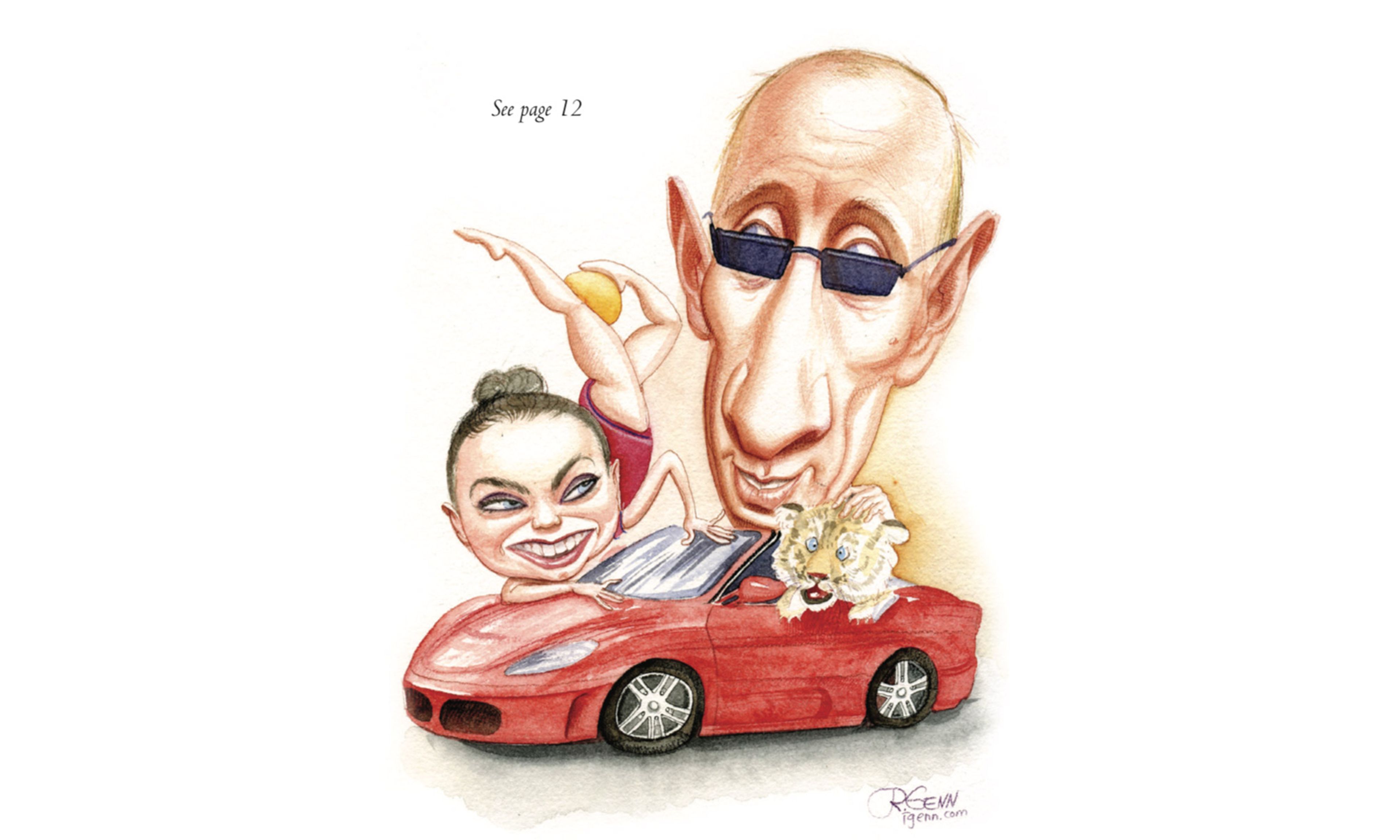
• Vladimir Putin’s mid-life crisis grows ever more bizarre. First he reportedly left his wife for a 24-year-old rhythmic gymnast; then he found a new job, sort of; then he invaded Georgia; then he shot a runaway tiger (and was later given a tiger cub, which he keeps in his home and strokes affectionately while chatting with equally tame journalists). The Russian media show endless pictures of Putin flying a fighter jet or riding and fishing bare-chested in Siberia. And now the Russian prime minister has released a video called Let’s Learn Judo with Vladimir Putin. In it, Putin, the former amateur champion of Leningrad (and understandably so; you wouldn’t want to be the guy who knocked him out in the finals), shows that he can dispose of judo opponents just as efficiently as political opponents. We encourage Mr. Putin to continue his soul-searching struggle to find himself. In fact, if he ever gets tired of his strenuous exertions and decides to go off and spend a few years painting watercolors, we would not object in the slightest.
• O. J. Simpson was convicted of armed robbery and kidnapping, for breaking into a Las Vegas hotel room with five cronies and straight-arming two dealers of sports memorabilia. Simpson fared better in 1995 when he was acquitted for the murder of his ex-wife, Nicole Brown Simpson, and Ronald Goldman. That verdict polarized America on racial lines. But away from the pyrotechnics, justice of a sort caught up with him step by step. He vowed he would find the real killers; he searched mostly on golf courses. He lost a civil suit brought by the victims’ families, which forced him to live in straitened circumstances. In 2006, a clownish effort to publish a “hypothetical” confession, If I Did It, collapsed to general mockery. The brutish narcissist continued to think he could do whatever he liked. Now his desires and his options will be confined to a cell. God sees everything, as the Russian proverb has it, but waits. Or as Heraclitus wrote, character is fate.
• Jörg Haider was one of the most disturbing figures in Europe. An Austrian born in 1950, he was the child of convinced Nazis. After the war, these parents were treated as social pariahs, which Haider found unfair. A deep sense of resentment drove him into far-right politics. Soon he became a member of parliament, and then leader of the minority and extremist Freedom party, which won enough votes in a general election to enter for a time a coalition government with the People’s party. A scandalized European Union announced sanctions against Austria, without much effect because so many people secretly sympathized with Nazism and shared Haider’s sense of resentment at the way the past was criticized. Personable, a clever operator, Haider was a master of euphemism and innuendo. “Small Nazis” like his parents, he said, were punished, but “big Nazis” reaped rewards. Concentration camps had really been “penal camps.” Hitler’s employment policies were “orderly.” Haider himself lived on a large estate that had originally been sequestered when its Jewish owner fled. If anyone could have remodeled Nazism for the present age, it was he.
THE ECONOMY
Emergency Planning
The Paulson plan went from unpalatable to worse. The Treasury Department will now inject equity directly into major banks in exchange for preferred shares, making the institutions an offer they literally cannot refuse. Of the $700 billion in the bailout bill, $250 billion will be devoted to recapitalization of the banks, and Treasury secretary Hank Paulson has made it clear that he wants the banks to loan it back out quickly to businesses and other customers.
Originally, Paulson had proposed a slightly less intrusive scheme whereby Treasury would buy so-called toxic debt from financial institutions, then hold it until the crisis passed and resell it to private players. This procedure may still be an element of the plan, but it was too complicated (how to price the debt?) and would take too long (weeks to get the program up and running) to address a credit crisis that was spinning out of control by the hour. Prime Minister Gordon Brown proposed a direct equity injection in Britain, and with the rest of Europe following suit Paulson also got on board this approach as a simpler and faster option. The initial market reaction was positive, with credit markets showing slight signs of loosening.
Unfortunately, in a financial panic, there must be a lender of last resort, and in today’s world only government is big enough to perform that function, one way or another. The old, tried and true prescription in a panic, going back to Alexander Hamilton and Walter Bagehot, is pumping liquidity into the system until the fit of madness passes. Paulson, Federal Reserve chairman Ben Bernanke, and FDIC chairman Sheila Bair — joined by central banks and finance ministers around the world — have been attempting this cure in every manner possible, with more deposit guarantees, with direct lending to small businesses, with guarantees of new debt issued by banks. It all amounts to a stunningly wide-ranging government intervention, but one that — if it saves the financial system from collapse — will be worth it.
If successful, most of these measures will naturally recede. The equity injections are explicitly a temporary measure. Some analysts believe that at the end of the day the government will recoup its money and even make some. But conservatives should have no illusions. The Paulson plan will create an even more difficult political environment for opposing government — after $700 billion, everything else seems affordable.
Over the long term, conservatives have to highlight the role that government played in inflating the housing bubble. It promoted subprime lending, particularly through Fannie Mae and Freddie Mac (see the article by Peter J. Wallison and Edward Pinto on page 36), and pumped too much liquidity into the economy through a loose monetary policy. We have to oppose regulatory overreach in the months ahead, while supporting commonsense measures to lessen risk at financial institutions that truly are “too big to fail” (see Andrew Stuttaford and Jim Manzi on pages 30 and 39). Finally, we have to advance market-oriented measures to promote economic growth and protect the interests of the middle class.
It has been a depressing time for fiscal conservatives, but we can take heart. The public hasn’t lurched to the left. A recent Fox News poll asked people whether they think it’s a good time for higher taxes and a larger government, or for lower taxes and a smaller government. Only 13 percent opted for higher taxes and larger government, while 76 percent preferred lower taxes and smaller government. Democrats chortling over the financial mess seem delighted at the supposed advent of socialism in America, but may be surprised at the reaction when they try to impose their agenda.
The country wants a change. It is fed up with both parties, but especially Republicans after eight years of Bush. The financial crisis has heightened that mood. John McCain has not appeared to be the steady, unflappable, reformist leader the public wants. So it is not surprising that he is trailing in the polls.
The McCain campaign made some brilliant tactical moves in the summer, slowly chipping away at Barack Obama’s lead. But that success, and the early reaction to McCain’s selection of Sarah Palin as his running mate and to the Republican convention, papered over McCain’s deeper strategic problems: his failure to establish a reformist image and his lack of a compelling middle-class economic message.
Now McCain is being told by a lot of our friends that he should hit Obama hard for his radical connections: his ties, above all, to the terrorist Bill Ayers and to the hatemongering Rev. Jeremiah Wright. Those connections are legitimate issues and McCain’s discomfort at raising them is self-destructive. But they are not, by themselves, enough to turn around the campaign.
In the last weeks of the campaign, McCain should first of all concentrate on middle-class economic concerns. People were worried about the state of the economy before the financial crisis became dire, largely because of the state of their wallets. McCain should do more to publicize his proposal to double the tax exemption for children, which would amount to more than $1,000 for a typical family. He should present his entire economic agenda as a way to lower the cost of living. He should note that his health-care plan will lead to a large increase in wages as employers convert health benefits into cash for their workers. The result could be a $9,000 increase in take-home pay for a typical family. Obama’s health-care plan, by contrast, is a small-business job-killer.
Second, McCain needs to make the case that his agenda will do more to promote growth. Obama wants higher taxes, including on capital gains. It is hard to think of a worse time to implement that proposal. Obama has been hostile to trade, one of the strongest engines of the economy in recent years and itself a downward force on the cost of living. He has proposed an avalanche of new spending, adding up to almost $1 trillion during his first term. Even Obama has admitted that his tax hikes could hurt the economy; how else to make sense of his comment that he might not impose them if the economy is still faltering? McCain’s tax cuts, spending restraint, and stalwart support for free trade are much better suited to reviving the economy. But McCain has too often overemphasized the spending restraint without putting it into the context of an overall economic policy that helps the middle class. He cannot afford to keep making that mistake.
Third, he needs to make a credible pledge not to allow anything like this financial crisis to recur. Fannie Mae and Freddie Mac should lose their privileges. Capital requirements throughout the financial industry should be gradually increased. Clear lines of regulatory authority should be established, consolidating existing bodies where needed.
Fourth, McCain must tie Obama to the liberals in Congress. Congress is as unpopular as, if not more so than, President Bush. It had a huge hand in stoking the mortgage mess (see again: Fannie and Freddie). With Democrats sure to get larger majorities in the House and the Senate, they will be emboldened to push Obama’s already-liberal agenda leftward off a cliff. And Obama has shown no willingness over the years to stand up to his party.
This is the deeper political import of his relationship with Ayers and Wright. For all his talk about change, Obama has been far better at adapting to the environments in which he finds himself. If he wins the presidency, there will be very little check on Nancy Pelosi and Harry Reid.
McCain needs to ask whether it would serve the national interest to create the most left-wing Washington in decades. He needs to ask this with respect to many issues, but the economy is certainly one of the top ones. As the economy sinks, do we want more taxes, spending, and trade restrictions?
The most important reason to hope McCain is elected is that he would keep the country from going on an ideological bender that it does not truly want. That is the case for McCain. He may as well make it.
CAMPAIGN 2008 II
Health Scare
In a 2005 survey of health economists, 91 percent agreed that company health benefits come out of wages. No other issue generated as much consensus. The idea is that an employer hires, and sets his compensation policies, based on what employees are worth to him and the total cost of employing them. How much of that cost goes to wages and how much to benefits is a matter of relative indifference. Government-mandated benefits should therefore be expected to come out of cash wages, not profits. The point sheds light on a neglected flaw in Obama’s health-care plan and a neglected virtue in McCain’s.
The Obama campaign has been doing saturation advertising against McCain on health care. It notes that McCain will tax company health benefits for the first time, and argues that this tax will cause employer-based health insurance to “unravel.” When the Democrats note that McCain would replace the tax break for employer-provided insurance with a tax credit that applies to all health-insurance purchases — something they acknowledge only under duress — they say that it would be a bad deal for workers. The credit would be worth $5,000 for families, but the employer-provided coverage they would lose would typically cost more. What Obama and his aides ignore is that health benefits come out of wages. The long-term effect of McCain’s tax reform should be to increase take-home pay. Increased wages and the tax credit should be enough to cover a health policy and the disappearance of the old tax break while leaving money to spare. Every independent assessment of the plan indicates that at least 95 percent of taxpayers would come out ahead.
Obama would mandate that businesses either offer health coverage to their workers or pay the government to cover them. But benefits come out of wages. If the government imposes a per-worker tax, wages will have to drop (as will hiring). Incidentally, this feature of Obama’s plan is one of the principal reasons he is wrong to say that he would “cut taxes for 95 percent of people”: His health-care plan involves a large tax on employment.
McCain’s plan would do nothing directly to alter companies’ incentives to offer health coverage. If Obama’s plan sets its tax below the cost of coverage, however, companies will have a strong incentive to drop their coverage and pay into the public system. Thus his promise that people will be able to keep their existing coverage if they want it is also dubious.
McCain has done very little to publicize his health-care reform or to defend it against these charges. Nor has he pointed out that Obama’s plan would raise taxes on employment or induce employers to drop coverage. These failures on the part of McCain may contribute to his election defeat. But this debate, while frustrating, has not been pointless. Obama may have distorted the truth to slam McCain’s health plan but he has also sounded conservative themes in the process. His argument, after all, is that it is wrong for the government to raise health-care taxes or to threaten existing health-care arrangements. Should Obama be elected, these arguments may come back to doom his own plan.
THE LAW
The Courts vs. Marriage
In 2005, Connecticut enacted “civil unions,” designed to be marriage in everything but name for same-sex couples. We are not sure what good purpose is served by such laws. The reason governments recognize marriage in the first place is to promote the well-being of children in the setting most conducive to their flourishing. There may or may not be great value in other types of relationships: those between friends, or heterosexual lovers, or relatives who take care of each other. But why should the government grant recognition to one subset of those non-marital relationships — those between people of the same sex who are sexually involved? What goal does such recognition serve? Other, that is, than the legitimization of homosexual conduct?
But Connecticut, at least, decided the matter democratically. Those people who objected could try to persuade their fellow citizens to repeal the law.
Now Connecticut’s supreme court has decided that marriage in all but name is not good enough, and imposed same-sex marriage on the state. Like other courts, the Connecticut court treated the legislature’s attempt to meet gay activists halfway as a reason to throw out the compromise and hand the activists a victory. If the legislature was willing to recognize same-sex unions as though they were marriages, the court reasoned, why not call them marriages too? Opponents of same-sex “marriage” should be warned: Thanks to the courts, compromise is now folly.
The courts have so far imposed same-sex marriage on Massachusetts, Connecticut, and California. The next step will be to force other states to recognize same-sex unions solemnized in those jurisdictions. The Defense of Marriage Act protects states that wish to maintain their marriage laws as they are. Senator Obama wants to repeal that act, however, and the Democratic platform comes out for repeal — a position to the left of any previous Democratic presidential candidate. When Obama says that he opposes same-sex marriage, his words mean nothing.
A pity, then, that Senator McCain has not raised the issue. In the vice-presidential debate, Governor Palin even suggested that the tickets agree on same-sex marriage. We are on track to have same-sex marriage from sea to shining sea, without the people ever authorizing the idea. The public will be consulted as little as possible, and only after the fact.






Comments