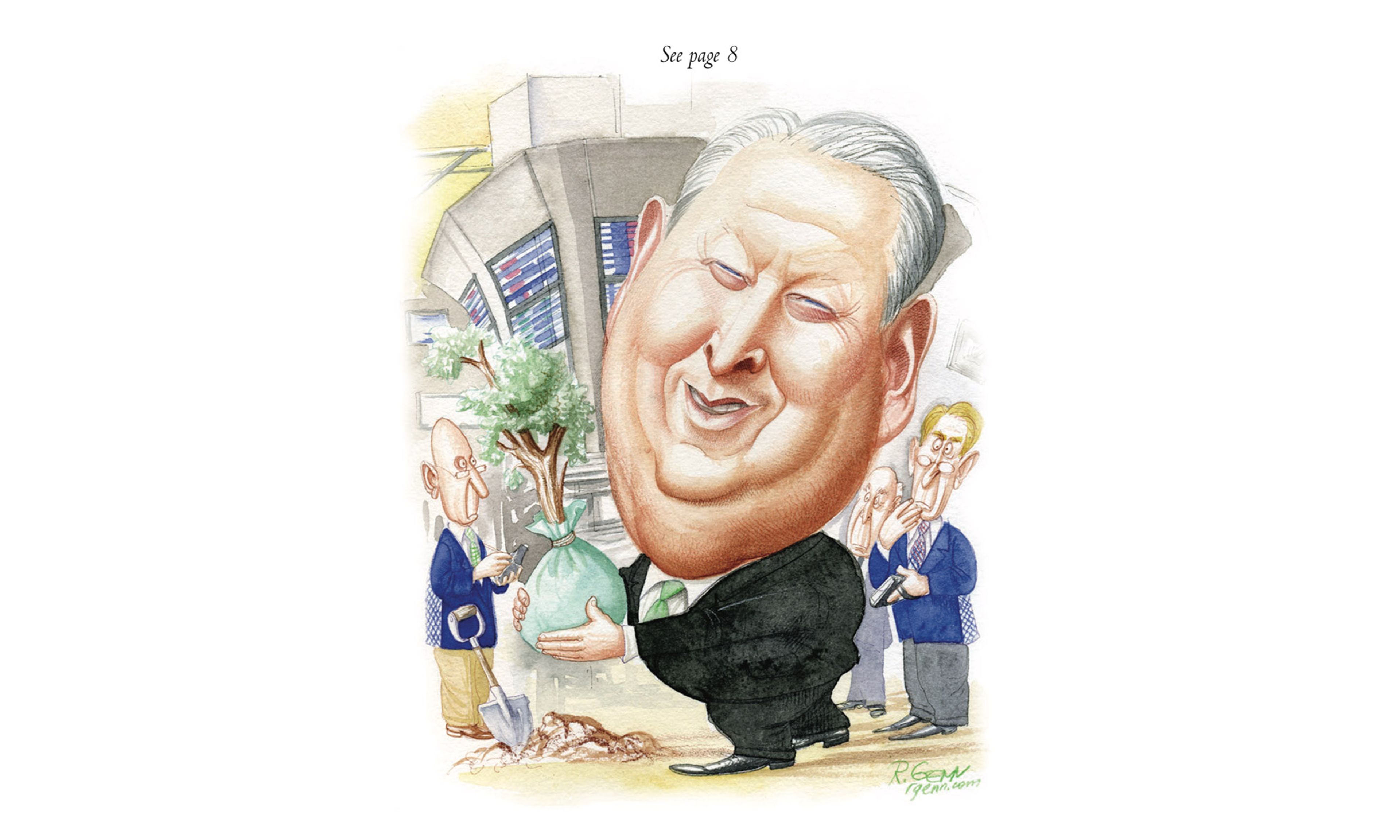
• Cheer up! Things could get much worse.
• The financial blizzard and the first debate have lit up the presidential candidates like flares. John McCain is a man of the Senate, proud of its friendships, and reveling in the free hand that senators are given. He uses his stature to express the same nature he showed as a Navy pilot: aggressive, risk-taking, self-directed. Barack Obama is professorial, and writerly; he intellectualizes problems, the better to distance himself from them. Because he is eloquent, Americans have been slow to appreciate his underlying stance, though they may be starting to. We have put both types in the White House before (Andrew Jackson and TR for McCain, John Quincy Adams and Woodrow Wilson for Obama), with mixed results. McCain is a hero, possibly a leader, hopefully an executive; Obama would be the ideal historian of the Obama administration. We hope Bismarck was right when he said that God looks out for drunkards, children, and the United States.
• McCain says our corporate-tax rates are among the highest in the industrialized world, and wants to cut them. Barack Obama says we have low corporate taxes based on how much revenue they bring in. They are both right: We have high rates that bring in little revenue. Maybe McCain is on to something?
• Obama adds that we have “tax breaks” for companies that send jobs overseas. What he means is that we let such companies pay foreign taxes and pay our taxes only when they bring their profits home. Making them pay both sets of taxes simultaneously is a formula for making them uncompetitive abroad. Obama talks a lot about restoring our leadership in the world. Apparently he does not have economic leadership in mind.
• If you listened only to Obama, you would think that McCain’s health-care plan consisted entirely of taxing health benefits. It’s nice to hear that there are tax increases of which Obama disapproves. Over time, the McCain plan would amount to a net tax increase, since it would replace the unlimited tax break for employer-provided insurance with a limited break for both employer-provided and individually purchased insurance. But McCain plans to cut other taxes, and the net effect would be to give people more control over a higher percentage of their wages. Obama is adept at exploiting the rhetoric of markets, but their substance still eludes him.
• Obama ran an ad saying McCain favored “cutting Social Security benefits in half” and “risking Social Security on the stock market.” Actually, it was the last Democratic administration that proposed having the government invest Social Security funds in stocks. McCain wanted to let young workers invest some of their Social Security payments for themselves, if they so chose, and to reduce the rate of growth of benefits for high-income workers. Every time there is a bear market, liberals say that the idea of reforming Social Security is forever discredited. But over the long run, stocks are a good investment; ditto free markets.
Sale of the Century
As policymakers huddle in Washington and scheme up plans to end this financial crisis, markets around the world have continued to panic. Such a response may well reflect a prudential understanding of Congress’s innate inability to respond rationally to nearly any economic circumstance, let alone a crisis.
But part of the problem may well be a kind of myopia. All crises end, and this one will too. It will end not because of a government intervention, but rather because asset prices have adjusted to the point that taking risk makes sense again. Governments do not have enough resources to purchase all of the world’s risky assets. Investors do.
In other words, bargain hunting is the only thing that can save us.
So when can we expect bargain hunting to begin? By definition, it should occur when asset prices have moved to the point that the scenario priced into asset values is so negative that it could not possibly occur. At that point, taking on risk is attractive, precisely because profit can be expected.
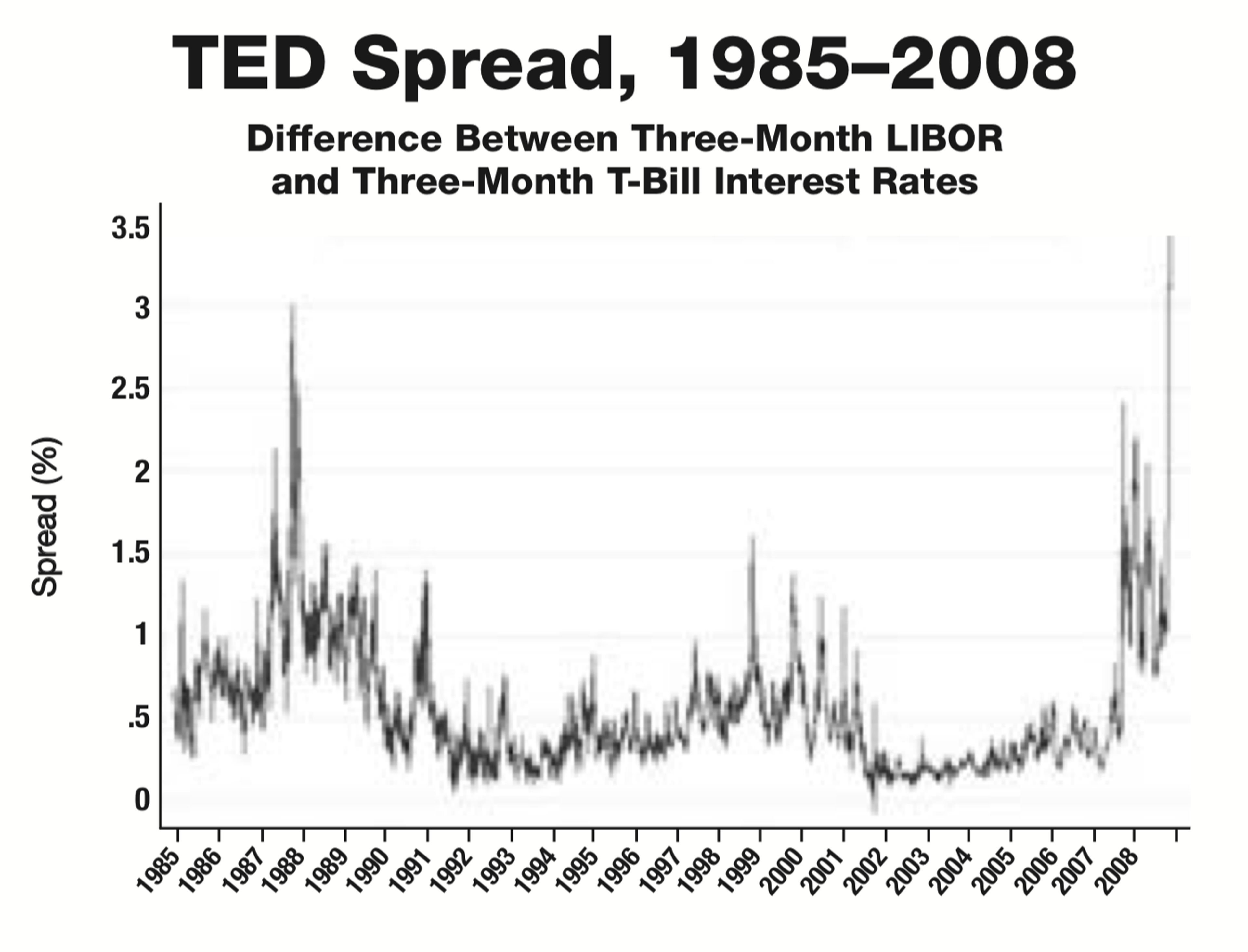
Have prices of risky assets fallen to that point? There are numerous signs that they have. The nearby chart provides one such example.
The chart plots the difference between the rate that the world’s most prominent banks pay one another in order to borrow money for three months and the three-month U.S. Treasury rate. The first rate is called the LIBOR, or the London InterBank Offered Rate. Their difference is known in the industry as the “TED spread.”
If Deutsche Bank borrows money from J. P. Morgan for three months and pays it 4 percent interest, and the three-month U.S. Treasury rate is 3 percent, then the spread on the chart would be 1 percent. Over history, this spread has been about half a percentage point. In late September, it climbed to the highest it has ever been, 3.5 percent.
In other words, if you lent money to Deutsche Bank for three months at the end of September instead of purchasing a Treasury, you got 3.5 percent more interest.
Such a high interest rate makes sense only if there is a high probability that Deutsche Bank will default on its debt over the next three months. But such a default is almost impossible. Surely, if such a big institution were to approach failure, governments would step in.
The TED spread is just the tip of the iceberg. As of late September, AAA-rated ten-year bonds were priced as if the probability of default for the bluest of blue-chip firms were 39 percent. If 39 percent of AAA firms default on their debt, then we will not have an economy left. It cannot happen.
The financial panic has advanced to the point where interest rates for even minuscule risks are absurdly high.
At some point, hopefully soon, investors will notice that, and financial markets will begin to reverse themselves.
— Kevin A. Hassett
• Obama and his allies have shown an unhealthy zeal for suppressing critical speech. His campaign has instructed its acolytes to drown out radio interviews with critics such as Stanley Kurtz and David Freddoso (both of whom are NR regulars). It has sent menacing cease-and-desist letters to television stations airing NRA ads against him. The New York Times has editorialized against letting ads on Obama’s extremist pro-abortion record be aired. The ads say that Obama favors taxpayer-funded abortion, which the Times calls a lie and a smear. It happens to be true: Obama has sponsored legislation to this effect. (All the news that’s fit to print, if it favors the Democrats.) The Democrats are confident this year, but they won’t leave anything to chance, or freedom.
• The assault on Sarah Palin, psychotic in intensity and irrelevance, continues. Comedienne Sandra Bernhard warned Palin that she would be “gang-raped by my big black brothers” if she campaigned in Manhattan. Just a potty-mouthed funny woman? Then what about Rep. Alcee Hastings, who told an audience of Jewish Democrats in Florida that “anybody toting guns and stripping moose don’t care too much about what they do with Jews and blacks”? Or Rep. Charles Rangel, who prefaced a discussion of Palin by saying, “You got to be kind to the disabled.” Meanwhile, hackers who broke into her private e-mail account and posted (innocuous) messages online defended themselves by saying she was conducting government business there. Huh? Aren’t the usual grounds for outrage that a politician uses a government account for private business? Some Democrats, when pressed, back off: Rangel said he should have called Palin “disadvantaged,” while Rep. Artur Davis of Alabama, who was present during Hastings’s rant, warned his fellow Democrats that they “had better win enough of those gun toters if we are to be successful.” Warning wasted, congressman. They are unhinged, they are flying, they can’t help themselves.
• Conservatives must acknowledge that Palin has real shortcomings, besides the fantasies projected onto her by her enemies. By all accounts she has been a competent mayor and governor, moving smoothly from the lesser position to the larger. But her knowledge of a range of national and foreign affairs is startlingly skimpy; her inability to turn questions on such matters to her strengths highlights her weakness. In an earlier time, no one cared much what vice presidents thought; it is also true that some opinionated veeps had very bad opinions (Henry Wallace, Andrew Johnson, Aaron Burr). But Sarah Palin is running now, during a war (which was predictable) and a financial crisis (which was not). She must cram. We expect she would grow on the job, but she has little time to grow before Election Day.
• Something interesting and unusual happened at the end of September. Joe Biden made a grossly inaccurate political statement. That is neither interesting nor unusual. But the news media — even the mainstreamers — jumped on him for it. And that is. Biden had said that McCain’s health proposals would be “the largest tax increase in the history of America for the middle class.” Not true, as the papers reported. Biden also committed a boner when he suggested that FDR had gone on television to reassure Americans after the Great Crash. He will never taste the derision or opprobrium that is Palin’s daily fare. But at least he has not gone unnoticed.
• When you have a hammer in your hand, goes the saying, everything looks like a nail. On roughly the same principle, when you’ve been awarded an Oscar and a Nobel Peace Prize for climate-change alarmism, everything looks like a climate crisis. It was therefore not surprising to hear Al Gore, speaking at a “green technology” conference in San Jose, tell us that the financial crisis and global warming are one and the same. “I think we need to bail-in renewable energy,” he said. Later, speaking in New York, he elaborated: “The world has several trillion dollars in sub-prime carbon assets,” frothed the former vice president. Yes, yes, it’s all of a piece, Al. Securitize the polar ice caps! Deposit insurance for the rain forest! Foreclosure relief for wind farms! (When do the men in white coats get here?)
• Gore has also called for environmentalists to engage in “civil disobedience” to stop the construction of new coal-fired power plants unless those plants are outfitted with certain green technologies. Gore is a partner in the $5 billion private-equity fund Generation Investment Management Ltd., which happens to invest in green technologies. “Civil disobedience” is an action directed against one’s government; the word for comparable assaults upon one’s business rivals is “extortion.”
• Charlie Rangel never disappoints us. Last issue, we noted that the congressman had been accused of not paying taxes on a condo he owned in the Dominican Republic, and before that, his ability to acquire four rent-stabilized luxury New York apartments raised eyebrows. Now, even some members of his own party have asked him to step down from his chairmanship of the House Ways and Means Committee — for the condo taxes and apartments, and also for allegedly using official government stationery to ask for donations to a City University of New York building (which, coincidentally, was to be named after Rangel). Oh, and he converted one of those rent-stabilized apartments into his campaign office, and three months ago promised to move out. As of this writing, he has not. The House Ethics Committee has launched an investigation, and we cannot wait for the results.
• With the public backing offshore drilling by a margin of two to one, Democrats in Congress could not muster the votes to keep America’s coastal waters off-limits (for the details, see “Gangster Politics” on page 26). On October 1, the congressional ban on offshore oil and gas leasing expired, technically freeing up nearly 18 billion barrels of oil and 76 trillion cubic feet of natural gas. We say “technically” because the victory is by no means secure. Lawsuits and red tape will delay the permitting process long enough for Democrats to have another shot at reinstating the ban after the elections. Democrats are telling their supporters in the environmental movement: If you want to keep America’s offshore energy resources locked up, then sue, sue, sue, and vote for Barack Obama.
• The Clarion Fund, a non-profit organization, purchased ad space in dozens of major newspapers and periodicals (including National Review) to distribute some 28 million DVD copies of Obsession: Radical Islam’s War Against the West. Using fiery footage from Arab television, insider accounts from a former terrorist, and expert interviews, the film contends that the militant strain of Islam is every bit as threatening as Nazism. Regardless of whether one agrees, Obsession is not a campaign production: It has no connection to either candidate or the presidential election. The distribution, moreover, seemed clearly timed to coincide with the seventh anniversary of 9/11. Yet, because the distribution was allegedly concentrated in several “swing” states, the Council on American-Islamic Relations — which is the creation of a Hamas spin-off, and masquerades as a civil-liberties organization while advocating for terrorists and against sensible national-security measures — filed an FEC complaint. Essentially, it argues that the distribution was a transparent Zionist plot to promote the McCain campaign. However unintentionally, CAIR’s speech-suppression ploy is useful: At least we know which candidate the jihadists and their apologists think will take the war seriously.
• Obama and Biden have suggested that, if elected, they may attempt to prosecute members of the Bush administration for alleged criminal offenses. Their campaign literature has even raised the possibility of “war crimes” tribunals. The Democrats walk a fine line: Their hard-Left base bays for blood, but Americans have a native suspicion of political prosecutions. Feelings vary widely and passionately about the decision to topple Saddam Hussein, about eavesdropping on our enemies, about interrogation tactics, and the like. Many citizens are disquieted by some or all of these measures; many others — more, we suspect — see increased vigilance as the price of preventing attacks on our nation. But across the political divide, there is a sensible understanding among Americans that these disputes are political differences, not legal ones. They are the stuff of elections, not indictments. It is tyrannies and banana republics, not mature democracies, that criminalize policy disputes.
• The federal government, like the House of the Lords, has many mansions — so many that you might go a whole lifetime without hearing of the more obscure ones. Take, for example, the U.S. Railroad Retirement Board. This agency was established in the 1930s to provide retirement, survivor, unemployment, and disability benefits to railroad employees. (Who do not pay ordinary Social Security taxes. Did you know that?) It turns out that someone in the RRB has been asleep at the switch, as it were. An investigation by the New York Times showed that a local office of the agency has been handing out disability benefits to any employee of the Long Island Railroad who walked in, all the livelong day. In a recent year, 97 percent of employees who retired after the age of 50 applied for and received disability payments. Now FBI agents have raided the Long Island office of the RRB, so perhaps there will be an end to the scam. We are left wondering how many other alphabet-soup federal agencies are making free with the public fisc . . . and why we didn’t listen to that wise uncle’s advice to “Get a government job!”
• Khalid Sheikh Mohammed, the 9/11 terror-plotter and mass-murderer, is being tried at Guantanamo Bay. But he is putting the judge on trial too. In court, he said, “There are some extremist organizations in America that are against us. If you, for example, were part of Jerry Falwell or Pat Robertson’s groups, then you would not at all be impartial toward us.” (Has he been listening to NPR?) The AP reported that the judge, Ralph Kohlmann, “responded that he doesn’t belong to a church now but has attended Lutheran and Episcopalian services.” Sounds safe enough — very reassuring. Then one of Mohammed’s co-defendants, Ramzi Binalshibh, said, “As far as I know, your last name is Kohlmann, which is a Jewish name, not a Christian name.” The judge denied this — no yellow stars for him. Thanks for clearing that up, judge. Keep in mind that the Left wants a civilian trial for these characters.
• Iraq’s parliament unanimously passed a law to hold local and provincial elections. It’s an important step forward for political normalization in Iraq. It will allow Sunnis who sat out prior elections but subsequently rejected the insurgency to get political representation. In the Shiite areas, the religious parties have dominated, aided by a “closed list” electoral system that permitted people only to vote for party slates. The new law providing for an “open list” should make it easier for healthy grass-roots ferment outside the religious parties to achieve formal political expression. When the Iraqi parliament failed to pass the election law a few months ago, the press highlighted it as another Iraqi political failure. The passage of the law now has gone mostly unremarked.
• President Bush spoke at the U.N., probably for the last time. During his address, “he urged world leaders to take ‘an unequivocal moral stand’ against suicide bombings, hostage taking and other terror tactics.” (We quote a wire-service report.) When he was through, the audience gave him less than ten seconds of weak applause. During the speech itself, Iran’s Ahmadinejad had given a thumbs-down — a literal thumbs-down. We suspect that in his heart the president was doing the same to the institution.
• During his 33 months as prime minister of Israel, before resigning late last month, Ehud Olmert was not a success. In 2006 he was called on to respond to aggression from Hezbollah, the Islamist movement implanted in Lebanon by Iran. Everything he then did was misguided, and Hezbollah was able to claim victory. Afterwards Olmert appeared to concentrate solely on wishing the responsibility for his failure onto other ministers and senior officers. The opening of peace negotiations at the same time with the Palestinians and Syria seemed forlorn efforts to make himself indispensable, and visibly lacked conviction. Even the successful raid on Syria that apparently destroyed a nuclear facility ended up adding confusion to Olmert’s intentions. Then there were the multiple corruption charges. In particular, he is accused of receiving envelopes of cash from an American well-wisher and double-charging on expense accounts. A huge majority of Israelis are shocked by what is alleged so far about Olmert’s profiteering from office; no previous Israeli politician has had such unfavorable polls. Whether or not he is finally prosecuted, Olmert has made things difficult for his likely successor, Tzipi Livni, for his Kadima party, and for the peace process. Israel does not need that sort of turmoil at a critical time like the present.
• The Kremlin is once again in the mood to lash out. President Medvedev has allocated $50 billion for next year’s armaments program, which includes the construction of new types of warships, nuclear submarines, and a space defense system. The smashing of Georgia has thoroughly frightened everyone around Russia’s borders, so Medvedev and his prime minister, Vladimir Putin, are having to look farther afield as they use their weaponry to create a new power bloc against the United States. Russia has put one protective arm around Iran in order to scupper international sanctions aiming to halt its nuclear program, and it is stretching its other arm out to the quasi-Communist or populist dictatorships of Bolivia and Venezuela, not forgetting the faithful Castros in Cuba. Russia has made a $1 billion military loan to Venezuela, announced an oil consortium, and dispatched two long-range bombers there. This November Venezuela will also stage joint military maneuvers with warships and 1,000 troops from Russia. Venezuelan president Hugo Chávez says he is merely supporting the work of a “strategic ally,” but in case anyone misses the point, he and the like-minded Bolivian president, Evo Morales, earlier accused the United States of interfering in their internal politics and even conspiring to overthrow them, and have expelled the U.S. ambassadors. Evidently the old Soviet dream of power is alive and well in Moscow.
• The U.S.-India nuclear-power pact has cleared the House of Representatives and been forwarded to the Senate, where it is expected to win approval. The deal is a milestone in relations between the world’s largest democracies and the product of deft statesmanship on the part of the Bush administration. (“Cowboy diplomacy” apparently works for Indians.) India is a natural confederate in the War on Terror and an important trading partner; recognizing its new status as a nuclear power costs America little and bonds us to an ally strategically located between Jihadistan and China. The pact also underlines how far behind the rest of the world the U.S. lags on civilian nuclear power: India will purchase its new state-of-the-art nuclear reactors from France. While the senators are considering topics nuclear, they might see if they can’t clear away a few barriers to our own nuclear industry, too.
• This wasn’t how it was supposed to go at all. Kim Jong Il, you may recall, promised to dismantle his nuclear program in exchange for a raft of foreign aid and eventual diplomatic normalization with the United States. He had made and broken similar promises before, but things were to be different this time, for some reason that no one bothered to explain very clearly. Well, guess what? Having spent the summer balking at U.S. proposals for a verification mechanism, the regime now says it will resume plutonium enrichment at its Yongbyon facility, and has barred International Atomic Energy Agency inspectors from the site. (Matters are complicated by the absence of Dear Leader from the scene: He has apparently had a stroke, and it’s anyone’s guess who is tyrannizing the country in his stead.) There are lessons here: Don’t ease up on the pressure — the U.S. had succeeded in getting the U.N. Security Council to pass tough sanctions, which the deal nullified — in exchange for a mere promise; and don’t mistake diplomatic chatter for actual progress.
• Having survived the Black Death, the Great Fire, and Hitler’s Blitz, the citizens of London have decided to subject themselves to a further test, the 2012 Olympic Summer Games. Construction of an Olympic park is under way. The first priority is . . . what? Why, to cater to Muslim sensibilities, of course. What on earth could be more important than that? London’s Olympic organizers have accordingly issued detailed design rules for the 2012 facilities, including a mandate that at least some toilets in the Olympic park not point toward Mecca. Apparently Muslims are enjoined to face away from the holy city when relieving themselves. A harmless enough accommodation in itself; like the previous one, and the one before that, and the one before that . . .
• Informal courts interpreting Muslim sharia law have long existed in Britain. Now their judgments can be enforced through the regular British judicial system if both parties agree to it in advance. Proponents call this just another form of alternative dispute resolution, but it’s hard to believe that such arrangements will be free of coercion — particularly in situations such as marital disputes or domestic violence — or that the judgments will fit Western ideas of decency. The jurisdiction of sharia courts will inevitably continue to expand, and ensuring fairness and banishing corruption in them will be virtually impossible. Defenders of the plan point to Jewish courts, which operate under similar authority, yet these deal mainly with religious matters like kosher laws and ritual baths; they also decide civil cases among businessmen in fields dominated by Orthodox Jews, such as the diamond trade. A government-sanctioned religious system to rule everyday life for an insular people with little tradition of using regular courts is an entirely different matter. Any nation that prizes justice and its own continued existence will say to immigrants: Follow your own customs, but our laws.
• Morton Sobell, at 91 the last living member of a spy ring that passed atomic and other military secrets to the Soviets, has finally admitted what a court found, and what unbiased historians had long accepted: that Julius Rosenberg was a spy. Sobell was sentenced to 30 years; Rosenberg and his wife Ethel were executed in 1953. The Rosenbergs were long a two-sided totem for the American Left: They were believed to be innocent, but if they had been guilty, it was no bad thing. Sobell himself still clings to aspects of this stance, saying “I helped an ally (admittedly illegally) during World War II,” and “I chose not to cooperate with the government in 1950.” He worshipped Stalin, who was trying to conquer the world, and whom he and Julius Rosenberg helped by betraying their country’s secrets. Loose ends of the case remain, chiefly Ethel’s degree of complicity: Did prosecutors wrongly file the maximum charge against her in order to break Julius? The case has outlasted the empire that Sobell and Rosenberg served.
• Carnegie Hall opened its season, and the program was all-Bernstein. The late conductor, composer, and pianist would have been 90 this year. On the stage was the San Francisco Symphony, led by Michael Tilson Thomas. In the middle of the program, he gave a speech, as musicians are wont to do now. And in the course of this speech, he said — no, shouted — that Bernstein was “a proud LIB-ER-AL!” That’s how he pronounced it: with three distinct, fist-shaking syllables. The crowd roared with delight and approval. It was a classic self-congratulatory New York moment. It could have taken place in North Korea, only the New Yorkers were more sincere, and better fed. Tilson Thomas went on to explain that Bernstein wanted to make music “to inspire a better world” — and we all know that only liberals hope for a better world. We will leave Bernstein’s music to one side for the moment. What about his politics? He raised money for the Black Panthers when they were at their cop-killing height. The liberals of yesteryear would have considered it a slander to call him one of them.
• Our college-age youngsters are such delicate blooms, they must be protected not only from insulting speech directed at them, but even from hearing scholarly explanations of what is, or has been, insulting speech. Such is the opinion of authorities at Brandeis University. Lecturing on Latin American politics last fall, sociology professor Donald Hindley told his students that Mexican immigrants to the United States used to be called “wetbacks.” This is true. In fact the Eisenhower administration repatriated more than a million illegal Mexican immigrants in 1954 under a project officially named Operation Wetback. A student complained. The college bureaucrats, citing “significant emotional trauma” to the complainant, commenced an operation of their own against Professor Hindley, who had taught for 48 years at the college with no previous recorded complaints. A year later the case is ongoing, with the invaluable Foundation for Individual Rights in Education pushing to have Hindley’s name cleared. Justice Brandeis, a great champion of free speech, would weep to hear this miserable story.
• In truth, neither the rebuilt Yankee Stadium (opened in 1976) nor Shea Stadium (1964) was a thing of beauty. The former seemed thrown together, full of narrow corridors and odd angles that weren’t antique enough to be charming, while the latter never quite lost its transistor-radio feel. Not that it matters. No ballpark had a better urban backdrop than Yankee Stadium, with the Bronx County Courthouse and the elevated 4 train visible beyond the outfield wall, while Shea’s endless vista of parking lots and Archie Bunker houses encapsulated post-war suburbanization. We’re all for creative destruction, but why are these two perfectly serviceable structures being demolished so taxpayers can help the Mets and Yankees extract even more money from their fans? Never mind; that’s a question for another time. Here we pay tribute to the departed. True New Yorkers are always nostalgic about the days before their neighborhoods improved; and in similar fashion, while the new stadiums will probably be better places to watch a game, Met and Yankee fans are certain to remain wistful for the clunky old piles where they learned to love America’s greatest sport.
• Comedian Sacha Baron Cohen, having made as much as can be made from his Borat character, is now working on a movie about Bruno, another of his alter egos. Bruno is a gay Austrian fashion designer, and the working title of the new movie is: Bruno: Delicious Journeys through America for the Purpose of Making Heterosexual Males Visibly Uncomfortable in the Presence of a Gay Foreigner in a Mesh T-Shirt. By way of forwarding the enterprise, Baron Cohen was recently spotted wearing Velcro and a blond wig, strutting the catwalk in a fashion show by real designer Agatha Ruiz de la Prada in Milan, Italy. Security guards quickly removed Baron Cohen, but presumably not before footage for the new movie had been gathered. All good clean fun; but, Sacha, how about a movie title that can actually fit on a marquee?
• There is a bumper sticker across America that says, “Who would Jesus bomb?” This does a couple of things, of course: It mocks Christians who ask, “What would Jesus do?” In this, it is like the bumper sticker that shows the traditional Christian fish symbol, but with little “Darwin feet.” At the same time, it mocks those who find the War on Terror necessary and right. Do not expect a bumper sticker that says, “Who would Mohammed bomb?” That might be more logical, because bombers across the world bomb in Mohammed’s name. But it would be disrespectful of Islam. And, of course, the owner of the car might not live out the week.
• Jeepers creepers, where’d you get those peepers? Paul Newman had them, all right, blazing blue, piercing as drill bits. But he brought some other qualities to his stardom, and his life: a commendable lack of vanity as an actor; a long and happy marriage to Joanne Woodward, his second wife; and years and millions of dollars worth of charitable giving, so much more focused and concrete than the usual star’s turn at an anti-fur or pro-Darfur rally. That more than makes up for his lousy political opinions. Dead, at 83. R.I.P.
The Bailout
Taking On Water
Treasury secretary Henry Paulson’s $700 billion rescue plan is palatable to no one. The price tag is huge. The bill was originally presented to Congress as all but a fait accompli. Paulson and Federal Reserve chairman Ben Bernanke have been underwhelming in selling the plan on Capitol Hill. It is hated by a public suspicious of the country’s elites, whether in Washington or on Wall Street. Various experts have raised questions about whether the plan would work.
No wonder the bill went down on the first attempt to get it through the House, a victim of a Right-Left coalition. Ordinarily we would join the opponents. The unseemly rush to pass the bill and the establishment’s sometimes bullying advocacy of it bear a resemblance to the fight over the amnesty bill last year. But the financial crisis is real. In a space of a few weeks, large investment banks as we have known them for decades disappeared from Wall Street. With a crisis of confidence affecting the entire system, banks are not loaning to one another and businesses are already having trouble getting credit, the lifeblood of the economy.
In such circumstances, the financial system needs a government backstop. Panics must be stopped because it is their very nature to damage the economy out of all proportion to reason. If this panic led to a prolonged slump, as it could, the likely result would be a lurch toward statism that would make the $700 billion bill seem a bargain.
As Paulson and Bernanke have repeatedly argued, the reason to stop a financial meltdown is not to save the irresponsible players who created this mess, but to save the rest of us from the consequences of their mess. So far, the “real” economy has weathered the financial turmoil amazingly well. But its health will not last if no one can get a loan. At the very least, we will likely face a sharp economic downturn on par with 1981–82 or 1974–75, and perhaps a disruption that will take years to work through. The cost of such an event would be far larger than that of the Paulson plan.
We think conservatives should do three things. The first is reluctantly to support the Paulson plan while trying to do everything to limit its scope and keep it temporary. That means continuing to resist left-wing add-ons, from giving bankruptcy judges the authority to rewrite mortgages to funneling funds to advocacy groups like ACORN. It means doling out the money necessary for the programs in tranches and ensuring adequate oversight.
Second, they should push additional policies that will minimize the crisis. These are proposals like reforming the mark-to-market accounting rules that have worsened the crisis (and have at least been loosened by the SEC), suspending dividend payments by financial institutions, and allowing the Fed to pay interest on its reserves. Each step can help ease the crunch and increase capital in the system.
Finally, Republicans have to try to dig out of the hole in which this crisis — stoked by misbegotten government policies (see our next editorial) — has put us. Once the emergency has passed, Fannie and Freddie should be broken up and privatized. The government should end its stake in AIG, an otherwise profitable insurance firm caught up in the madness. And initiatives to cope with the recession that may be coming should be advanced. Cutting the capital-gains and corporate-tax rates — measures that some conservatives advocated in lieu of the Paulson plan — might not help in the immediate liquidity crisis, but they will put gas in the engine of economic growth over the long term.
American capitalism is endlessly adaptive, and has overcome much worse than either this credit crisis or the violence to our principles that the Paulson plan represents. It will overcome once again, provided that the invisible hand is not smothered by the overbearing hand of the Leviathan.
The Bailout II
Anything-Goes Democrats
Shortly before the House rejected the $700 billion “bailout” of the U.S. financial system, Speaker Nancy Pelosi accused Republicans of causing the problem. She said, “They claim to be free-market advocates, when it’s really an ‘anything goes’ mentality: no regulation, no supervision, no discipline.” The timing of Pelosi’s remarks was curious: One would think the moments before a tense vote in which Republican support is essential would be an occasion to avoid partisan attacks. Not our Nancy.
Pelosi’s timing was off, but we agree in part with her assessment. An “anything goes” mentality toward two firms in particular contributed substantially to the financial meltdown. “No regulation, no supervision, no discipline” is definitely the right way to describe the attitude that allowed Fannie Mae and Freddie Mac to grow into unstable behemoths that helped inflate the housing bubble and left taxpayers holding a mountain of bad debt.
Of course, the “free-market advocates” pilloried by Pelosi long ago recognized the risks Fannie and Freddie posed to the financial system. Fannie and Freddie are government-sponsored enterprises (GSEs). As long as they’ve been around, investors have assumed that the U.S. government would never let them fail. Their implied taxpayer backing allowed them to borrow at low rates and maintain debt-to-equity ratios that would have caused concern at other firms.
Direct and indirect government subsidies allowed the GSEs to grow huge. Starting in 1970, they doubled the amount of mortgage debt on their books every five years — from $15 billion in 1970 to over $5 trillion when they finally collapsed. Free-market advocates warned that Fannie and Freddie’s heedless growth was, to quote Alan Greenspan, “placing the total financial system of the future at a substantial risk.” But the GSEs built an impressive lobbying machine to keep would-be regulators at bay.
Over the past ten years, Fannie and Freddie spent over $200 million on lobbying and campaign contributions. Democrats Chris Dodd, John Kerry, and Barack Obama — the top recipients of Fannie and Freddie largesse — have all broken the $100,000 mark. It should come as no surprise that Senate Democrats were the key obstacle to reforming Fannie and Freddie when Congress had a chance in 2005, before the mortgage crisis spiraled out of control.
Fannie and Freddie’s defenders in the House were no better. Massachusetts Democrat Barney Frank maintained that Fannie and Freddie did not pose a risk to the financial system, even as they helped inflate the housing bubble by subsidizing mortgage debt. Then, when the bubble finally burst, Frank tried to loosen Fannie and Freddie’s constraints so they could reinflate it. They might have succeeded if they hadn’t collapsed, requiring a bailout from taxpayers that could cost as much as $200 billion.
Fannie and Freddie were not the only irresponsible players whose behavior led to the mortgage meltdown. The Federal Reserve held interest rates too low for too long, making mortgage debt look like a better investment than it was. The Community Reinvestment Act, championed by Democrats, coerced banks into lowering their credit standards to meet diversity targets. And certainly Wall Street deluded itself into thinking that relentless securitization could make risk disappear. But Fannie and Freddie were definitely the biggest players, and the Democrats’ “anything goes” mentality allowed their worst excesses to go unregulated, unsupervised, and undisciplined.
Politics
That Sinking Feeling
John McCain spent the latter half of September sinking in the polls. Financial turmoil has added to the public’s already strong desire for change in the White House. And a string of unimpressive media interviews has reduced the appeal of McCain’s running mate, Alaska governor Sarah Palin.
All is not lost. The public still has respect for McCain, doubts about Obama, and an aversion to liberalism. But McCain will not win unless he persuades middle-income voters that he will advance their economic interests. He has not succeeded in doing that, largely because he has hardly tried. In his first debate with Obama, the economic topic he most emphasized was earmarks and overspending. But he never explained how ending earmarks or restraining spending would help voters.
Neither McCain nor Obama has been very specific about what he would do to end the financial panic. That symmetry works in Obama’s favor, since economic distress is his party’s meal ticket. McCain has a tougher task: He must demonstrate that he can lead us out of this crisis, and that he will make the economy work again for middle-class Americans. McCain can credibly run as the candidate who will not only cut the cost of government, but cut voters’ costs too, by lowering their energy, health, and tax bills. But time is running short.






Comments