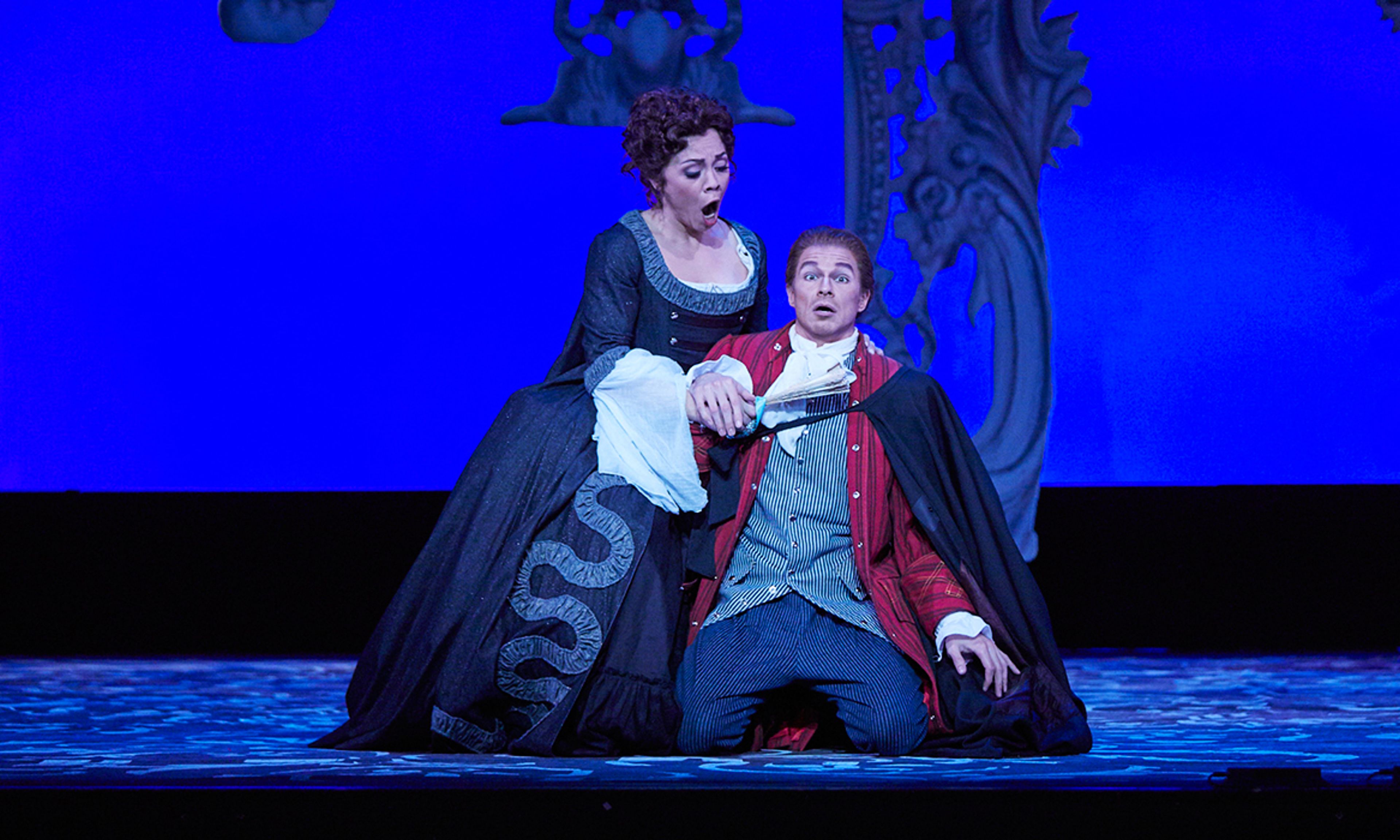
In November, I reviewed in these pages the Kentucky Opera’s production of Glory Denied, a modern, still relatively unknown opera about America’s longest-held prisoner of war; by way of doing so, I also reflected a bit on my first cultural outing since moving (for non-opera-related reasons) from New York City to Louisville. Over Presidents’ Day weekend, I was back, for something at the other end of the operatic spectrum: a traditional performance of The Marriage of Figaro. Clever servants and dimwitted aristocrats flitted about in breeches and petticoats, just as God and Da Ponte had originally intended — albeit with one sly wink to modernity, in the form of a pair of powder-blue Converse All-Stars on the feet of the page Cherubino. The set, while minimalist, was suggestive of a rococo palace. Susanna (Tess Altiveros) and Countess Almaviva (Amber Monroe) stole the show musically in the second act, while Figaro, sung by André Courville, was the straw that stirred the drink. Meanwhile, though the leads have the best parts in the music, the action was carried by Brian Vu, an energetic Count Almaviva who seemed determined to bury his guilty conscience through zealous assertions of his authority (rightful or otherwise) as count over servant and wife alike, and by Zachary Owen, magnificently buffoonish as the comic villain Dr. Bartolo.
Just as noteworthy, from my point of view, was the audience. Some, like myself, were transplants from the coasts, or native Kentuckians returning from a long sojourn in cities where seeing five or six or even a dozen performances in a year is not particularly difficult. Then there was the portly, bearded gentlemen behind us, with the grey shirt tucked into buckled jeans and the thick Kentucky accent. Like far more people than stereotype credits, he seemed to have an in-depth, largely self-taught knowledge of opera, particularly Mozart and Wagner. At the same time, clearly what had held him back was geography — he’d seen far fewer operas live than he’d listened to or read about, and one wondered, as he waxed about what it would be like to see the Salzburg Festival or the Vienna Philharmonic, how things might be different had he lived in Austria (which contains both in a state about four-fifths the size of Kentucky). One wonders also about the sort of coastal elite who assumes unthinkingly that such people spring from the soil of Bavaria but not of the Bluegrass State.





Comments