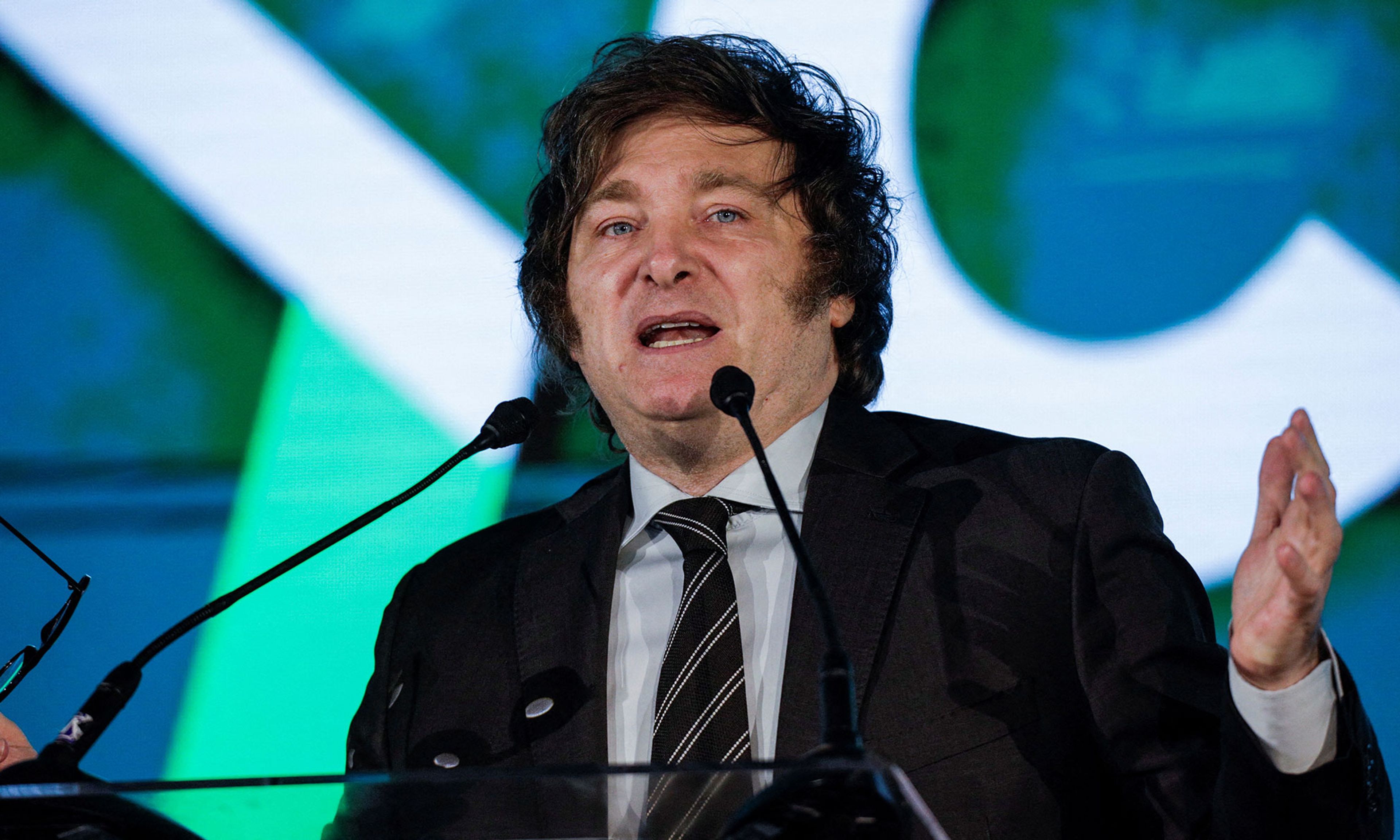
On Sunday, firebrand economist Javier Milei won nearly a third of Argentina’s presidential-primary voters, placing him in the lead ahead of the elections set to take place in October. English-speaking media outlets have been taken aback by this development in what was once a reliably center-left Latin American democracy. The AP has dubbed Milei a Trump-admiring “right-wing populist” akin to Brazil’s Jair Bolsonaro and El Salvador’s Nayib Bukele, Bloomberg News has similarly accused this “Trump-like candidate” of disturbing markets, and the BBC concluded its coverage with the jarring memory of Bolsonaro supporters storming the congress in Brasilia. This is the latest attempt to brand a broad range of right-wing populists, often donning eccentric hairstyles, as the “next Trumps” of their respective countries. It proves especially reductionist in the case of Milei, whose rise can only be understood as a consequence of Argentina’s unique predicament.
As I have written elsewhere, Argentina suffers from extreme and chronic economic mismanagement, its private sector shackled by extensive price controls, prohibitively high taxes, onerous regulations, and irresponsible macroeconomic policies. Two decades of political hegemony by the left-wing Justicialist Party, only briefly interrupted by the center-right Macri administration between 2015 and 2019, are now culminating in catastrophe. This March, inflation rose above 100 percent for the first time in decades, showing no signs of slowing down. Accordingly, the currency has depreciated spectacularly. On December 10, 2019, when current president Alberto Fernández was inaugurated, one U.S. dollar was officially worth 60 Argentine pesos. That figure rose to a staggering 287 last weekend, less than four years later. While Milei’s primary victory prompted the central bank to further devalue the currency, down to 350 pesos per dollar, Argentina’s official exchange rate continues to understate the problem, since dollars had been unofficially trading for more than 400 pesos as early as April. Moreover, Argentina saw no real GDP per capita growth between 2008 and 2022, and its debt-to-GDP ratio has nearly doubled since 2011.


Comments