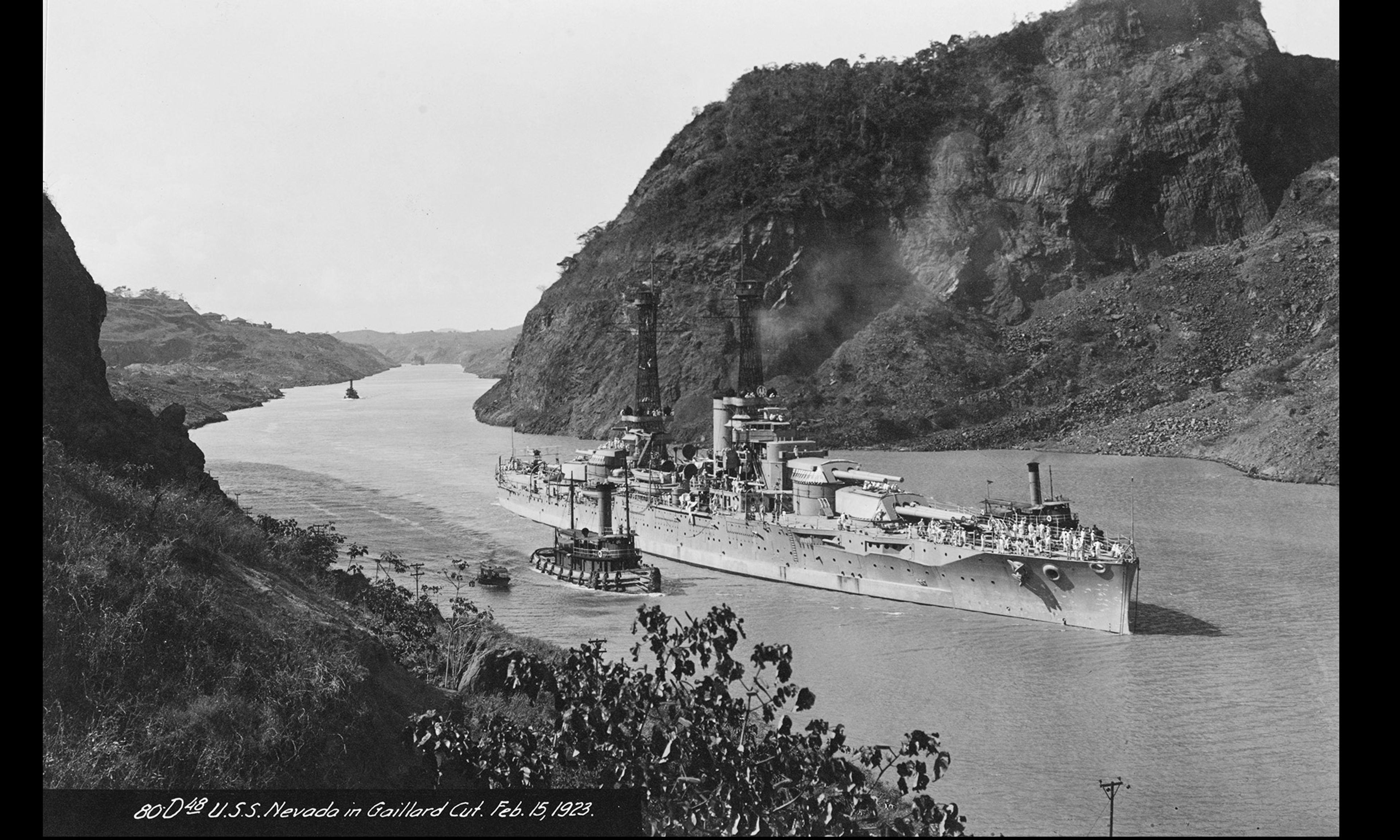
In 1977 Warren Steibel, the producer of my television show, Firing Line, came up with the idea of supplementing its weekly schedule with special two-hour programs four or five times per year. The first of these, in January 1978, was a formal debate on an issue that had divided the American Right.
The question of the Panama Canal’s future had recently become acute when President Jimmy Carter signed a treaty that would cede control of the Canal Zone to Panama. This would mean a diminution of American control over the canal itself, and a hint of any such thing — especially so soon after the Vietnam debacle — greatly alarmed conservative America.
I traveled to Panama in October 1976, and the visit caused me to change my opinion. Departing from conservative ranks, I urged the Senate to ratify the proposed treaty, mainly on the grounds, as I wrote in my column, that Panamanians of all political colorations saw “the reintegration of the Canal Zone as something of a magical restoration of the nation’s dignity: the elimination of an ugly birthmark that now condemns Panama to wander around the world conspicuously sullied.”
Earlier that year, Ronald Reagan, energetically campaigning for president, had begun rallying conservative forces to stand behind the existing arrangements. Reagan had lost narrowly in the New Hampshire and Florida primaries, but in North Carolina, he made his opposition to the treaty (which President Ford had already started negotiating) a major part of his campaign — and he won. It proved too late to wrest the nomination from Ford, but Reagan did not forget the impact, especially among conservatives, of his stand on the Panama Canal.
We went back and forth on the subject over the next year, in public and in private. Then I asked him, in the course of a telephone conversation, whether he would consent to debate the subject in a two-hour Firing Line. His first reaction was to say, “Why would I want to get into a debate with you?” — but eventually he reconsidered. We exchanged correspondence about the issue in the weeks that preceded our debate.
September 12, 1977
Dear Ron:
I know that we are almost certain to continue disagreeing in the matter of the Canal, but I am most anxious both to read everything you say on the matter, and to have you read everything I write on the matter, and accordingly I am asking Miss Bronson to send you all the columns I have written on the subject since the announcement of a month or so ago. It would be good to talk to you about it, and I’ll look for an opportunity. Sorry you couldn’t join me in New York.
With warm regards,
Bill
September 27, 1977
Dear Bill:
I was happy to get your letter and have read all your fine columns; however, I must confess that we are still disagreeing on the matter of the Canal. I am enclosing some things that I have done, including my testimony before the Senate Committee.
I appreciate your kind words about me in several of the columns and am happy we carry on our disagreement in this manner. I assure you, it could not in any way affect the friendship I feel for you.
I look forward to a day when we can sit down and discuss this, so won’t try to argue any of my points in this letter. One thing I do hope you understand is that I have not simply been demanding the status quo. I believe there are alternatives, other things we could do, as you will note in some of the material that I am sending to you. I am concerned about the seeming weakness in which we did not negotiate, we simply made concessions. The United States, dealing from strength, could say to the Panamanians that we are interested in internationalizing the Canal, and possibly creating an American Canal in which the governing board would consist of representatives of all our neighbors in North, Central, and South America.
But this we can discuss, drink in hand, when we have an opportunity.
Again, thanks and best regards.
Sincerely,
Ron
October 12, 1977
Dear Ronnie:
Thanks for your good letter. You have some extremely good material, and I think our public discussion of the affair will be extremely lively. I am trying to think offhand of a precedent — two old warriors, united in the faith, differing on a particular. It should be refreshing.
With warmest regards,
Bill
As plans for the debate took shape, we secured the assistance of the principal treaty negotiator, Ambassador Ellsworth Bunker. He would not take sides in the debate but would be on hand to answer technical questions concerning the treaty from either side. For our moderator we got Sam Ervin, a North Carolina Democrat recently retired from the Senate, where he had presided over the liquidation of Richard Nixon.
I suggested to Reagan that each of us bring along two debating partners and one military expert. On my side were my colleague James Burnham, who had been a senior editor of National Review since its inception and was the foremost (in my judgment) anti-Communist strategist in the free world, and George Will, who had briefly served as National Review’s Washington columnist and had become one of the nation’s premier polemicists. My military expert was Adm. Elmo Zumwalt, former chief of naval operations, and a stalwart and resourceful anti-Communist.
On Reagan’s side were Patrick Buchanan, the talented author, columnist, and polemicist, and Prof. Roger Fontaine of Georgetown University, a highly informed anti-Soviet expert specializing in Latin America. Reagan’s military expert was Adm. John McCain Jr., the (theoretical) supreme commander of our military forces during much of the Vietnam War and the father of future senator and presidential candidate John McCain.
Reagan was the first speaker. He performed eloquently for 15 minutes. I followed for 15 minutes. Each of our seconders made a briefer statement. Then the time came for the cross-examination.
REAGAN: Well, Bill, my first question is, Why haven’t you already rushed across the room here to tell me that you’ve seen the light? [Laughter and applause.]
BUCKLEY: I’m afraid that if I came any closer to you the force of my illumination would blind you. [Laughter and applause.]
REAGAN: Well, all right. The United States has run the canal at no profit. We have maintained its neutrality throughout the history of the Canal. We have certainly vastly benefited Panama. What do we gain by making this change?
BUCKLEY: Well, what we gain by making this change, to quote myself, is increased security and increased self-esteem . . .
I called on Ambassador Bunker to speak to a technical question, and then Reagan resumed his interrogation.
REAGAN: Bill, the next question is: If the Canal is so unimportant to us commercially, defense-wise, or whatever, why don’t we just give it to them? Why do we pay them to take it off our hands? And if it is important to us, why don’t we keep it?
BUCKLEY: You have outlined nonexclusive alternatives. In the first place, under the projected treaty there would be a net income to the United States for the next 22 years. In the second place, under the projected treaty, there would be a period of orderly transition during which power gradually accumulates in the Panamanian government. I would like to, if I may, supplement my answer to your question by reasserting that there is an importance to the canal, but that its importance is precisely protected by that treaty. And let me ask Admiral Zumwalt to give the military reasons why this is so.
ZUMWALT: The situation, in thumbnail, is the following. The United States has surrendered strategic nuclear superiority to the Soviet Union. This means that conventional military war is likelier. It means that, as both you and Governor Reagan have said, the need for the Panama Canal is vital. We must be able to deploy ships from one ocean to another in choosing which of our allies we will save, because we can’t save them all. The best security — the best certainty — the likeliest probability of being able to use that canal is to have a friendly regime in support of the operation rather than a hostile regime.
It was then my turn to cross-examine Reagan. The evening moved briskly along, with our debating partners bringing in a useful variety of perspectives, until Senator Ervin sounded the warning bell as only he could:
ERVIN: The chair is going to have to interrupt. Personally, I wish this debate could go on till the last lingering echo of Gabriel’s horn trembled into ultimate silence, but we are prisoners of time, and at this time, the chair is going to call on Governor Ronald Reagan for his rebuttal and going to give the very sad advice that it has to end at strictly 10:44.
REAGAN: I claim that the United States, with a military force trained on the ground, which has defended the canal against any attempt at sabotage through four wars, recognizing the fact that it’s going to take more than a single saboteur slipping in in the night with a hand grenade or an explosive charge — it’s going to take a trained demolition team, with plenty of time to work and no interruption, to do something to disable the gates, the locks, and so forth. Now, I submit that with an American armed force on hand guarding those vulnerable points, they are far safer than if the Panamanians are in charge and the Americans are not there.
Now, we have to face the Panamanians in a negotiation, not because we’ve been threatened that they’re going to cause trouble — I say that this is one of the first things that should have called off the negotiations. When they threatened violence, I believe the United States should have said to them, “We don’t negotiate with anyone under threats. If you want to sit down and talk in a spirit of goodwill, we’ll do it.” [Applause.]
I don’t believe that in Latin America we would do anything to strengthen our position by, again, yielding to the unpleasantness in this treaty. I think, if anything, we would become a laughingstock by surrendering to unreasonable demands, and by doing so, I think we cloak weakness in the suit of virtue. This has to be treated in the whole area of the international situation. The Panama Canal is just one facet of our foreign policy, and with this treaty, what do we do to ourselves in the eyes of the world, and to our allies? Will they, as Mr. Buckley says, see that as the magnanimous gesture of a great and powerful nation? I don’t think so, not in view of an administration that is hinting that we’re going to throw aside an ally named Taiwan. I think that the world would see it as, once again, Uncle Sam putting his tail between his legs and creeping away rather than face trouble. [Applause.]
Then it was my turn to sum up:
BUCKLEY: Governor Reagan says we don’t negotiate under threats, and everybody here bursts out in applause. The trouble with that is that it’s not true. We do negotiate under threats. Ninety-nine percent of all the negotiations that have gone on from the beginning of this world have gone on as a result of threats, as the result of somebody saying, “If you don’t give me a raise, I threaten to leave my job.” That’s a threat, isn’t it? What do you call what we did to George III? It was a most convincing threat.
The fact of the matter is that there are people in Panama who don’t accept the notion of Governor Reagan about the undisputed, unambiguous sovereignty that the United States exercises over that territory. We do have there the absolute right, which I do not deny and which my colleagues do not deny, to stay there as long as we want. But to say that we have sovereignty, as Governor Reagan has said, is to belie the intention of the people who supervised our diplomacy in the early part of the century, and it is also to urge people to believe that we harbor an appetite for colonialism . . .
I think that Governor Reagan put his finger on it when he said the reason this treaty is unpopular is because we’re tired of being pushed around. We were pushed out of Vietnam because we didn’t have the guts to go in there and do it right, just as Admiral McCain said. [Applause.] We’re prepared, as it was said, to desert Taiwan because three and a half Harvard professors think that we ought to normalize our relations with Red China. [Applause.] We are prepared to allow 16 semi-savage countries to cartelize the oil that is indispensable to the entire industrial might of the West because we don’t have a diplomacy that’s firm enough to do something about it. And, therefore, how do we get our kicks? How do we get our kicks? By saying no to the people of Panama. [Laughter and applause.]
I say: When I am in a mood to say no, representing the United States, I want to be looking the Soviet Union in the face and say no to the Soviet Union, next time it wants to send its tanks running over students who want a little freedom in Czechoslovakia. I want to say no to China when it subsidizes genocide in Cambodia on a scale that has not been known in this century, rather than simply forget that it exists. I don’t want to feel that the United States has to affirm its independence by throwing away its powers — by saying we must not distinguish between the intrinsic merits of rewriting the treaty in Panama and pulling out of Taiwan because it is all a part of the same syndrome.
Let’s listen to reason. Let’s recognize, as Admiral Zumwalt has so effectively said, that we are so impoverished militarily as a result of so many lamentable decisions that we need the Panama Canal, and that we need the Panama Canal with a people who are residents of Panama, who understand themselves as joined with us in a common enterprise, because when they look at the leaders of the United States they can recognize that, not as a result of our attempt to curry favor with anybody, but as a result of our concern for our own self-esteem, we were big enough to grant little people what we ourselves fought for two hundred years ago. [Applause.]
A few months after the debate I was headed for the Reagans’ house in Pacific Palisades for dinner. “Drive carefully as you approach the house,” Reagan had warned me over the telephone. “I have special instructions for you on my driveway.” I did as I was told. At intervals of 20 yards there were cardboard strips hand-painted with huge block letters. They read, in sequence:
WE BUILT IT.
WE PAID FOR IT.
IT’S OURS!
Well, the Senate did ratify the treaty, and the Panama Canal proceeded to operate just as smoothly as it always had. In other words, Ronald Reagan was, as a prophet, simply mistaken. And I, for my part, did not go on to be president.





Comments