
Child-care reform proposals come in many shapes and sizes. What are the most tenable options?
Canada has tried subsidies that cap daycare costs at $10/day, an approach that the Democratic platform advocated for the U.S. The Biden administration’s American Rescue Plan Act made extensive temporary increases to federal child-care funding in 2021. Legislation for a universal child-care system in the U.S. has been introduced in Congress in recent years.
Rather than pouring more money into child care, the government should be looking for ways to reform the regulations that cause costs to rise. The Knee Regulatory Research Center has offered a starting point for reformers. Released in October, the Childcare Regulation Index provides a childcare freedom score between 1 and 10 for each state. It is based on common regulatory standards such as child-staff ratios and group sizes for various age groups, as well as educational requirements and annual training hours for staff.
Louisiana tops the list with a score of 9.08 and Massachusetts is at the bottom with a score of 1.73. Higher scores represent more freedom in the industry’s regulatory environment — think larger group sizes and fewer degrees required for child-care providers.
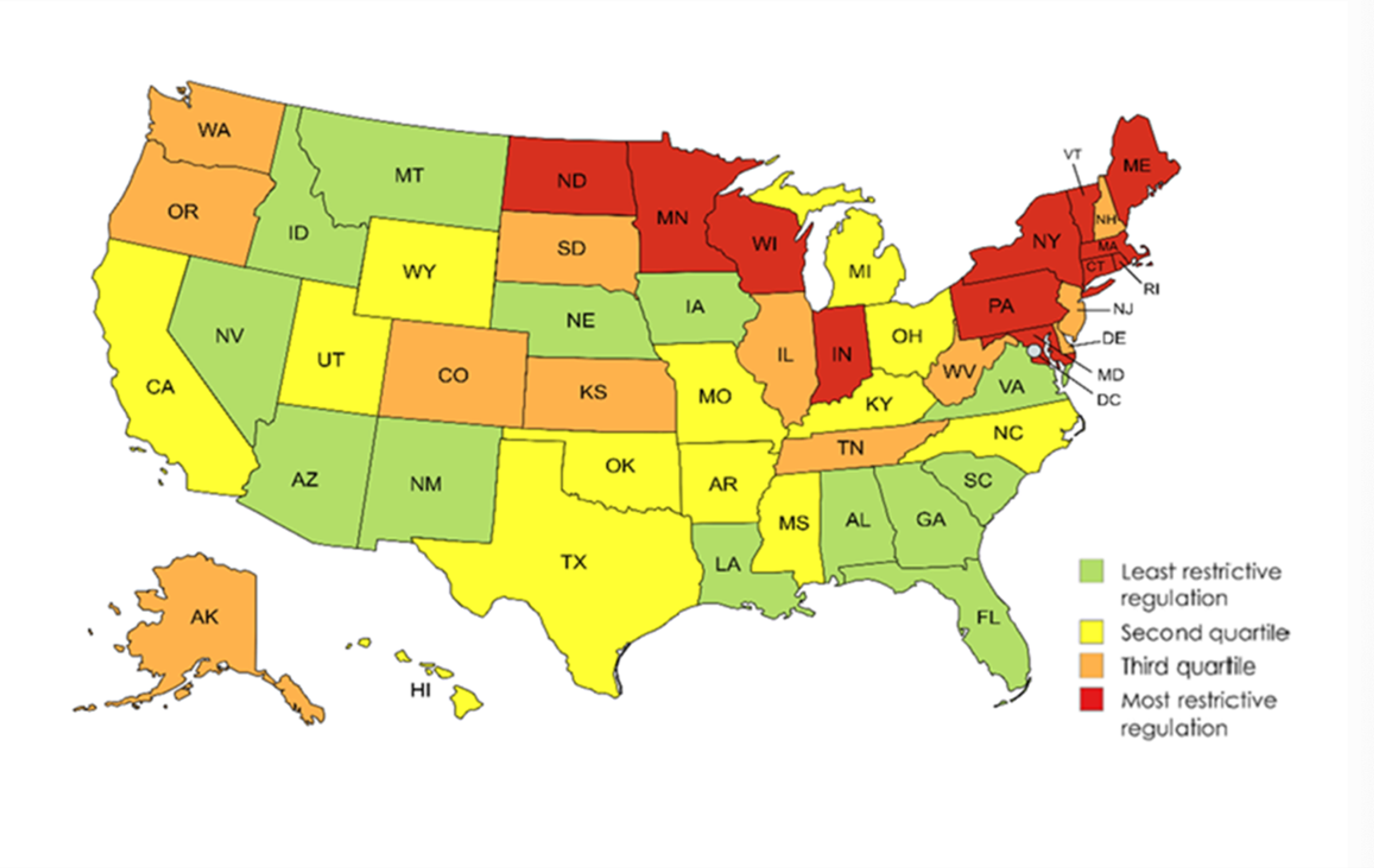
The above image shows the states which are in each quartile of the index. Maryland’s maximum staff-to-child ratio is 1:3 for 12- to 18-month-olds and 1:10 for three- to four-year-olds. In Arizona, the maximum staff-to-child ratios are 1:6 and 1:15 for the same age groups. These states have Childcare Regulation Index scores of 2.27 (Maryland) and 7.9 (Arizona), reflecting their relative position among all 50 states.
Educational requirements are scored on a scale. For example, Idaho, Iowa, and others allow those with no high school diploma or GED to work in child-care facilities. At the other extreme, Rhode Island requires applicants to have a bachelor’s degree in early childhood education or a closely related field.
Regulating staff education credentials and group sizes is meant to promote safety and quality. However, research has shown that the main areas of child-care regulation included in the index have negligible effects on quality of care or the frequency of dangerous incidents. Instead, more intensive regulations cut into staff wages, which can result in lower-quality care.
Child-care licensing compliance is an administrative headache for providers, who must divert time from actual child care to tend to license upkeep, staff training requirements, and federal ratings systems that help centers win grants.
Increases in child-care regulation also make it more difficult for parents to find the right child-care fit. Small, licensed, family child-care homes decreased by 22 percent between 2014 and 2017, with providers citing economic pressures and increased regulations as reasons for closure. These homes provided a valuable service, especially to parents who work unconventional schedules.
A one-point increase in child-care freedom, as measured by the Knee Center index, is correlated with a 5 percent reduction in child-care costs. The fact that parents in Massachusetts pay 263 percent of what parents in Louisiana pay for infant center-based care is largely due to their states’ regulatory approaches.
Regulations are barriers to entry. They discourage new child-care businesses, reducing choices for families and contributing to rising costs. Before turning to comprehensive overhauls of the child-care market, it’s time to look at which states are worth imitating.





Comments