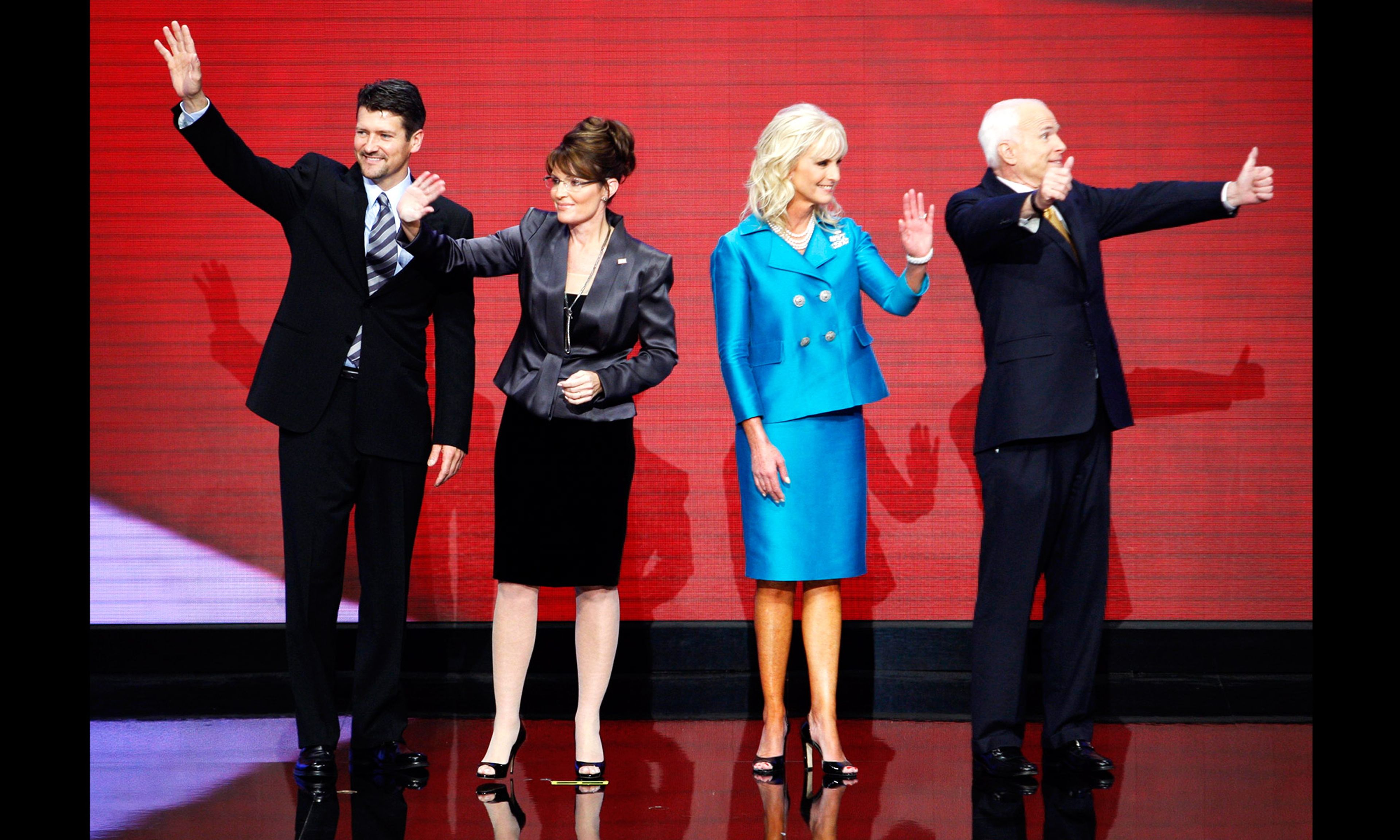
In the first grim days after the Democratic blowout, three overlapping schools of thought emerged: No Republican could have won this year; McCain lost because he was the type of moderate who can never make the party’s best case; and McCain lost because he was trying to appeal to the conservative base of the party rather than swing voters. There is no need to choose among these explanations: All are true. Each problem reinforced the others.
“Headwinds” was the Republican strategist’s cliché of the year, and they were indeed fierce. Even if President Bush had been popular and the economy been good, there would have been time-for-a-change sentiment after eight years of a Republican president. But of course Bush has been very unpopular for a very long time. He became unpopular for a lot of reasons, but a few stand out. The discovery that Iraq had no weapons of mass destruction hurt his credibility. For the first three years of the occupation, he insisted that we stay the course while the public came to believe, correctly, that we were losing. Similarly, Republicans insisted that the economy was fine even as wages stagnated. And Bush was widely blamed, fairly or not, for the botched handling of Hurricane Katrina.
The financial crisis created another headwind: The public was bound to blame the party in charge of the White House for it. These conditions made it extremely difficult, and perhaps impossible, for Republicans to hold on to the White House this year even while up against an inexperienced and liberal Democratic presidential nominee.
The type of campaign McCain ran eliminated whatever chance he may have had left. Liberals spent the fall pretending that it was the nastiest campaign ever, in part to justify their own abandonment of the senator, over whom they had previously fawned, for Obama. Almost all of the McCain campaign’s attacks on Obama were fair game, as were a few it did not make. (If McCain thought that keeping silent about the Rev. Jeremiah Wright would protect him from charges of racism, he rather badly misjudged.) But the campaign lacked substance, particularly on domestic policy, which neither McCain nor his running mate, Alaska governor Sarah Palin, seemed particularly interested in or knowledgeable about.
While McCain’s campaign rarely stuck to any message for very long, federal spending was a policy issue about which McCain did get passionate. His central economic message for most of the campaign was that he could be trusted to control spending. Most voters would like the federal government to spend less in general (while favoring spending more on nearly every specific program any politician proposes). But spending cuts will not lead to any direct improvement in middle-class Americans’ well-being, and McCain never even bothered to argue that it would help them in the long run.
Much of the time McCain made an even narrower argument: He would eliminate earmarks from the federal budget. A lot of conservatives have come to hate earmarks in principle. Their elimination is not, however, a major priority of most voters.
For the most part, McCain adopted the most unimaginative possible Republican agenda on taxes: Keep the Bush tax cuts, and throw in a reduction in corporate tax rates too. There was not much for the middle class there, especially since the Democrats had already pledged to keep Bush’s middle-class tax cuts. McCain gave Obama the opportunity to present himself as a tax reformer for the middle class.
When McCain had proposals that could appeal to middle-class voters, he never made anything of them. His health-care plan would have made insurance more affordable, increased coverage, and given individuals more control and, especially, the ability to take their insurance with them from job to job rather than depending on their employers. But McCain rarely explained the plan’s benefits or defended it against Obama’s many misleading attack ads. In the middle of the fall campaign, the senator’s aides made major changes to the plan, as though to emphasize how lightly they took the whole issue. His tax plan would have increased the tax exemption for children. But neither McCain nor his aides presented his proposals as a program to help the middle class, and indeed McCain repeatedly bungled his descriptions of the tax exemption. The McCain campaign wasted the months between the effective end of the Republican primaries and the end of the Democratic ones. What if McCain had spent that time establishing himself as someone who would fight for reforms to benefit the middle class? Had McCain run on a middle-class tax reform, for example, he would have simultaneously separated himself from Bush on economic policy, addressed his party’s longstanding weakness on domestic issues, and made more voters feel that he sympathized with their concerns.
In his bestseller What’s the Matter with Kansas? left-wing author Thomas Frank argued that Republicans had won a generation’s worth of elections by using contrived cultural controversies to distract the working class from the way their policies were immiserating it. It has been remarked that at times this fall the McCain campaign felt like a parody of Frank’s thesis. When his campaign brought up Obama’s ties to the terrorist Bill Ayers, liberals suggested that McCain was obsessing about the ’60s while the economy was melting down.
What they failed to note is that McCain’s campaign disproved Frank’s thesis. Ronald Reagan and George W. Bush succeeded by appealing both to voters’ values and to their interests. If the median voter had seen McCain as a protector of her interests, it would have been easier to get her to see Obama as out of the mainstream. On their own, however, these attacks were not capable of winning an election.
When the financial crisis hit, McCain carried a triple burden: He was in the incumbent’s party, his economic platform strongly resembled the incumbent’s, and he had done nothing to make middle-class voters consider him an answer to their anxieties. He then briefly suspended his campaign and tried to cancel the first presidential debate while he went to Washington to work on a financial-rescue bill. It was an act of considerable folly. McCain had no particular economic expertise, and there was no reason to think he would be able to deliver a deal. He reinforced his image as an erratic showboat at the worst possible time.
Some conservatives have suggested that McCain should instead have voted against the financial-rescue bill, taking up the populist cause against Wall Street bailouts. That course of action would have separated McCain from Bush pretty dramatically, but it might also have looked reckless, particularly if McCain had sunk the bill and the markets had nosedived. McCain was never going to take this advice in any case. He had made a second career out of bucking his party in favor of conventional wisdom; he was not about to buck both.
According to the exit polls, voters whose top issue was the economy went for Obama over McCain by 9 percentage points. Worse, 60 percent of voters concluded that McCain was not in touch with people like them — and 79 percent of those people voted against him. Those voters alone put Obama very close to victory: He had to win over a mere 6 percent of the voters who considered McCain “in touch.”
Governor Palin’s vice-presidential candidacy ended up conforming to every bad pattern the McCain campaign had set. Once again there was no follow-through. If her selection made any sense, it was as a way of underscoring that McCain was a fresh-thinking reformer willing to take on his own party when appropriate, as she had done. After the selection, however, no further attempts were made to develop that theme, and Palin was placed in the traditional veep-candidate role of attack dog, specializing in cultural attacks on the elitist Democrats. She was not the first, second, or third most important reason McCain’s campaign failed, but she illustrated those reasons.
Because McCain’s campaign was so weak on the issues, he would have had no mandate if he had won. He would have been elected not to be an inexperienced coddler of radicals. He had not pledged to veto any attempts to raise taxes or nationalize health care, and so a Democratic Congress would have considered every policy up for grabs. A stronger McCain candidacy, even if it had still lost, might at least have placed limits on what Obama can do in office. It is hard to avoid the conclusion that McCain’s campaign accomplished nothing other than to determine the floor on opposition to Obama.
Nonetheless it would be a mistake to look at McCain’s errors in isolation from those of his party. Democrats made big gains in the House and Senate, too, and not all of the victorious Democrats were clutching Obama’s coattails. In Virginia, North Carolina, and New Mexico, Democratic Senate candidates ran ahead of Obama. Democrats did so well because much of McCain’s weakness on domestic policy (along with some of his uninterest in it) is shared by his party.
McCain’s status as a maverick would have made it harder for him to address that weakness even had he been inclined to do so. At first blush it may seem paradoxical that George W. Bush was able to establish himself with swing voters as “a different kind of Republican” in 2000 while the maverick senator failed to do so. But it was the fact that most Republicans were comfortable with Bush already that allowed him to move the party in new directions.
McCain was the wrong kind of maverick. He departed from party orthodoxy on issues that did not win him votes. Many people thought more highly of McCain because he sponsored campaign-finance reform and favored greater funding for embryonic-stem-cell research (or would have if they had known about it). But not many people base their votes on those issues.
Because McCain’s heterodoxies caused the base to distrust him, however, they limited his room to maneuver on other issues. If McCain had been a down-the-line conservative, he would have been able to get away with adjusting the party’s message to match the times. The old war hero might not even have had serious competition in the primary: It was his weakness with the Right that made it possible for Mitt Romney, Rudolph Giuliani, and the rest to think they had shots.
For a party to change, either it must be so desperate for power that the need for change is accepted from its top to its bottom, or its leadership class must agree on a new direction and have the power to force it through. Neither condition applied to the Republican party of 2008. Rank-and-file Republican voters, accustomed to holding power, were not ready to change their approach. A wide-open multi-candidate field led all the primary candidates to pander to them. So the primary contest often boiled down to who could do the most convincing impression of Ronald Reagan circa 1979. Discovering new policies (or new ways of talking about old policies) that might unite the center and Right was not anywhere near the top of the agenda. McCain assembled a center-Right coalition that was capable of eking out a plurality in the Republican party. But he could not devise a way of broadening his appeal to independents while holding on to conservatives. Having won the nomination, the maverick found himself unable, based on his own temperament and his position within the party, to lead.
In short, Republicans had a bad hand, and played it badly.






Comments