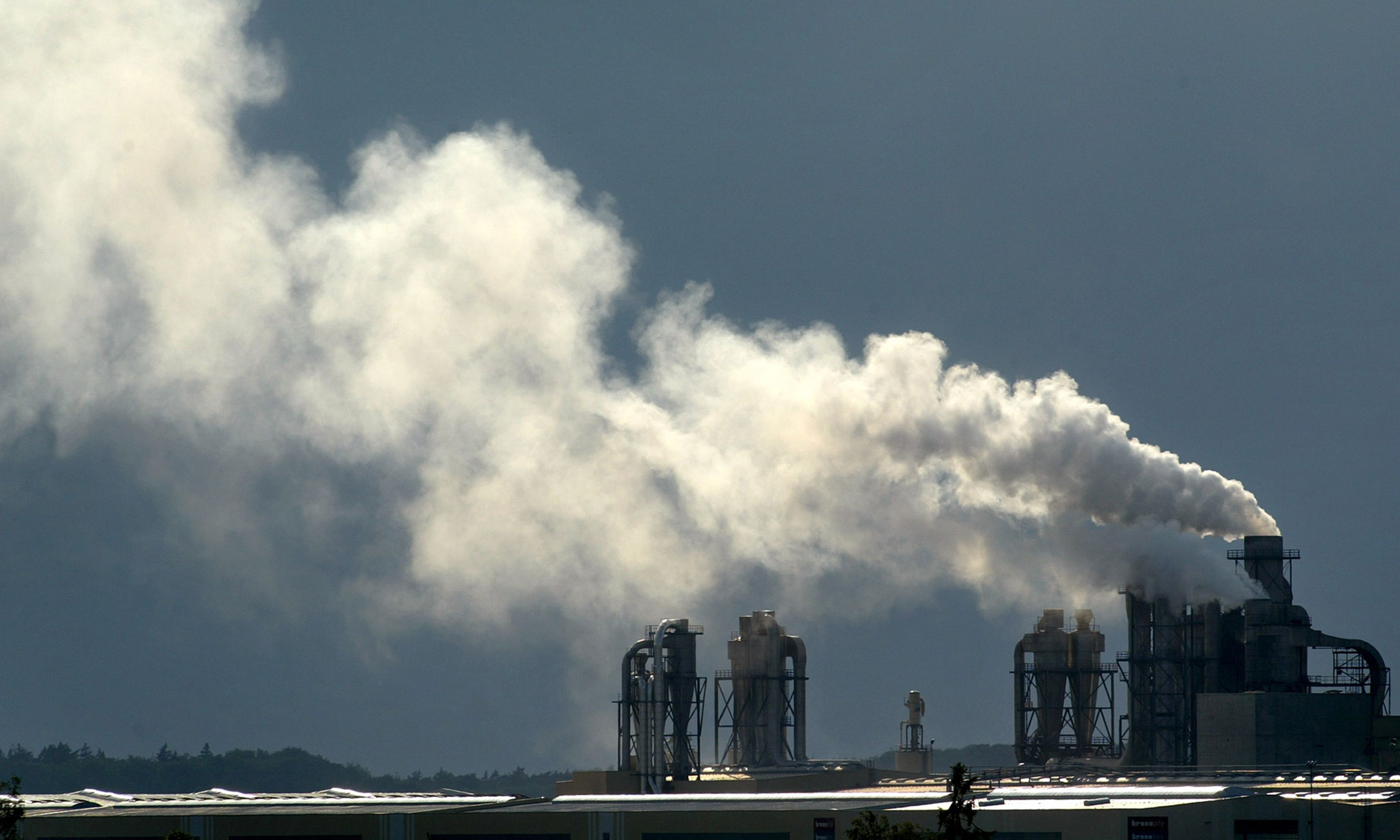
The American people have elected a Democratic president and congressional majority. It is incumbent on conservatives to try to work productively with the new leadership until the next election. Part of the role of loyal opposition is to pick battles wisely. We need to focus major disagreements on political issues that are significant — issues on which either victory is possible, or laying down a marker for future elections is critical. One obvious example of such an issue is so-called cap-and-trade legislation.
The premise behind cap-and-trade is that carbon-dioxide emissions will produce increasingly severe global warming, and that we therefore should force reductions in the use of the fossil fuels that generate most U.S. carbon-dioxide emissions in order to avoid some of the damage they are predicted to cause. Cap-and-trade is often presented by advocates as a complicated, technocratic, and “market-oriented” approach to the problem, but in plain English cap-and-trade is simple: It is carbon rationing. Basically, the federal government would make it illegal, in most cases, to emit carbon dioxide at scale without a ration card. Government officials would decide how much carbon dioxide the U.S. would emit in a given year (that’s the “cap” part), print up only that many ration cards, auction them off, and then allow people to buy and sell them (that’s the “trade” part).
In order to reduce carbon-dioxide emissions in any serious way, the cap would have to force the U.S. economy to consume a lot less fossil fuel than it otherwise would. Barack Obama has proposed a cap-and-trade program intended to reduce U.S. emissions by 80 percent by 2050. Given that about 85 percent of all energy consumed in the U.S. is produced by fossil fuels, this implies using government fiat to demand the elimination of a majority of all energy that would otherwise be used by the economy over roughly the next 40 years. A person possessed of common sense might think that this would keep the economy from doing as well as it otherwise would. And this person would be right.
But, of course, advocates say that these enormous costs are justified, because we are preventing a global catastrophe. A careful review of the facts indicates otherwise. The United Nations Intergovernmental Panel on Climate Change (IPCC) represents the largest existing global effort to project the potential extent and impact of global warming. The current IPCC consensus forecast is that, under fairly reasonable assumptions for world population and economic growth, global temperatures are projected to rise by about 3°C by the year 2100. Also according to the IPCC, a 4°C increase in temperatures would cause total estimated economic losses of 1 to 5 percent of global GDP. By implication, if we were at 3°C of warming at the end of this century, we would be well into the 22nd century before we reached a 4°C rise, with this associated level of cost. Note that the vast majority of mainstream economists expect the average person in this far future to have an income at least five times larger than the average person of 2008.
This is the central problem for advocates of rapid, aggressive emissions reductions. Despite the rhetoric, the best available estimate of the damage we face from unconstrained global warming is not “global destruction,” but instead something on the order of a 3 percent cut in global GDP in a much wealthier world well over 100 years from now.
This is why formal attempts to weigh the costs and benefits of cap-and-trade have to make patently implausible assumptions in order to claim that the program is sensible. One trick is to build into the assumptions an unrealistically heavy weighting of benefits a century or more from now versus costs today. Another is to assume global agreement to, and enforcement of, emissions-reductions rules — when these things do not in fact exist, and when China and India seem in no imminent danger of joining such a regime. Cap-and-trade advocates want to wave away careful scrutiny, because their arguments cannot withstand it.
In June 2007, this magazine published what turned out to be a somewhat controversial cover story on global warming in which I argued three things: (1) man-made global warming is real, (2) current projections of its expected impact are wildly uncertain, but are not sufficient to justify the costs of an aggressive emissions-reduction program, and (3) conservatives have an unseen political opportunity to win on the issue by pointing this out.
At that time, many conservatives feared, and many liberals hoped, that this was simply a way-station to a me-too conservative emissions-reduction program that accepted the massive government intervention and did a little tinkering around the edges. But the defeat in Congress this spring of the Lieberman-Warner cap-and-trade proposal showed the success of exactly the strategy I advocated. This bill was not beaten by an esoteric argument about science; it was beaten by pointing out the immediate pocketbook loss it would create for voters today in return for small, uncertain benefits in the far future.
A future cap-and-trade bill is very possible in the new Congress, and Republicans can beat such a bill with the same strategy. The reason for this is simple: They have the facts on their side. The economic problems with cap-and-trade are not fixable with clever drafting. Even if one accepts the scientific and economic projections used by cap-and-trade advocates, the costs of restricting emissions can’t be justified based on the benefits that it is expected to provide. This is why getting drawn into a discussion of how to improve cap-and-trade is a strategic error. The Republican reaction should be to “just say no.” The positive Republican alternative should be investment, at the level of single-digit billions of dollars per year, in technologies that will provide insurance in the unlikely event that the consequences of global warming turn out to be much worse than expected.
The likely fulcrum of this resistance will be a real or threatened filibuster by the Republican caucus in the Senate. This is where Lieberman-Warner was stopped, and Republican losses in the recent elections should not necessarily undermine this capability. Senators Dole (N.C.), Smith (Ore.), and Sununu (N.H.), who were defeated in the 2008 elections, are among the few Republicans who voted in favor of Lieberman-Warner. A careful analysis of prior voting records, and of the fossil-fuels-dependence and income profiles of each state, indicates that there should be at least 40 Senate votes to hold the line against cap-and-trade.
All this said, there is a real possibility that resistance in the Senate will fail, and Congress will pass a cap-and-trade law. Even in this scenario, the program is very likely to fail in practice, either because (as has happened in Europe) it becomes a pointless boondoggle, or because it actually starts to restrict energy use and thus becomes a visible drag on the economy. One way or the other, if Republicans force a party-line vote, it would just create an issue for conservatives to campaign on, win, and roll back.
As an inherently uncertain political process winds forward, how do we keep pushing this debate to the best possible outcome, given the overall correlation of political forces? Simple — keep coming back to the same question: “What do we pay, and what do we get?”






Comments