
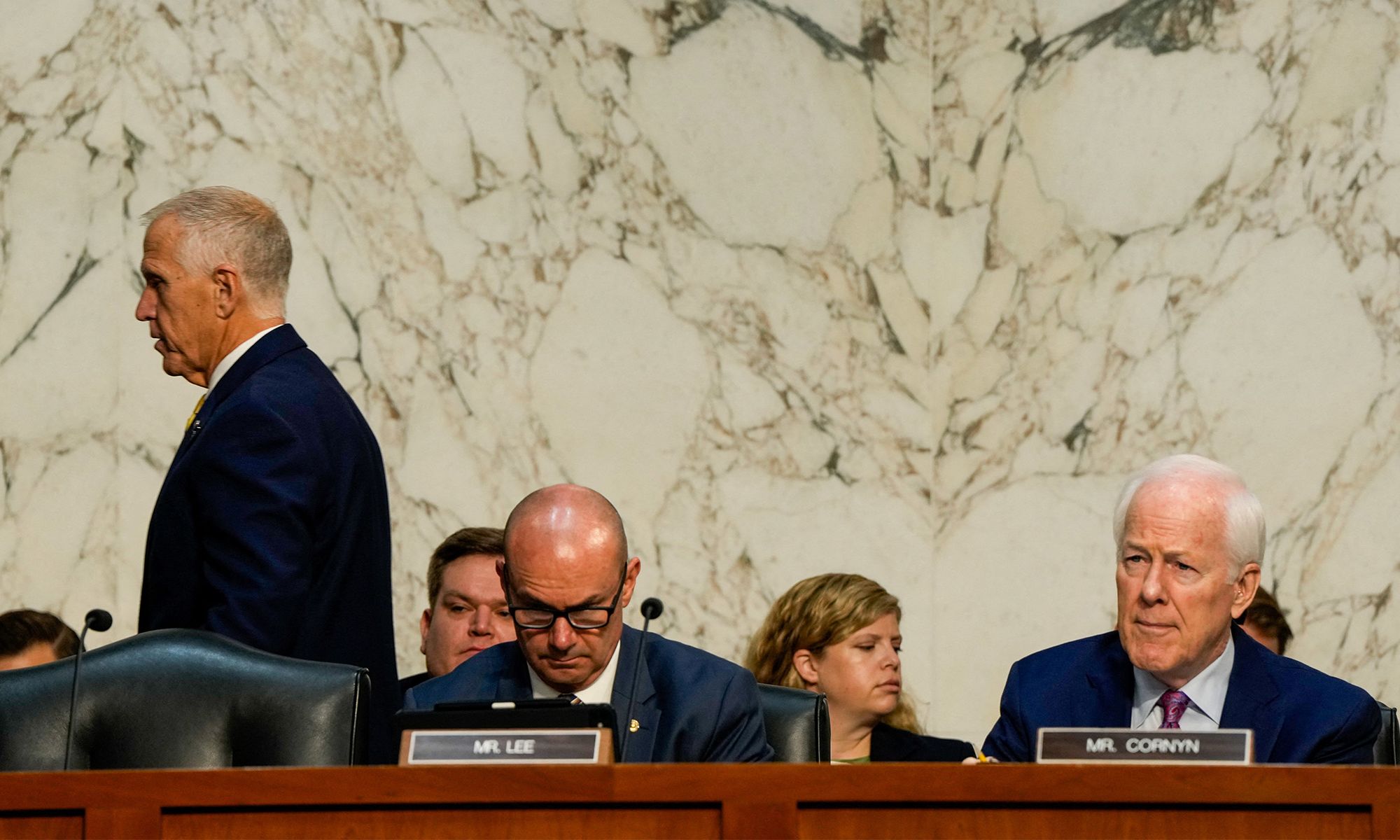
As I said yesterday, I generally hear good things about ’s supposed pick for the Dallas District Court, Steve Fahey. I say supposed because it’s not clear to me that he has actually recommended Fahey to the White House. (Somebody should probably ask?) Regardless, people I respect both from the Dallas U.S. Attorney’s Office and Fahey’s old firm say he’s a solid conservative.
That’s good, but it’s also beside the point. T. Elliot Gaiser, the choice of both the White House and Senator Ted Cruz, is a solid conservative, too, but — as we’ve seen — this does not end the inquiry into a nominee’s political suitability.
When considering Fahey’s candidacy, for example, the White House and Senate Republicans could take issue with the nature of his legal practice. Consider the case of Rafeek Virani, a criminal alien who served six months for SBA loan fraud. Fahey filed the writ of coram nobis on Mr. Virani’s behalf to get his conviction vacated in order to prevent a possible third-country removal for this convicted fraudster with a removal order.
Or consider the case of United States v. Patel et al., an action involving over $50 million of loan fraud under the Paycheck Protection Program, where Fahey represents an accused fraudster. Or United States v. Moreno, a prosecution over a Medicare kickback scheme relating to COVID tests and where Fahey again represents an accused fraudster. Or United States v. Ubaldo, yet another kickback scheme where Fahey — you guessed it — represents an accused fraudster.
Is that the end of the world? No. I’m sure these are paid representations, and far be it from another lawyer to criticize paid work. It’s the foundation of our legal system! Even in the case of Hubbard v. D.C.G., Inc., et al., where Fahey seems to represent an alleged VIP “John” in a civil human-trafficking suit against Dallas’s “finest Gentleman’s club and cabaret,” well, a job’s a job. “Johns need lawyers, too,” as Horace Rumpole might say.
But the fact is that Fahey’s private legal practice stems from his high-level experience as a white-collar prosecutor and False Claims Act enforcer. This means that his client list probably looks like the rogues’ gallery of actuarial malpractice.
What else will pop when committee staffers review his cases?
The issue here is politics. Corruption is a real political problem, as Republicans recently learned the hard way. Is Cornyn’s idea for his colleagues to respond to midterms by giving a lifetime appointment to a fraud defender — conservative or not? Is the expectation here that — Mr. False Claims Act himself — will dutifully hold this political hand grenade when he catches it? Perhaps he has to; it’s the price of leadership.
But will, say, ? When he sees this nominee who’s been defending all manner of fraud — including as it relates to at least one removable alien and to say nothing of an alleged human trafficker — is he supposed to bite his tongue for the “greater good” of filling seats before Democrats take over?
I’m reliably informed we’re not doing that because it contravenes the constitutional role of the U.S. Senate. Just ask John Cornyn — or Thom Tillis.
Cornyn’s defenders say that, on his revenge tour, Trump reaps what he sows. True enough, but the trouble with St. Paul is that he was addressing not just the Galatians or Trump but everyone, including John Cornyn.
This is either a team effort or it isn’t. Cornyn has spent the last two weeks speaking in pious aphorisms about “the role of the Senate” as understood to be his individual prerogative to stymie legislative outcomes.
Well, his colleagues share that prerogative, and they may not be inclined to set it aside to excuse someone who makes a living defending those who defraud the government. If they don’t, Cornyn will have only himself to blame.
There may be a path forward, though. The fact is that a Fahey nomination is doomed without buy-in from Cruz, aggression from Grassley, and nose-holding from the committee’s crimefighters. Even so, Fahey — and any other outstanding nominees — will be at the back of the line, requiring one last Christmas miracle (before the Democrats turn it back into “Holiday”). Indeed, the markup will probably be so late in the year that any single Judiciary Republican holds all the cards on Fahey.
If the White House moves to Fahey, a Judiciary Republican — Grassley, Cruz, Hawley, whoever — should tell Cornyn that he will move Fahey if and only if Cornyn plays ball across the board. That means attending all markups and votes. It means supporting Zach West. It means not preventing en bloc inclusions absent objectively reasonable justifications. The same principle would apply to a North Carolina nominee (should one of those arise) and Senator Thom Tillis.
If you get to vote your conscience and damn the consequences, so does everyone else. Preventing this legislative Hobbesianism is the basis of party discipline. If Cornyn and Tillis are going to demand party discipline from others on their picks, others should demand it of them.



Comments