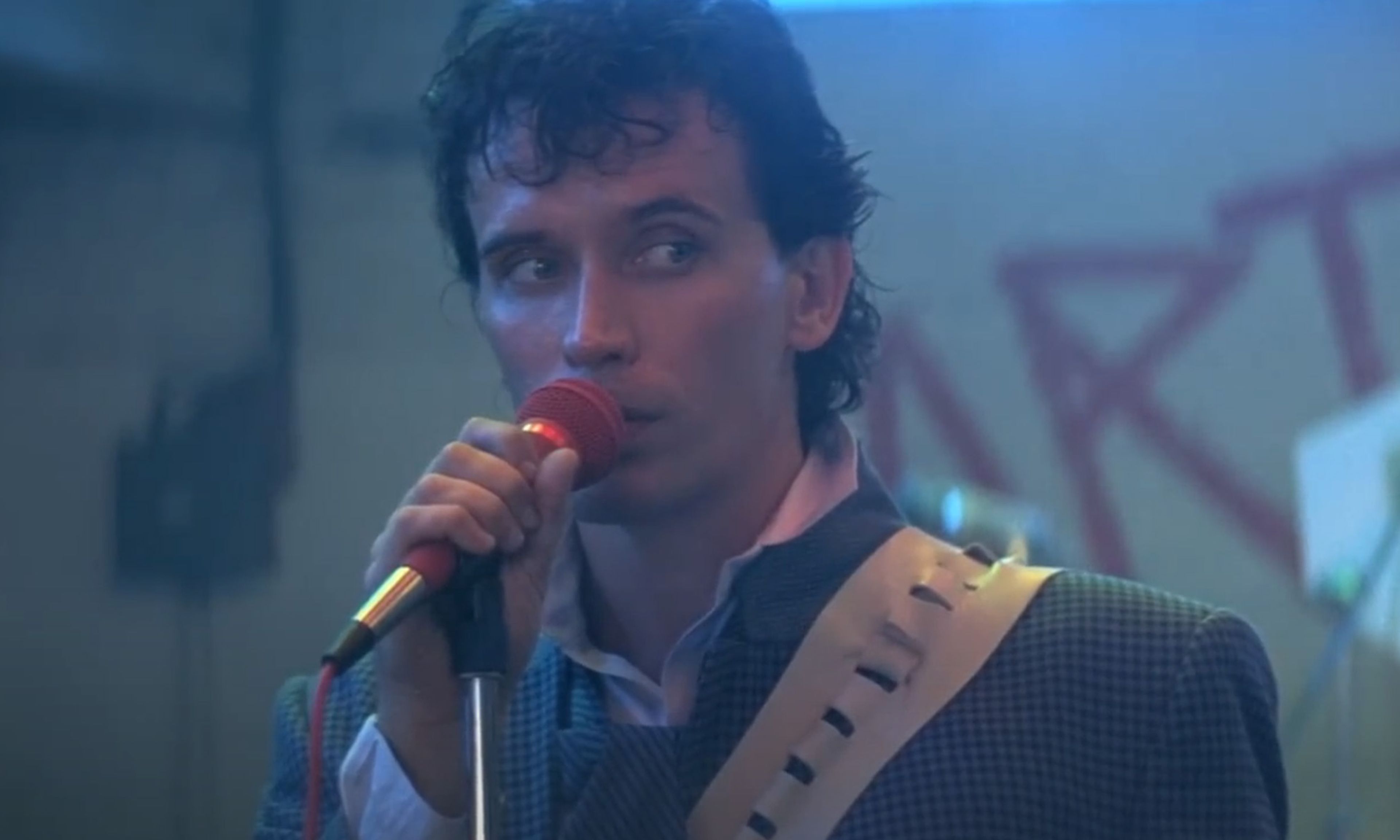
Greetings, and welcome into a slightly quirky, offbeat, synth-pop-themed edition of the Carnival of Fools. Why? Because the holiday season demands nostalgia. Yes, it’s Christmas Eve today, so rest assured that by the time you read this, I will be safely ensconced in the Chicago suburbs, sipping eggnog, attired in obscenely comfortable sweatpants and seasonally appropriate slippers as my son pesters me to open gifts in advance of Christmas Day. It’s not that the seasonal spirit has gentled my soul in any respect — I’m still a miserable coal-hearted Scrooge. Then again, Ebenezer never knew how to work unexpected yet slyly appropriate pop culture references into his commentary, so I’ve got that one up on the ol’ blackhearted miser, at least.
Don’t Be Mean . . .
In all honesty, it’s a matter of psychological exhaustion. I’ve tipped this a number of times throughout my various weekly Carnivals, but I’ll put it squarely here: 2024 has been an especially enervating year in modern global politics. If you’d been paying proper attention, you’d be throwing punches around and preaching from your chair, too, because everything everywhere is breaking down all at once. Not just American politics, mind you, but large parts of the Western order. This year the governments of Germany, England, and France all collapsed; Iran is currently collecting charred shards of its teeth from the floor after Israel’s destruction of Hamas and Hezbollah; Syria has been reduced once again to an awkward geographical expression; Romania’s elections were annulled on mere Europeanist pretense; our allies in South Korea nearly bearbaited a hot war with Kim Jong-un’s North Korea in the run-up to a botched coup. (I would mention the impending implosion of Justin Trudeau’s government in Canada, but it hardly seems sporting to hold Canada to the standards of actual nations.)
In sum: Be glad to be an American, because as bad as you might think you have it here, you could still be a Manitoban. But even in America we got kidney-punched: We lived through the renominations of Trump and Biden — a preordained fate in January of this year, I will remind you — only to see Biden at the June debate spontaneously mutate into seawater and melt away like an X-Men outtake. Adding gratuitously to the drama, a madman shot Donald Trump in the head a week later. We then subsequently suffered through an ongoing, rolling conspiracy between the media and the Democratic Party to suppress all of this and project the Kamala Harris Joy Show upon the electorate in the desperate hope that an unknown and intentionally unknowable puppet president could be quickly swapped in to replace the current puppet president.
All of this failed. It was quite the journey, friends — we all lived through it, and some of us in sadly irrevocable prose form. Now it is Christmas Eve, and I am tired. Who wants to talk about hatefully unpleasant late-breaking news, anyway? An illegal immigrant set a sleeping woman on fire in the New York City subway this weekend, killing her — I don’t want to talk about it. Joe Biden’s staffers (acting under the auspices of Joe Biden’s semi-animate corporeal form) commuted the death sentences of 37 out of the 40 prisoners on federal death row to life in prison, all except for the most politically risky ones — I don’t want to talk about it. Matt Gaetz’s House Ethics Committee report dropped yesterday and every nasty thing I said about him turned out to be agonizingly well supported (only the lawyers prevent me from typing “true” here) — okay, I sort of do want to talk about that one, but it’s Christmas and I neglected to pack my hazmat suit with me.
Joe Biden’s revealed senility was laid forth in the Wall Street Journal last week in detail for all to see; if you’re in the market for two incredibly angry — but measured — essays about its ramifications for the presidency and the media, I invite you to survey the horrifying damage to the twin engines of our American civic-political arrangement over there. But I’ve already done my assessment and said my piece, so I’m pulling the rip cord on 2024 and bailing out of this mess until I finally float back down to earth on New Year’s Eve. ¡Feliz Navidad y adios, muchachos!
. . . We Don’t Have to Be Mean
But wait, what’s that? Excuse me . . . is someone out there not having a good time? Is somebody crying? Out there in the darkness, is somebody crying? Don’t be mean . . . we don’t have to be mean.
Christmastime means a number of special things to me (aside from the theology of it all, that is). A season of joy. A season of wonder. And a season of nostalgia as well, because whether or not it was movies, music, television shows, or even Nintendo games, all of my most important pop cultural moments as a youth — the ones that ended up worming their way inside my brain and shaping my sensibilities — seem to have come around by way of Christmas. And few have mattered more to me than the film The Adventures of Buckaroo Banzai across the Eighth Dimension (1984).
Last year I wrote fondly about how a little Minneapolis-area cow town puppet show called Mystery Science Theater 3000 fundamentally and forever altered my comedic prescription lenses when I was a kid back on Christmas 1991, fitting me with a worldview that made sense of whatever kind of weird preadolescent mess I must have been at the time. But what laid the groundwork for all of that? How does one find oneself at age eleven, ready to absorb the most left-field sort of comic weirdness without blinking? The answer is simple: From the moment I was capable of telling chalk from cheese, my father reared me on earlier Yuletide showings of Buckaroo Banzai. Yes, my reward for being a good kid around Christmas? I got to hang around the family room TV with a bag of microwave popcorn and battle the Red Lectroids again.
It’s not that Buckaroo Banzai is a “Christmas movie” per se, not at all. It’s an improbably eccentric Eighties comedy/sci-fi one-off about a test pilot/samurai/brain surgeon who saves the world from evil aliens — with the help of his worldwide fan club — while also fronting a tight Jersey Shore rock combo when not distracted by work. The film was directed by W. D. Richter, who also scripted the superior 1978 Donald Sutherland remake of Invasion of the Body Snatchers, as well as (later) John Carpenter’s Big Trouble in Little China. (If you have seen either of those two films but not this, you doubtlessly already know where to go next.) Peter Weller, Ellen Barkin, John Lithgow, and Jeff Goldblum — all of them still years away from their most celebrated roles — star alongside a cast that comprises almost entirely “That Guy” character actor types whom you know even if you don’t know them by name: Clancy Brown, Jonathan Banks (“Laugh-a while you can, monkey boy!”), Christopher Lloyd, Dan Hedaya, Carl Lumbly, Vince Schiavelli, and Soviet-American stand-up comedian Yakov Smirnoff as national security adviser to the president of the United States.
Our hero is a brain surgeon rockstar who effortlessly doubles as an Evel Knievel–style test pilot experimenting with advanced dimension-warping technologies. Buckaroo Banzai has a hotline to the president of the United States, because of course — anybody that important just would, right? Buckaroo has an international fan club of junior G-men (one that includes their parents as well) ready to drop what they’re doing and assist him against aliens because of course — anybody that important just would, right? He has a comic book franchise built around his adventures, because of course — anybody that important just would, right? Buckaroo is half Japanese because of course — anybody that important just would be, right? You get my point.
All of these details are imparted casually as the narrative unfolds. Buckaroo Banzai makes no apologies for its narrative demands: A text crawl at the start laconically explains the necessary backstory, and we are plunged into the middle of an argument between Buckaroo and new protégé Jeff Goldblum in the midst of brain surgery. The confidence of the narrative pacing makes it impossible not to simply accept that this is a fully imagined alternate universe. Banzai would be a ridiculous comic book figure were it not for the fact that never, not once, does anyone in the cast wink at the ridiculous, juvenile space opera that makes up the plot: The comedy in this film emerges entirely from the writing and acting and the dramatic tension, endless laugh-out-loud moments, and brilliantly scripted exchanges in an adventure picaresque.
To this day, I think of Buckaroo Banzai as the most successful self-consciously “cult film” ever created during the ’80s, not because it sought to be unlikable but rather because it was so unapologetically self-confident in refusing to explain its priors. What was I, eight or nine, when my dad first sat me down on Christmas Eve’s eve and popped in the VHS? What would or could I have known at that age about the ironic “context” for this film? Nothing. I came to it with Lockean freshness. All I knew is that I had been plunged into a film world where nothing could be known or explained outside of the document itself: I was simply asked to accept these rules and work within them. (In a post-MCU era, when we aestheticize our cultural past along the lines of Ready Player One, these once-esoteric nerd subcultures have been mindlessly osmosed into our cultural zeitgeist, but I preserve the memory of the old ways.) I took it on faith, because the lightness of the movie’s tone carried you along without time for complaint. The easiest way to get viewers to accept outlandish premises, it turns out, is to not bother trying to ponderously explain them. (To quote Mystery Science Theater’s Joel Hodgson: “We never say, ‘Who’s going to get this?’ We always say, ‘The right people will get this.’”)
You might be asking, Why mention this film now, at Christmas? Well, aside from the fact that I personally associate it with Christmastime, I always associate its breezy upbeat weirdness and tone with my own take on a season of renewal. It’s a take best embodied by my single favorite exchange of dialogue in all of 1980s cinema:
Team Member: Buckaroo, President’s on line one calling about is everything all right with the alien space cloud from Planet Ten or should he just go ahead and destroy Russia?
Buckaroo: [walks by stoically] Tell him yes on One and no on Two.
[Brief pause after he exits]
Team Member: Wait, which was yes, uh, “destroy Russia” or number two?
The term “cult film” is so nebulous and indefinably personal that any nomination for the greatest one will inevitably deteriorate into special pleading. But I consider Buckaroo Banzai to be the greatest “cult” film ever made for my tastes. Not obscure or hostile, simply caught up in its own world. If you’d like to sample that world, simply watch its final credits, perhaps the best such sequence of the decade. (The cast was actually marching to Billy Joel’s “Uptown Girl” as it was being filmed — you can tell from the strut.) And after you’re done, settle in and watch this movie. Prepare for something half comedy, half sci-fi, and (secretly) entirely “art film.” Give it a shot, and you’ll be halfway to understanding where I’m coming from as a writer as well. (Don’t ask me why there’s a watermelon there — I’ll tell you later.) Most of all folks, always remember: No matter where you go . . . there you are.
Merry Christmas, and until next week.





Comments