
Shortly after the publication of Charles Darwin’s On the Origin of Species, a piece of doggerel signed by “Gorilla,” from the “Zoological Gardens,” appeared in the London satirical weekly Punch:
Am I satyr or man?
Pray tell me who can,
And settle my place in the scale.
A man in ape’s shape,
An anthropoid ape,
Or monkey deprived of his tail?
. . .
Let pigeons and doves
Select their own loves,
And grant them a million of ages,
Then doubtless you’ll find
They’ve altered their kind,
And changed into prophets and sages.
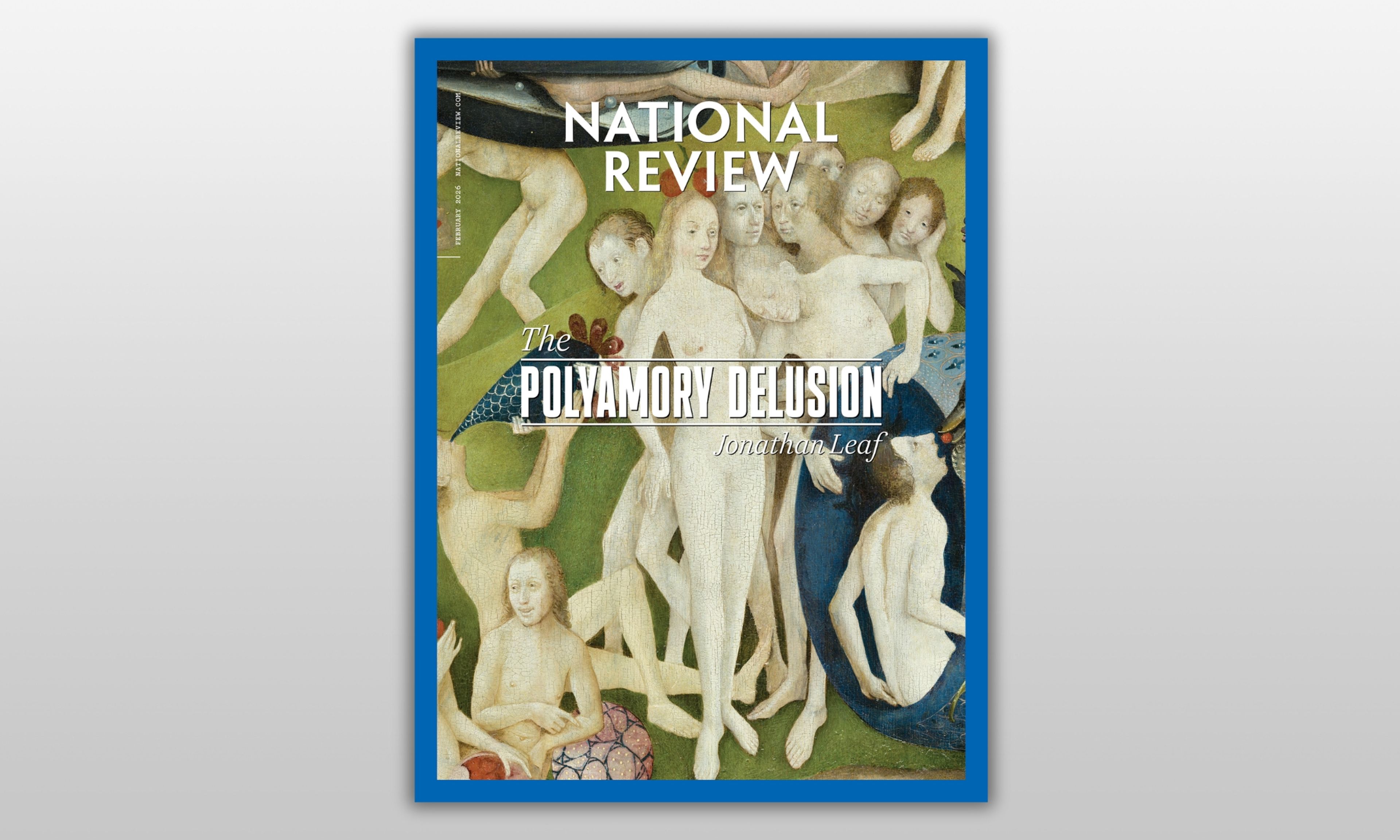
Growing self-knowledge of our kind has long misled experts and eccentrics alike about what human behaviors, norms, and customs are “natural.” In the latest issue of National Review, Jonathan Leaf, the author of The Primate Myth: Why the Latest Science Leads Us to a New Theory of Human Nature, takes on an increasingly popular fad that claims to have evolution on its side.
The idea of polyamory doesn’t just have hipster couples in thrall. In parts of Canada, it’s been taken up by the court system as judges in Newfoundland and Labrador, British Columbia, and Quebec have recognized the existence of “couples” composed of more than two parents.
The advocates of polyamory base their arguments on claims about human evolution. Almost invariably, they cite the long-standing assertion that humans are closely related to chimps and bonobos, and they point to the fact that these species aren’t monogamous to legitimize their belief that humans need not be either.
Such arguments in favor of monkey business, or against monogamy, are all too simplistic, of course, and rather unscientific. Citing the most recent comparative genetic analyses, Leaf explains why “chimp sexuality is about as much like ours as a banana is like a wind turbine or a perfume bottle is like a steam shovel” — and why we cannot reduce, or outsource, our culture exclusively to empirical observation.
Another highlight of this far-reaching issue of NR is Mark Antonio Wright’s firsthand account of his journey to Ukraine: “At Kyiv’s central station, you begin to see the costs of war. You see men in uniform, on leave, traveling to and from the front. You see men on crutches and with prosthetics, having given their very limbs in defense of their country.” Among these somber and awe-inspiring images of a nation at war, Mark ponders a perennial question:
What does this all mean to Americans? The war is horrible, everyone agrees about that — but should the people of Akron, Ohio, or Broken Arrow, Okla., believe that this war affects their families and hometowns? Ukraine, after all, is a very long way away.
The question deserves a direct response. It’s the one I came here to answer.
Speaking of perennial questions, there’s one that those who are pathologically opposed to Israel have for decades been asking and answering for themselves: Is AIPAC the “most successful foreign influence operation in U.S. history,” as former Democratic National Committee Vice Chairman David Hogg has put it? Daniel J. Samet sets things straight. The truth, it turns out, is unexciting to conspiracy theorists.
Also in this issue, John O. McGinnis explains how the rich can keep a democracy healthy; Fred Bauer dissects the competing “woke” and “based” vanguards that equally misunderstand our constitutional republic; and NR News Editor Jack Crowe tracks the voyage of a young captain who set sail on a merchant vessel in 1844 and has finally, miraculously made landfall in New Jersey.
There’s much, much more in this rich issue:
- Audrey Fahlberg reports on the Republican Party’s strategy and prospects a year ahead of the next midterm elections.
- Jeffrey Blehar, meanwhile, wonders whether Donald Trump is a lame-duck president, assuming that the term has a meaningful use in our modern politics.
- Charles C. W. Cooke offers an honest reflection on the blight of antisemitism and its most recent outbreak, during a Hanukkah celebration on Bondi Beach in Sydney, Australia.
- Abigail Anthony has hope that the British are finally waking up to the catastrophic effects of rapid demographic change in the U.K.
- And in our beloved Our Spacious Skies feature, Craig Young invites us to Loveland, Colo., where love is in the air — and especially at the post office.
The Most Wonderful Time of the Year is near. As you sink in a deep-buttoned sofa with a glass of eggnog, before the family shows up, flip through the Books, Arts & Manners section of the magazine to spend some time in the company of Charles Murray, J. R. R. Tolkien and C. S. Lewis, and, if you’re feeling adventurous, Wyatt Earp and Doc Holliday.
The February 2026 issue is a gem. If you don’t already subscribe, right now you can try NRPLUS (which gives you access to the normally paywalled magazine) for just $1 per week. Or, if you’d like to receive the next twelve issues of the print magazine in the mail, try the print-and-digital bundle for just $65 (that’s 50 percent off the cover price). The bundle is the best way to support NR’s conservative journalism.






Comments