
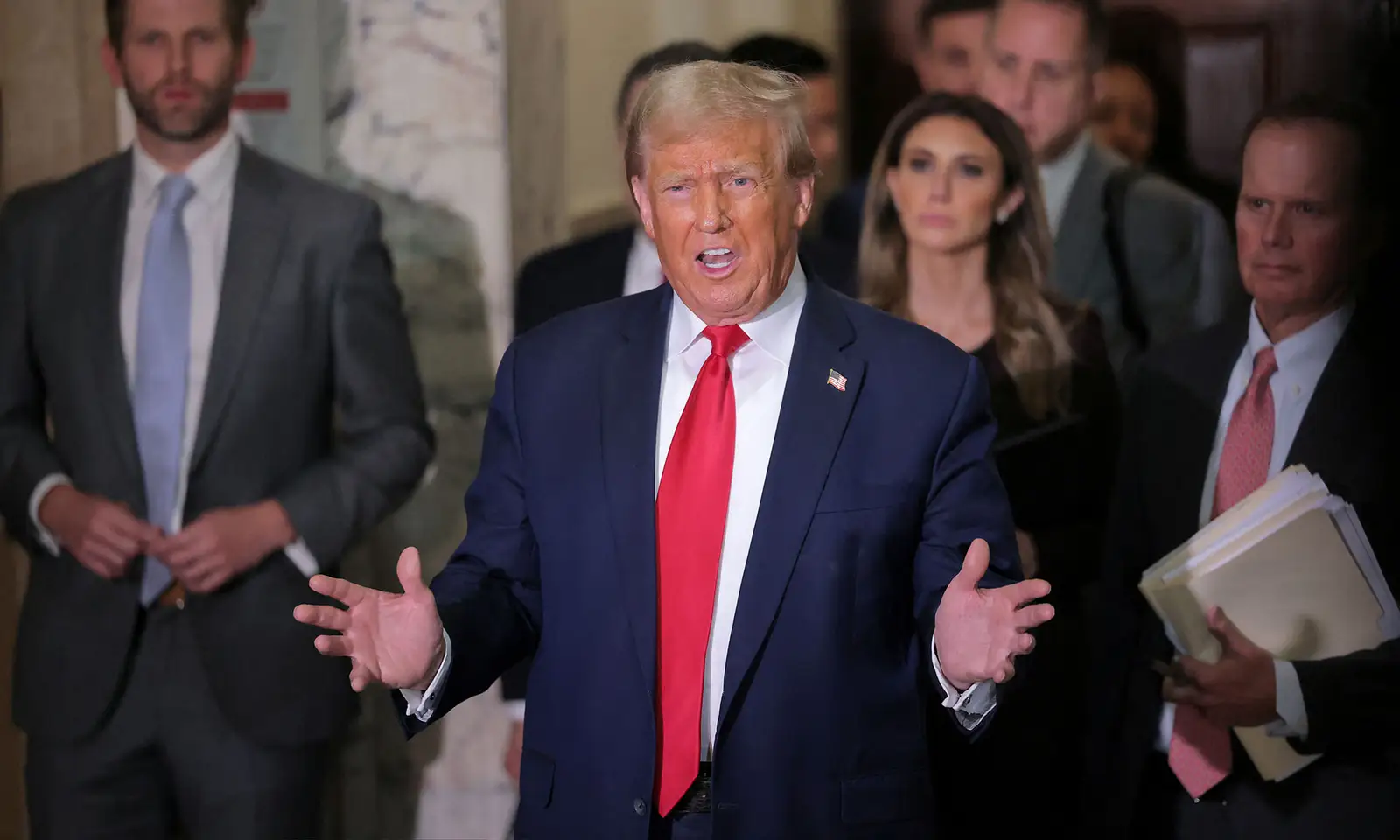
By all accounts, Republican voters have not tired of the Trump show. And “show” is the right word for it. To conclude from reporter Ben Jacobs’s dispatch from the still well-attended Trump campaign events, the atmosphere around the former president’s campaign is as electric as it ever was. But Jacobs doesn’t see its attendees as the former president’s supporters exactly. Trump doesn’t have “partisans” in the same way that other politicians do. He has “fans.”
Still more interesting about the Trump phenomenon, as the former president glides toward a third presidential nomination, is how little the campaign seems to be about anything other than winning the election — or, rather, campaigning for the White House as aggressively as possible. “John Miller of Fort Dodge was wearing a brand-new T-shirt displaying Trump standing with an American flag and giving the middle finger with both hands above the slogan ‘One For Biden. One For Harris,’” the report read. Jacobs photographed two Iowans who attended a recent Trump event wearing Trump-themed T-shirts, one of which was a play on Looney Tunes’ Elmer Fudd with the message, “Be very, very quiet — I’m offending liberals.” The other T-shirt bore the simple slogan “Revenge.”
These sartorial choices — which Jacobs chronicles at length, as well as the statements of unbreakable fealty to Trump expressed by those who made them — suggest that Trump backers are at least as excited about the prospect of a bitter campaign as they are about the possibility that Trump might actually do anything with the power he seeks. Of course, that risks becoming a self-fulfilling prophecy. A candidacy based on the proposition that it will, at the very least, annoy all the right people isn’t designed to stake out much of a governing mandate. But it is nevertheless revealing that the satisfaction Trump’s supporters derive from his candidacy is the candidacy itself. Save for the vague stipulation that Trump will satisfy some of his personal grudges upon his return to the Oval Office, he hasn’t promised to do all that much in a second term. And his “fans” don’t seem to care. They’re just along for the ride.
By contrast, President Joe Biden doesn’t have “fans.” At this stage of his presidency, his supply of plain old “supporters” is running low. But Biden’s candidacy shares Trump’s general lack of resolve to do much of anything in a second term. That’s probably for good reason, insofar as few Americans believe that Biden, should he win, is going to serve out that term.
Only 34 percent of respondents to a September CBS News/YouGov survey said they believed Biden would serve out another full term in the White House if he were reelected in 2024 — a total that captures just two-thirds of self-described Democrats. A plurality of respondents expects that Biden will leave office before January 20, 2029, which suggests a plurality of Americans know full well that a vote for Joe Biden next November is a vote for President Kamala Harris.
Democrats seem disinclined to address that nagging suspicion head-on, so they have focused all their energies on the campaign ahead. The fight against the GOP broadly, but Trump specifically, is what motivates Democratic partisans. What they’ll do with the power they’re soliciting from voters is a problem for another day.
So we’re left with two parties that appear to regard the campaign for the White House in 2024 as mere spectacle. It’s a big, booming parade, a source of catharsis, a psychological analgesic to ease the nagging suspicion that presidential politics is utterly bereft of purpose. No one seems to care all that much about what happens to America over the next four years. The foreseeable crises, to say nothing of the unpredictable exigencies, that the next president will confront at home and abroad are a secondary concern.
America’s most engaged partisans on either side of the aisle have lowered their expectations of the political process to such an extent that all they appear to anticipate is that they will be entertained. Cynical though that assumption may be, voters have probably set expectations where they belong.




Comments
On “Does Anyone Care about What Happens After the 2024 Election?”