
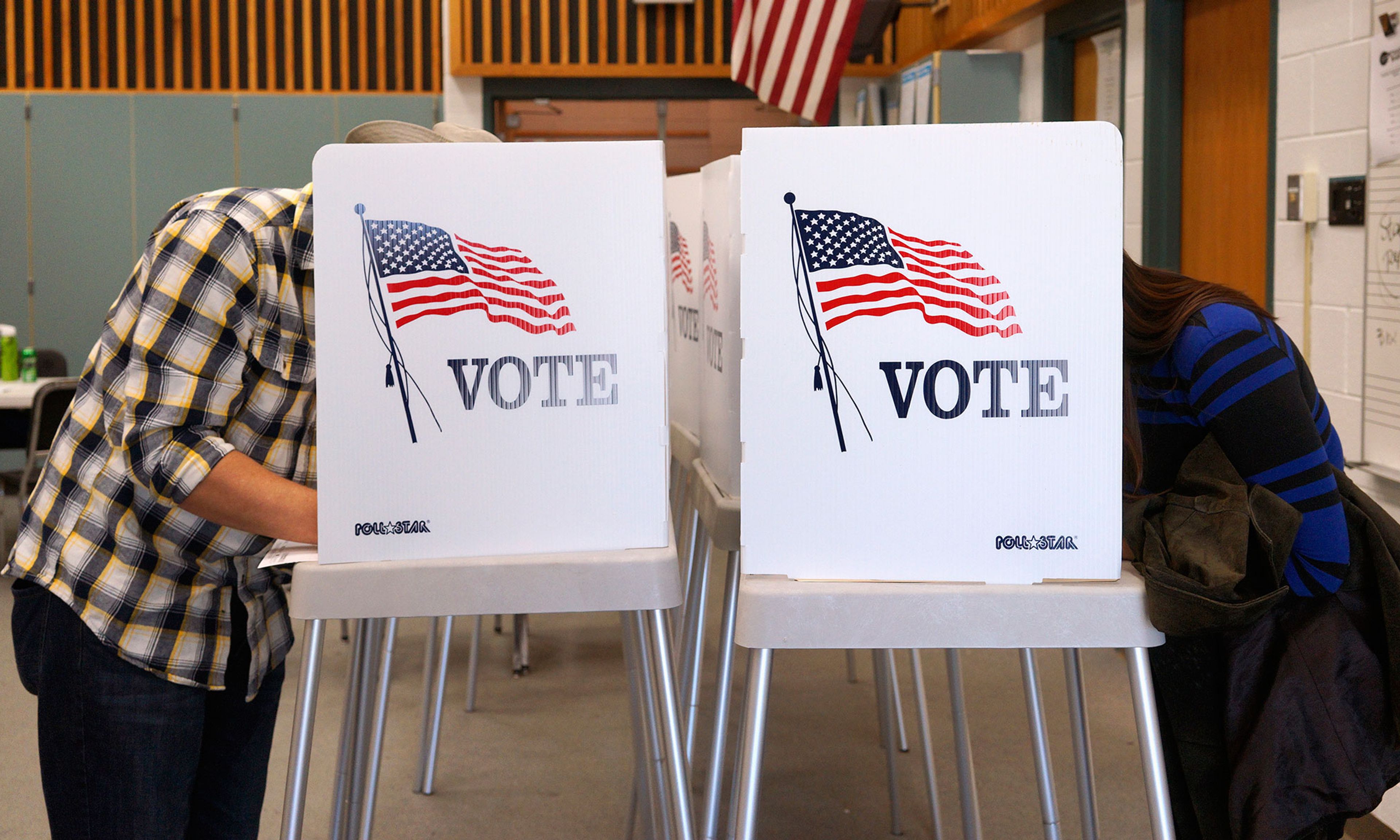
I can’t say I’ve been following the partisan-gerrymandering debate all that closely. I’ve long been convinced that the only solution to the supposed gerrymandering problem is to adopt multi-member districts. If we had multi-member districts that elect, say, three to five members, it would be all but impossible to freeze out Republicans or Democrats in any region of the country. Moreover, you’d open things up for minor-party candidates, provided they command fairly broad support. The Monster Raving Loony party wouldn’t make it, but a more serious contender — a true-blue Conservative party, for instance, or a Sandersite Progressive party — might clear the hurdle. Alas, a move to multi-member districts is not in the cards, at least not yet. Partisan gerrymandering looks like it is here to stay.
So I thought I’d share a fascinating article on the optimal partisan-gerrymandering strategy. Most discussions of partisan gerrymandering focus on the “pack-and-crack” strategy — packing opponents into districts where there are so many of them that most of their votes are wasted or cracking them apart into districts where there are too few of them to win. Although pack-and-crack is widely assumed to be the best strategy for aspiring gerrymanderers, research by Richard T. Holden, of the University of New South Wales, and Adam B. Cox, of NYU law school, suggests otherwise.
The problem, Holden and Cox point out, is that the pack-and-crack model assumes that all voters are either definitely Democrats or definitely Republicans. In reality, voter loyalty is not quite that certain. One can imagine voter preferences distributed along a bell curve, where the left-hand tail contains far-left voters (those who are most likely to vote for Democrats), the right-hand tail includes far-right voters (those who are most likely to vote for Republicans), and the middle sections are made up of voters about whom a redistrictor can be much less certain. The distribution matters: A district that winds up with a majority of Republicans from the middle of the curve is far less safe than one that has a majority of Republicans from the right tail.
Given such a distribution of voter preferences, Holden and Cox suggest that a better partisan-redistricting strategy would be to match slices of the electorate from one side of the distribution with slightly smaller corresponding slices from the other sides. So the farthest-right voters would be matched up with a smaller group of voters from the farthest left. The next most right-leaning group would be matched with the next most left-leaning voters, and so on.
This strategy, they argue, is optimal for a couple of reasons. First, it “uses a party’s diehard supporters most efficiently,” that is, in this example, diehard Republican votes would not be wasted countering people who could go either way. Even more, the margins of victory could be cut thinner, especially in districts where voter preferences are best known. Second, they say, it would ensure the election of politicians who are more conservative. To see how, imagine that with the crack-and-pack strategy, right-tail voters could be spread over many, many districts where they are “well to the right of the median voter.” But if a redistrictor starts by creating an extremely polarized district where the hardest-right voters are a majority, those voters will be the median. The process will repeat on down the line so that the median voter will be, as much as possible, to the right of the district’s average.
Holden and Cox conclude that their “matching slices” approach implies that Democrats should not try to pack black voters into majority-minority districts. Rather, since black voters are reliably Democratic, they argue, the party should distribute them into more thoughtfully crafted districts that include the farthest right voters possible.
Editor’s Note: This post has been updated.






Comments