
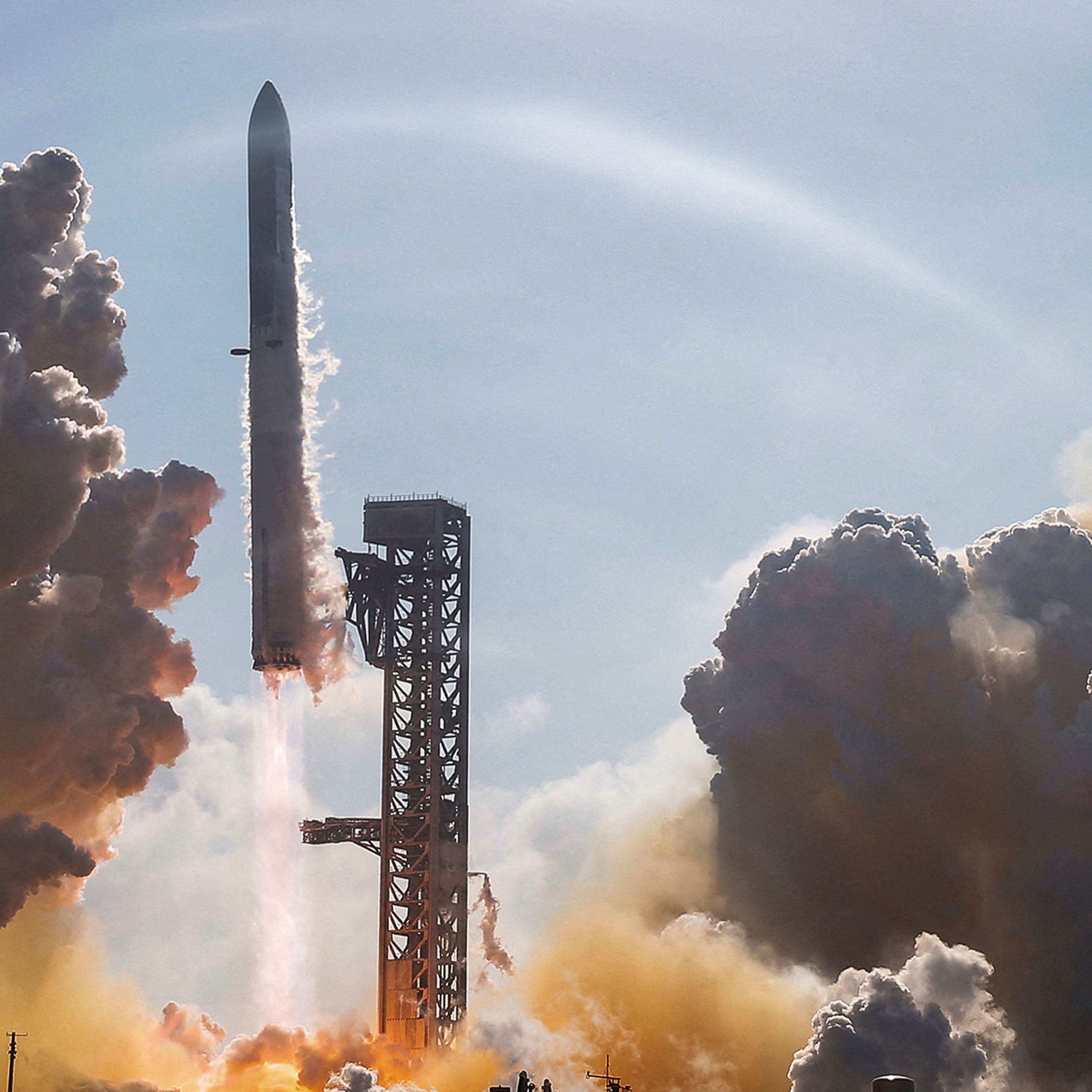
Out here at Stanford, excitement mounts (well, at least in the physics department) as the date of the Gravity B launch approaches. On April 17, a satellite will blast off, carrying into orbit four spheres, each somewhat smaller than a tennis ball, that represent the most flawless spheres ever made. The Gravity B probe in which the spheres will rest will orbit the earth for some 18 months. Minute measurements of the way in which the spheres spin during this period will prove, or—the shocker—disprove Einstein’s theory of relativity.
A word of background, from the online site (http://www.stanford.edu/dept/physics/newsletter/97/gpb.html) of the Stanford physics department, that only Derb will be able to follow:
When Leonard Schiff was Chair of the Physics Department in 1960, three years after Sputnik, he suggested that it should be possible to make two new tests of Einstein’s General Theory of Relativity by observations on gyroscopes in a satellite in orbit around the Earth….
Schiff calculated that, according to General Relativity, a gyroscope in a 650 km polar orbit, should experience two distinct relativistic precession effects: (1) in the orbital plane a geodetic precession of 6.6 arcsec/yr; (2) at right angles to the orbital plane a frame-dragging precession of 0.042 arcsec/yr due to the Earth’s rotation. GP-B aims at measuring each of these effects in each of four independent gyroscopes to an accuracy of 0.0002 arcsec/yr per gyroscope. This minute number (0.0002 arcsec) corresponds to the width of a human hair seen at a distance of 15 miles.
Test Einstein? When I first learned about all this a few days ago, the idea shocked me. Einstein, I’d always assumed, must already have been proven correct. But apparently not, or at least not completely. In any event, full marks to the old man for providing us with a theory that meets Karl Popper’s test of falsifiability, which is a lot more than Freud or, as best I can make it out, Darwin ever did.
For anyone who would like to read up on Gravity B, here’s the website: http://einstein.stanford.edu/. And as we await the launch date, a couple of questions for Derb, from someone who is far too much of a layman to begin to get his mind around the implications of this test.
Assume Einstein was wrong, Derb. How will that finding
a) Affect your view of the universe, and
b) Affect your own life?




Comments