
Even though Scott Walker is out of the race, I hope that we will not forget about his labor-policy reforms.
As James Sherk of the Heritage Foundation explained last week:
In a speech yesterday, Walker detailed solid labor-policy reforms that conservatives should embrace. His reforms boil down to eliminating union power over the government and focusing private-sector labor law on employee choice….
He goes on to list some of the reforms: ending collective bargaining in the federal government with the help of Congress, cracking down on the use of “union time” (when employees work for the union at taxpayers’ expense), stopping unions from using federal resources to collect the portion of dues they spend on political causes and lobbying, requiring unions to form through a secret-ballot election, requiring unions to periodically run for re-election. expanding union transparency requirements, instituting whistleblower protections for union officers who expose corruption, prohibiting unions from spending workers’ dues on political causes without their consent, and making voluntary union dues the default option in federal law, thereby effecting nationwide Right-to-Work.
Sherk concludes:
All of these changes would shift power from union bosses to rank-and-file workers. Governor Walker believes that private-sector workers have the right to unionize if they choose, but their unions should have to earn — not presume — their support. Polls show that union members themselves overwhelmingly support many of these provisions and want more say in their own union representation.
A new Gallup poll released Friday shows why this matters. It found union members are significantly less satisfied than nonmembers about their job security, flexibility of hours, and recognition for their achievements. Unions do not appear to be actually improving their members’ working conditions. If they had to earn their members’ support, though, they might. Walker’s reforms would go a long way toward requiring private-sector unions to do just that.
I wrote about Walker’s plan too, and I noted:
In theory, public-sector employees are accountable to the public, but their unions manage the government on our behalf. It is for this very reason that public-sector unions present a real problem in representing both sides of the negotiating table — for their own benefit.
In this sense, they harbor a special conflict of interest that sets them apart from private companies, private unions and trade organizations. They also make the government less effective and more expensive.
Needless to say, I fully support banning public-sector unions. I also believe that private-sector workers should be able to unionize if they choose so rather than being forced to by state laws catering to unions. For all these reasons, I certainly hope someone will pick up the governor’s plan, improve it if needs be, and run with it.
Some good news. On Monday, Matt Mayer from the Opportunity Ohio sent this update that shows that Right-to-Work states are dominating the recovery:
[L]atest rack & stack of states on private sector job growth from 1990 to July 2015. A couple of key highlights: (1) Michigan passed Ohio (now #48) in private sector net job growth from 1990 to July 2015 and (2) other than recently turned Michigan, the bottom (i.e., worse) 13 states for private sector job growth are forced unionization states. If newly right-to-work Indiana, Mississippi, and Alabama keep their current pace, they will soon pass Hawaii and Maryland leaving just newly right-to-work Michigan in the bottom 15 states for private sector job growth from 1990 to today. It is a stunning indictment of forced unionization that 22 out of 25 of the worst states for private sector growth from 1990 to today are long-term forced unionization states.
Finally, here is a reminder that unions are some of the country’s most powerful political donors.
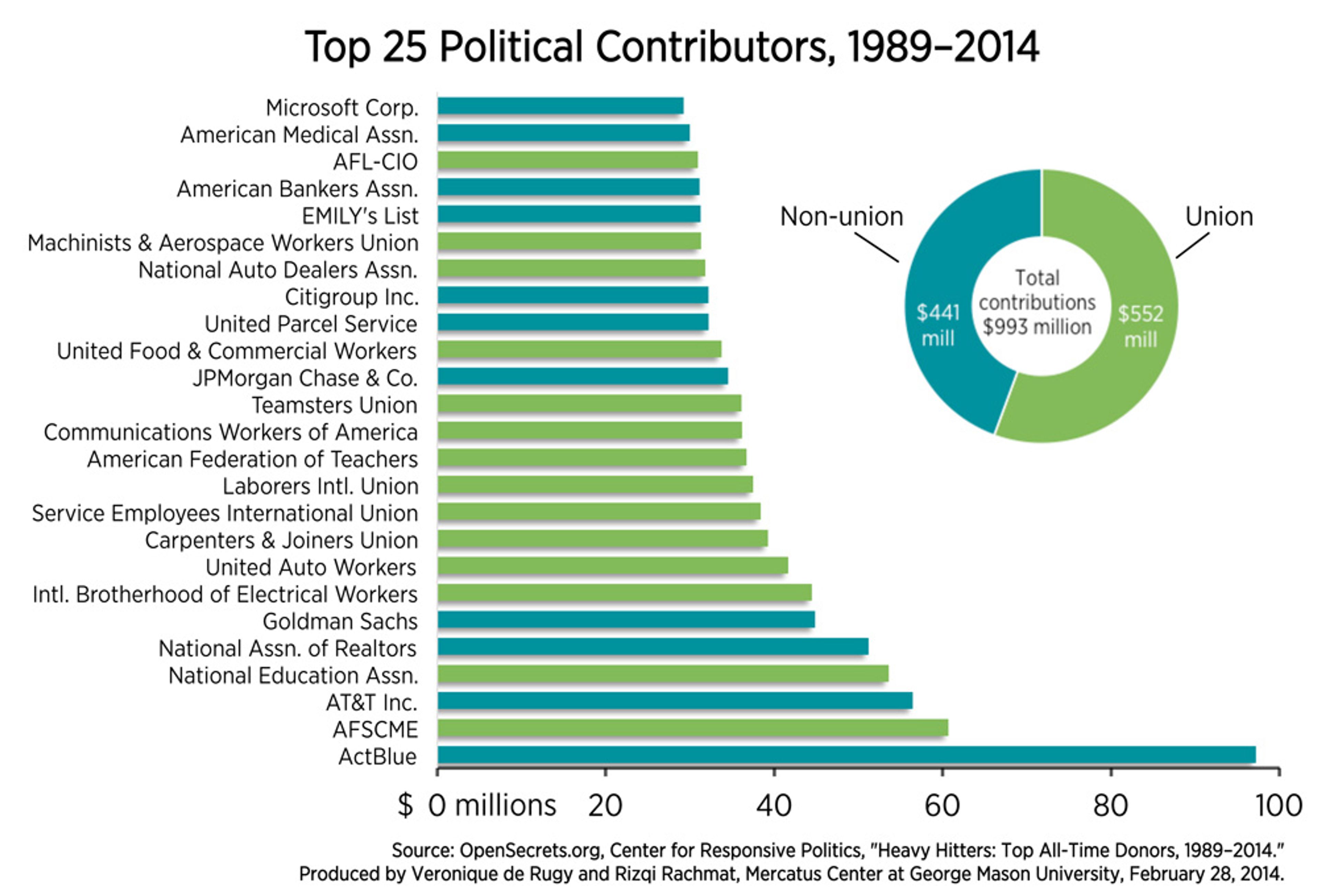
The whole thing is here.






Comments