
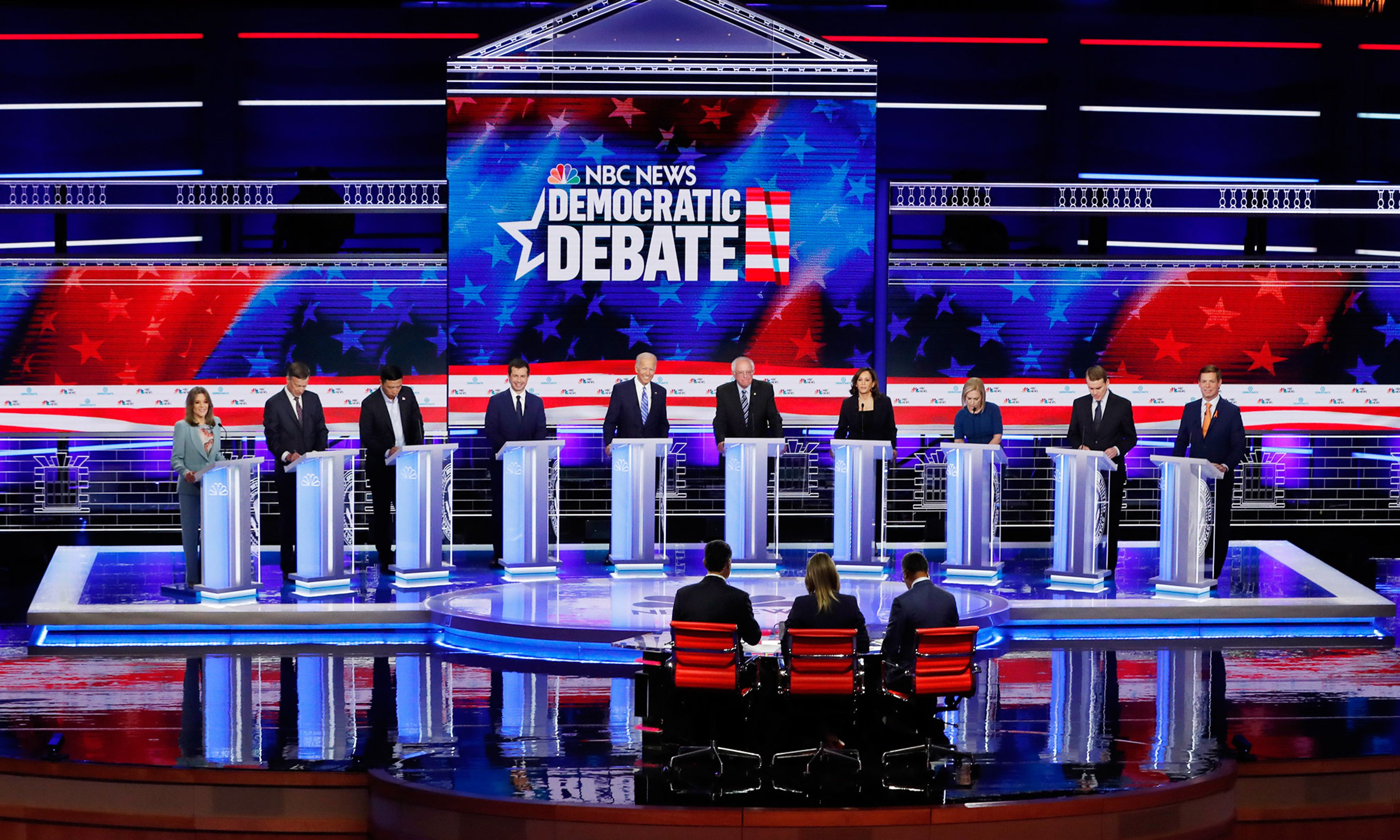
Over in Rolling Stone, Matt Taibbi offers a dark (and sometimes darkly funny) assessment of the Democratic field campaigning in Iowa, concluding, “they’re gonna blow this again.”
Four years ago, the rank inadequacy of the Lindsey Grahams and Scott Walkers and Jeb Bushes who tumbled into the pastures of Iowa made great sport for snickering campaign journalists, myself included. We dubbed the field of governors, senators, and congressgoons who couldn’t beat a game-show host the “Clown Car,” and laughed at what many of us thought was the long-overdue collapse of the Republican Party. The joke turned out to be on us.
Nobody will want to hear this, but Democrats are repeating the error. The sense of déjà vu is palpable. It might and should still work out, according to the polls. But a double catastrophe seems a lot less impossible than it did even a year ago.
Huge fields of candidates are bad for the parties, bad for the quality of the debate within that party, and probably bad for the country as a whole. The Republican National Committee should keep this in mind as 2024 approaches.
It’s bad enough that a typical group of Republicans or a typical group of Democrats will rarely have glaring differences on policy. It’s even worse when candidates have barely distinguishable resumes. (“This is the other-other senator, not the other-other former mayor.”)
You can look at quite a few asterisk-level candidates in this Democratic field and see an effort to force today’s Democratic party to have a debate about how they want to address a particular issue. Tulsi Gabbard wants to tear down whatever’s left of the bipartisan foreign policy consensus, and contends that we might as well work with the likes of Bashir Assad to stabilize Syria and accept that even dictators who commit war crimes are better for our interests than promoting democratic systems that could empower Islamists. That is a big controversial challenge to the established principles of U.S. foreign policy.
On the opposite side, Joe Sestak wants America to wake up to the threat of “an illiberal world order led by China and Russia” and to restock America’s toolbox for dealing with potential foreign policy crises.
Tim Ryan wants to force the Democrats to take a good, hard look at the towns and small cities where the mill, factory, or mine has closed and people feel left behind and figure out how to get technological innovations work for them instead of against them.
As loopy as Marianne Williamson can sometimes sound, you could probably find a broad spectrum of Americans who feel like economic abundance isn’t helping a spiritual sickness that grips America. Andrew Yang’s got about a million new policy ideas, some intriguing, some awful. John Delaney wants to enact mandatory national service for all 18-year-olds. (I think this is a terrible idea, but a candidate proposing a requirement that Americans give back to their country does break up the mentality of this primary debate turning into an auction to see which candidate can offer the most “free” goodies to voters.)
But none of their ideas or proposals will get much attention in a 25-candidate field. Heck, once-big-names like Cory Booker and Julian Castro are gasping for attention in a field this size.
In an absence of time and attention to get into policy debates, the focus on identity politics grows even stronger. The one legitimate breakout candidate of this cycle, Pete Buttigieg, probably did so in part because of how succinctly his unique points could be summarized: “young gay veteran mayor.” (And maybe “golden boy of the modern elite meritocracy.”)
Taibbi also shares an observation that most campaigns don’t want to hear, and don’t even want to seriously think about for too long:
For a lot of Americans, speeches never catch up with reality. Legislation designed to prevent pollution, contractor corruption, sexual assault, predatory lending, and countless other abuses may earn approving headlines — but create few results on the ground. This gap between reality and political proclamation is what opened the door for Trump in 2016.
A great and difficult question for any candidate tonight: Why should voters believe you can deliver on your promises?






Comments