
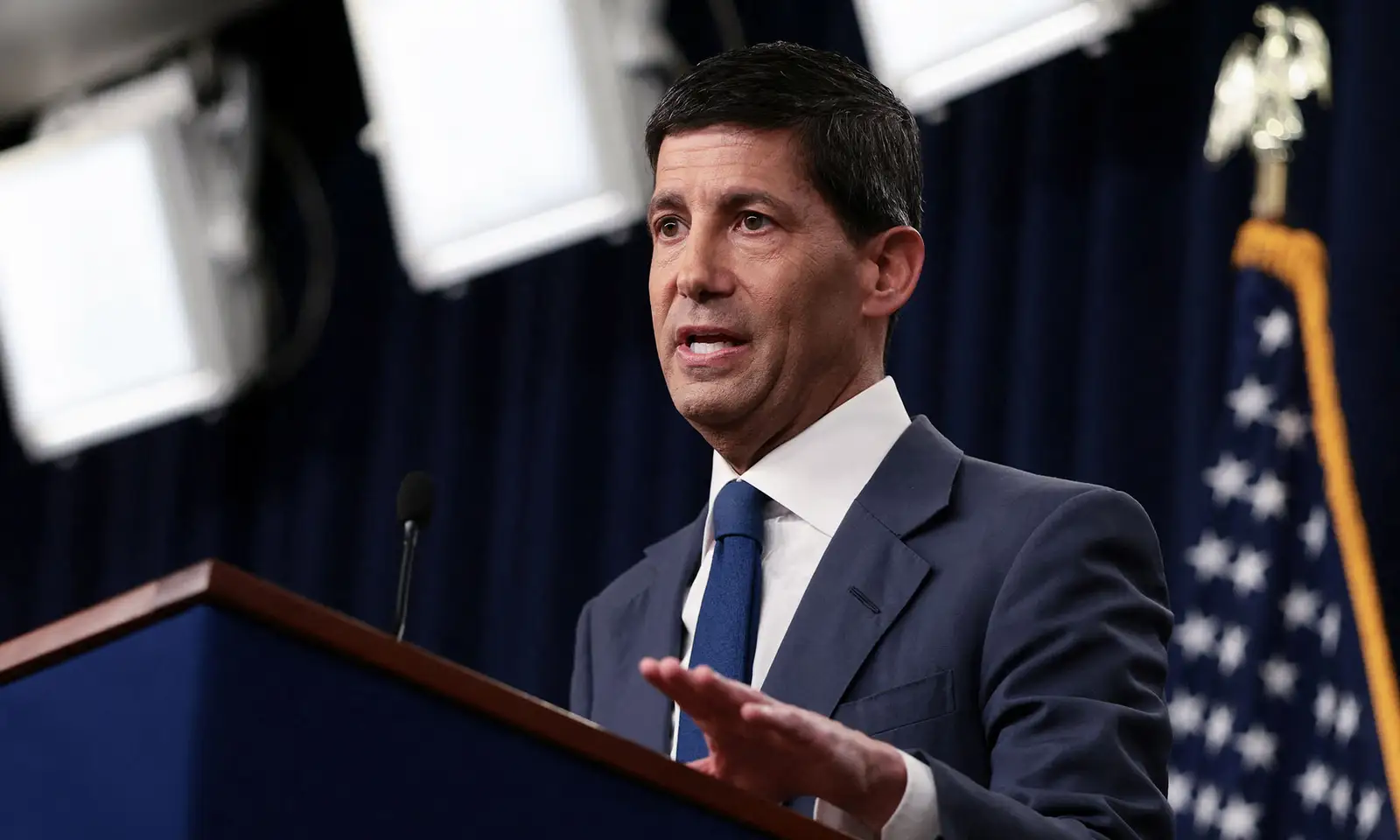
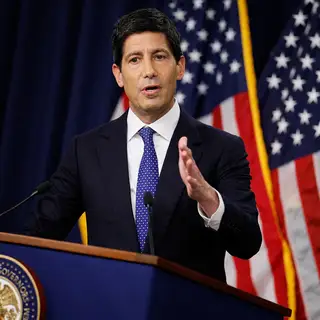
The words of Federal Reserve Chair Kevin Warsh are consistently more impressive than his actions on monetary policy. But during his speech in Jackson Hole, Wyo., this morning, Warsh gave some of his best words yet — particularly because they pointed in bright, neon colors to an obvious action.
First, Warsh recommitted (again) to a nonnegotiable 2 percent inflation target: “The Fed’s price-stability objective of 2 percent, as measured by the personal consumption expenditures (PCE) price index, is a firm, fixed target.” Even better, he made clear where responsibility for meeting this target lies: “Price stability is not self-executing, nor is inflation necessarily mean-reverting. It is the Fed’s job to deliver stable prices.”
Warsh then acknowledged the second part of the Fed’s dual mandate, “maximum employment.” However, he said, “achieving both sides of our mandate over the medium term is not an either/or proposition. I do not believe that the Fed’s dual mandate works at cross-purposes. After all, high inflation itself is very harmful to economic prosperity.”
What does the Fed have at its disposal? “Short-term interest rates are the predominant tool to achieve the dual mandate.”
And, in a moment that would make Milton Friedman proud:
Money matters. It’s not fashionable these days, but my view is that money has something important to do with monetary policy. We should pay attention to money created by the central bank and money that comes from the banking and financial systems. It’s true that financial innovations and other factors alter the mechanics that link the monetary base, the velocity of money, and the broader economy. But that is scarcely a reason to ignore the ultimate effects of money on financial conditions and prices.
So, how is the Federal Reserve doing nowadays? On the economic growth and employment side of things, Warsh sees a thoroughly positive picture:
I am impressed by the overall performance of the economy, which appears to have strengthened. One indicator of strength is how well an economy holds up to shocks. On that score, both Main Street and Wall Street have been remarkably resilient.
Business capital expenditures are “rising rapidly.” Profits for the largest companies “have grown by more than 20 percent over the past year.” Stock market volatility is “low.” Earnings expectations are “running quite high.” Credit spreads are “near the low ends of their historical ranges, and issuance volumes in these markets have been quite strong this year.” Most important for the Fed’s rate policy: “Credit and loan markets are showing few signs of policy restraint” (emphasis added).
Consumer spending is “healthy despite the shocks.” Labor markets are “quite stable,” and the unemployment rate “remains low by historical standards.” Lackluster job growth is due mostly to a labor supply that’s “barely growing.”
Inflation, meanwhile, is a different story:
On the price-stability side of our mandate, the numbers are more concerning. The Fed’s preferred measure of inflation, the 12-month change in the PCE price index, stands at 3.7 percent, while the six-month change is 4.1 percent. The comparable measures from the consumer price index (CPI) are also elevated, as are the core measures of both PCE and CPI inflation. None of these measures are perfect, but they all tell a similar story: Inflation is running above our 2 percent target. So the Fed’s predominant focus right now should be on prices. [Emphasis added.]
What about forward-looking trends rather than merely past data? “Progress over the past two years has been modest. While this summer’s PCE and CPI readings were better than expected, they do not tell me that underlying trends have meaningfully improved.”
For those who claim that current inflation is all the fault of transitory energy costs:
To try to gauge underlying inflation, I find it instructive to disaggregate the 199 individual components of the PCE price measure. Over the past 12 months, 54 percent of goods and services in the PCE basket showed price increases above 3 percent. This is well below the post-pandemic highs of about 77 percent, but it remains well above the level of 32 percent in the two decades that preceded the pandemic.
Looking over just the past six months, the conclusion is similar: Of goods and services in the PCE basket, 49 percent showed annualized price increases above 3 percent. Again, this is well below the post-pandemic highs but still quite elevated. [Emphasis added.]
Finally, how’s this for a policy signal at the speech’s end: “The responsibility for 65 months of sustained, elevated inflation sits squarely with the central bank. And that is where it belongs.”
If Warsh’s speech is not a case for the Fed to gradually raise interest rates once again until inflation subsides, I don’t know what is. He did everything but say the conclusion out loud. (For whatever it’s worth, traders on the prediction markets agree.)
As for whether Warsh will back these words up with action, the September meeting awaits.


Comments
On “Kevin Warsh Makes the Case for Rate Hikes”