
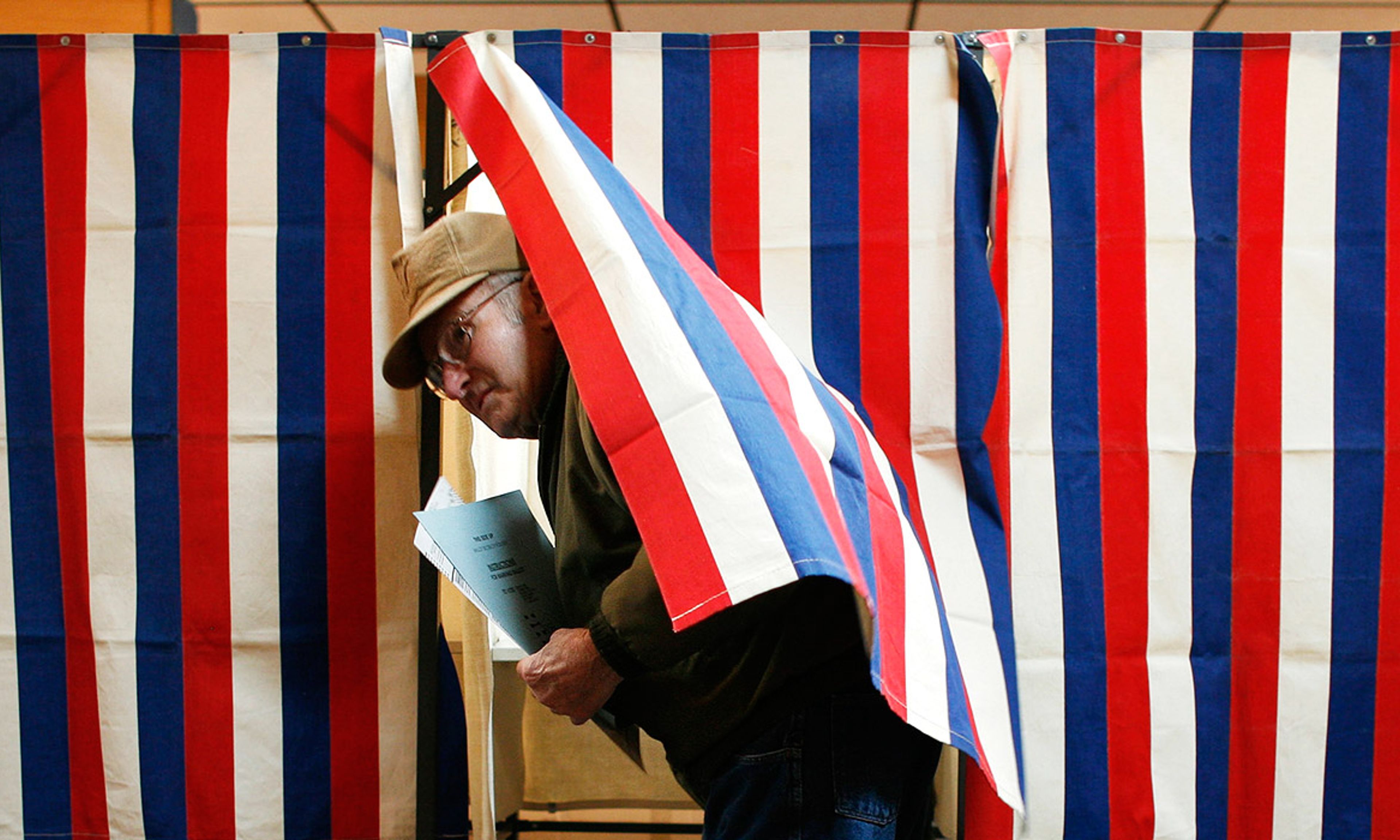
There is a steady dribble of articles and statements that claim that voter-ID laws are racist. I have been writing about this issue for a long time (because it’s been around for a long time). In 2006, I wrote a piece called “‘Poll Tax!’ They Cry.” That is the go-to move of the Democratic party: You try to introduce a voter-ID law, and they say “poll tax.”
I had a thought the other day, as I was reading about the racism, or alleged racism, of people who advocate voter-ID laws. I’m sure that some of these people are racist, or harbor some racism in their breasts. Lotta that goin’ around. So? Gun-control measures were proposed and instituted by a lot of Americans for racist reasons. That does not mean, however, that support for gun control is racist.
You see what I mean?
I believe that most advocates of voter-ID laws are motivated by good, clean civic-mindedness. And if some are motivated by racism — that does not invalidate the idea of voter ID.
• Did you see this article by Hannah Gais on the alt-Right? It has a lot of information in it. One of the things I learned was this: When these guys are talking to one another online, they use some codewords: For instance, blacks are “Alaskans.” And Jews are “Hawaiians.” (Israel is “Hawaii.”) (Hitler is “Our Friend” — of course.)
I had to smile, terrible as this is. Once upon a time, the Jewish community of Washington, D.C., had a codeword for “Jew”: “Canadian.” It was just kind of fun. “Oh, the Kleins’ daughter is engaged? Is her fiancé Canadian?”
One day, I was talking to a member of this community — an eminent, elegant woman — and mentioned the Bronfman family (of Seagram’s fame). (Seagram’s was the distiller based in Montreal.) “Oh,” she said. “They’re Canadian, right?” Then she caught herself and smiled: “I mean, Canadian Canadian.”
• I am not much of a boycotter. And I hear that Cathay Pacific is one of the best airlines in the world — a privilege to fly on. But I burned when I read this article, and thought, “Boycott.” The headline and subheading give you the essential story (as they should): “‘Big Brother’ in the Sky: Cathay Pacific Workers Feel China’s Pressure: Calling it ‘the white terror,’ employees describe a culture of fear as managers fire some who have made social media posts supporting Hong Kong’s protests.”
Actually, those are two subheadings — and, again, very informative.
• Earlier this week, President Trump said, “I think I’m going to get a Nobel prize for a lot of things,” adding, “if they gave it out fairly, which they don’t.” He then mentioned Barack Obama, who received a Nobel, a fact that clearly burns Trump — and not only Trump.
What should Trump win a Nobel Peace Prize for? I can’t think of anything — but if he got North Korea to denuclearize, he should receive the Nobel Peace Prize every day for the rest of his life. They should set up a special factory, somewhere in Norway, just producing the gold medal, on an assembly line.
I would say more, but I’ll leave the subject to the experts on the prize, who are always popping off, with great confidence. (Sorry, being a bit of a jerk here. In 2012, I published a history of the Nobel Peace Prize, entitled “Peace, They Say.” The longest chapter is on Obama.)
• Guess which EU government is upgrading its relations with the Syrian dictatorship? I’ll give you a harder one next time. It’s Orbán’s Hungary, of course. (News article here.)
• This, I regarded as really good news: “The Trump administration is more than tripling U.S. support for pro-democracy work in Venezuela.” (Article here.) But here comes less good news, I’m afraid: “The funding was mostly repurposed from aid originally earmarked for Honduras and Guatemala that President Donald Trump cut last year after accusing the Central American countries of failing to stem the flow of migrants to the U.S.”
Will less U.S aid mean greater Honduran and Guatemalan effectiveness in dealing with these problems? People who know a lot more than I are skeptical.
• Trump may give other countries a pass — Egypt, Russia, Turkey, North Korea, etc. — but he has knocked Cuba and Venezuela for their tyranny, which is gratifying. One person gratified is Rosa María Payá, the Cuban democracy leader who is the daughter of another one, the late, great Oswaldo Payá. After Trump’s U.N. speech, she tweeted, “We appreciate @POTUS’s courage by unmasking the corrupt dictatorship in #Cuba and its leading role in the Venezuelan crisis. Thank you for your support to our people who live under oppression . . .”
Praise from Rosa María is high praise indeed.
• Also gratifying is this, from Mike Pompeo, the secretary of state: “Sobering discussion with survivors of #China’s reeducation camps in Xinjiang. China’s brutal campaign of repression against Uighurs & other Muslim minorities is appalling & the international community must demand an end to this blatant assault on #ReligiousFreedom & #HumanRights.”
Any attention paid is helpful — and attention paid by the U.S. State Department is very helpful indeed.
• Something a little lighter? Eli Lake has written a column — a typically excellent one — saying, in part, that Trump is his own worst enemy. (Go here.) I can’t hear that phrase — “own worst enemy” — without thinking of Rudolf Bing and George Szell. Bing was the longtime, imperious general manager of the Metropolitan Opera; Szell was one of the greatest conductors in the world — and no threat to St. Francis’s reputation for kindness and gentleness.
The story goes like this: Szell had had a rocky stay at the Met, and when he left — on very rancorous terms — someone remarked to Bing, “That George Szell: He’s his own worst enemy.” Bing replied, “Not while I’m alive.”
• As we’re talking about music – care for a review? Here is a review of a New York Philharmonic concert — which began with a new piece by Philip Glass, continued with Knoxville: Summer of 1915 (the Barber work for soprano and orchestra), and ended with Romeo and Juliet excerpts (from the Prokofiev ballet).
Guess who sang Knoxville? A Broadway star, Kelli O’Hara. Not bad.





Comments