
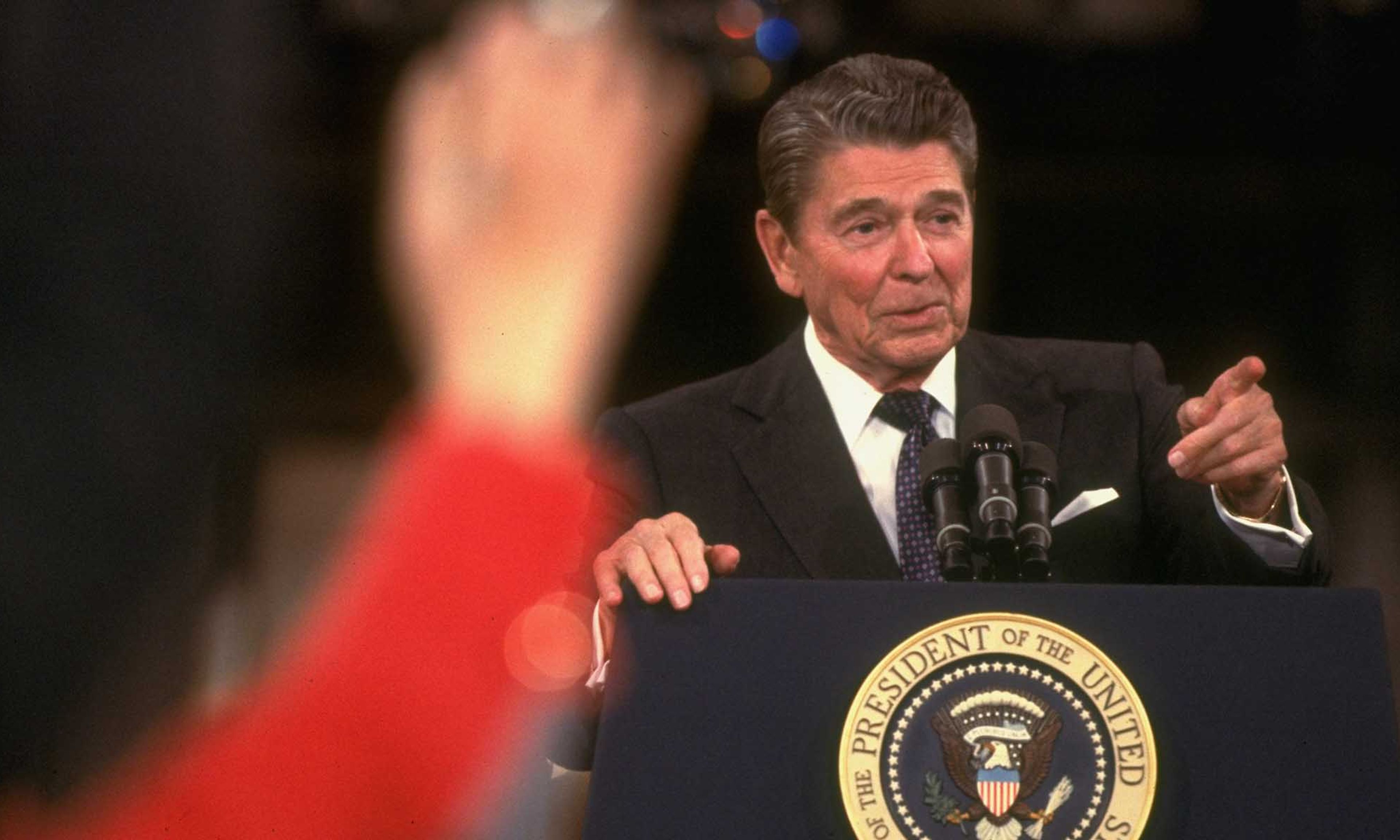
In recent days, I have been thinking about Ronald Reagan. That’s what “zombie Reaganites” do, right? I have been thinking about him for a couple of reasons. One of them is this: A columnist on the right made a sneering remark about “Reaganite bromides.” One man’s bromides, I suppose, are another man’s principles and values, enduring. Also, I have been reminded of Reagan’s efforts in behalf of political prisoners and dissidents in the Soviet Union.
On the homepage today, I have a piece called “Russian Honor, Exemplified.” It is about Vladimir Kara-Murza, Father Georgy Edelstein, and others. Kara-Murza has been a political prisoner of the Kremlin since April 2022. Before he was arrested, he made a documentary about Father Georgy: a priest who took brave stands during Soviet days and who takes them now.
Earlier this month, Kara-Murza’s film was shown at — gulp — the Reagan Institute. Specifically, at its Center for Freedom and Democracy. (Do those words give you the heebie-jeebies?) The showing of the film, and related discussion, was co-sponsored by the Reagan Institute and — more gulping — the National Endowment for Democracy, which was founded at Reagan’s instigation.
The Edelsteins are an interesting family. The eldest son of Father Georgy and his wife, Anita, is Yuli Edelstein, who is a prominent Israeli politician. He has been a cabinet minister three times and from 2013 to 2020 was speaker of the Knesset. In the Soviet Union, he was a refusenik, imprisoned for three years. Imprisoned brutally.
In November 1987, Reagan met with him and other Jewish leaders and activists in the White House. Many years later, in 2016, George Shultz, the former secretary of state, reminisced about all this. Speaking at the Israel Democracy Institute — oops, there’s that word again, “democracy” — he recalled a meeting with Anatoly Dobrynin, the Soviet ambassador to the U.S.
“Just the three of us were there,” said Shultz: Reagan, Shultz, and Dobrynin. “We were there for over an hour and a half, and at least half of it was spent by President Reagan talking about Soviet Jewry. He knew names, he knew incidents, he was well-informed, he cared deeply, and he gave the Soviet ambassador that message, and we carried that through.”
Many refuseniks were released.
In 1988, Father Georgy, Yuli’s father, met Reagan. The president had traveled to Moscow, and he spoke to a group of dissidents at Spaso House, the home of the U.S. ambassador. Said Reagan,
I thought it might be appropriate for me to begin by letting you know why I so wanted this meeting to take place. You see, I wanted to convey to you that you have the prayers and support of the American people, indeed of people throughout the world. I wanted to convey this support to you that you might in turn convey it to others, so that all those working for human rights throughout this vast land — from the Urals to Kamchatka, from the Laptev Sea to the Caspian — might be encouraged and take heart.
Reagan also spoke to students at Moscow State University. I watched it on television. Yesterday, 35 years later, I read the speech (here). Extraordinary document (yet also typical of that president).
Here is a sample:
. . . progress is not foreordained. The key is freedom — freedom of thought, freedom of information, freedom of communication.
A longer sample:
. . . entrepreneurs and their small enterprises are responsible for almost all the economic growth in the United States. They are the prime movers of the technological revolution. In fact, one of the largest personal computer firms in the United States was started by two college students, no older than you, in the garage behind their home.
Some people, even in my own country, look at the riot of experiment that is the free market and see only waste. What of all the entrepreneurs who fail? Well, many do, particularly the successful ones. Often several times. And if you ask them the secret of their success, they’ll tell you it’s all that they learned in their struggles along the way. Yes, it’s what they learned from failing. . . .
And that’s why it’s so hard for government planners, no matter how sophisticated, to ever substitute for millions of individuals working night and day to make their dreams come true.
More:
Freedom is the right to question and change the established way of doing things. It is the continuing revolution of the marketplace. It is the understanding that allows us to recognize shortcomings and seek solutions. It is the right to put forth an idea, scoffed at by the experts, and watch it catch fire among the people. It is the right to dream — to follow your dream or stick to your conscience, even if you’re the only one in a sea of doubters.
Freedom is the recognition that no single person, no single authority or government, has a monopoly on the truth, but that every individual life is infinitely precious, that every one of us put on this earth has been put here for a reason and has something to offer.
Maybe just a little more:
Freedom, it has been said, makes people selfish and materialistic, but Americans are one of the most religious peoples on earth. And because they know that liberty, just as life itself, is not earned but a gift from God, they seek to share that gift with the world.
Donald Trump is a different kind of Republican, of course, and was a different kind of president. His first trip abroad as president was to Saudi Arabia, where he said this, on landing: “We are not here to lecture. We are not here to tell other people how to live, what to do, who to be, or how to worship.”
That is music to dictators’ ears. Because, as they see it, it’s their job to tell other people how to live, what to do, who to be, and how to worship. Dictators specialize in this. But who will stand with their victims? Who will give voice to the voiceless?
Squishy stuff, I know.
Last month, I traveled to California, to visit an extraordinary site: the Liberty Sculpture Park, which is the project of Weiming Chen, a Chinese exile. (For my piece, go here.) I asked him whether he had heroes in life. “Reagan,” he said. And then, of course, all the outstanding democratic heroes in China — for instance, Liu Xiaobo, the Nobel peace laureate and political prisoner (now dead).
John Dos Passos, the great writer and a contributor to National Review, published a collection under the title “The Theme Is Freedom.” Good theme, ever and always.
Thus endeth my “Reagan nostalgia,” for now . . .






Comments