
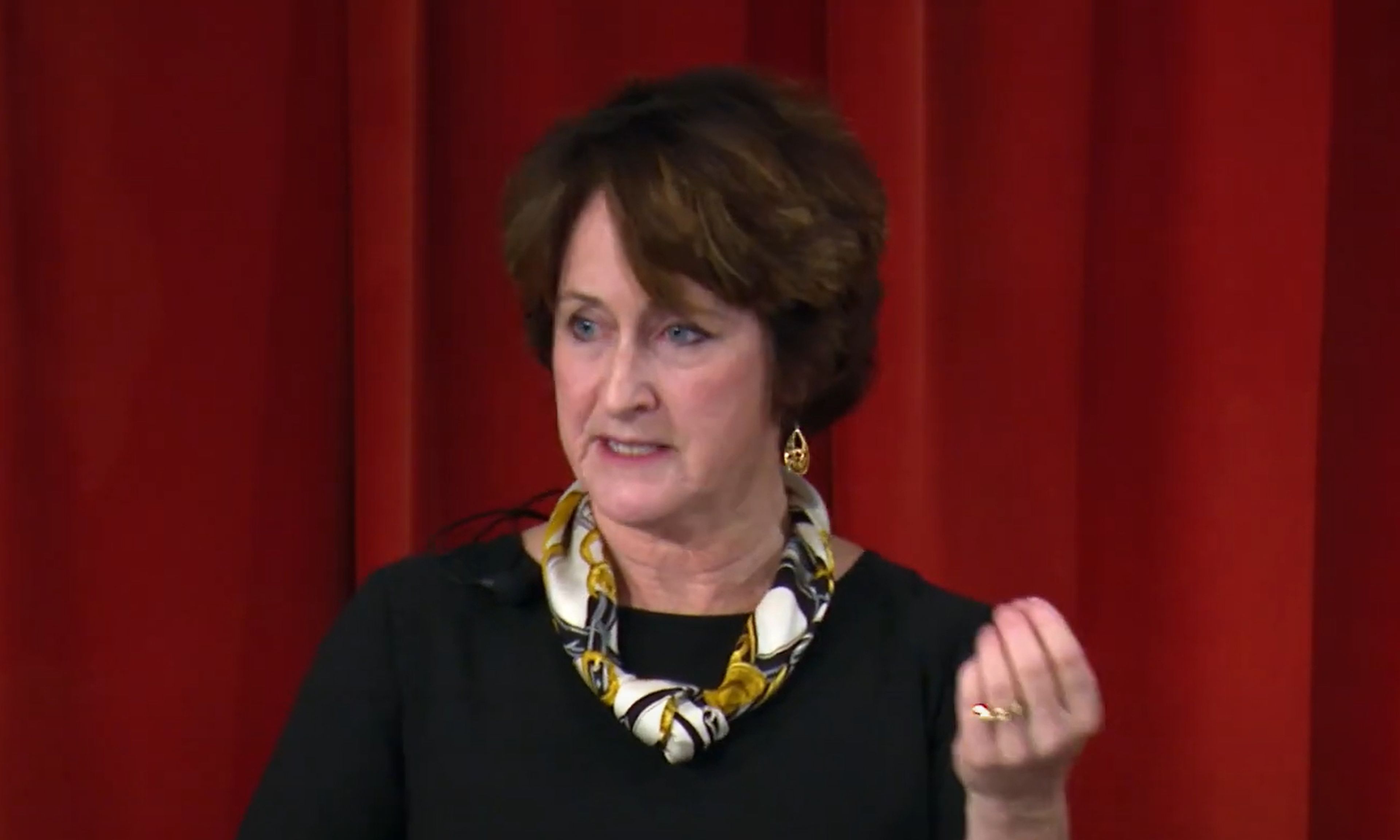
This month marks a decade of Mary Rice Hasson’s work at the Ethics and Public Policy Center (which, by the way, I have always thought is the coolest think-tank name, which tells you a little about my coolness). If you don’t know Mary, she is one-half of a powerhouse couple. Her husband, Seamus “Kevin” Hasson is the founder of the Becket Fund for Religious Liberty. They’ve raised kids and a religious-liberty movement. And as Seamus is in retirement — one forced by Parkinson’s — Mary is still the loving wife and mother that she has always been, but also that kind of motherly force we need in the public square. She is a great encourager and connecter, especially for Catholic women intellectuals. And she stands athwart the evil of gender ideology not only yelling Stop!, but imploring the protection of children from abuse. She has confidence that the teachings of the Catholic faith — in no small part on how sexual morality offers freedom and joy to men, women, and families.
Here at National Review and the National Review Institute, we have a very personal interest in Mary’s work — she’s the Kate O’Beirne Senior Fellow at the Ethics and Public Policy Center, doing her work in honor of my dear friend and mentor and our former longtime Washington Editor at NR (and president of the National Review Institute in another of its iterations). I miss Kate every day (I know I am not alone in this), and it gives me some consolation that Kate loved Mary and would love her continuing perseverance for the good.
Mary and Seamus were honored by the Catholic Information Center in 2015, and Mary talked at the time about how women can change a culture. And, in the spirit of Kate O’Beirne’s Women Who Made the World Worse (which also had a lot of gratitude in it), about the damage liberal feminism has done to the culture and the family, Mary said:
We Catholic women have a secret weapon: we don’t have to be like feminists pretending we’re doing it all by ourselves. We embrace complementarity. We value — and count on — the collaboration of men and women. And that is a secret weapon, because we need the voices and the talents of both men and women in order to make a difference in the culture. Women must be brought to the foreground — but not just for strategic reasons, that is, because women are half the population or because we need women speaking to women or because women can shape the most effective messaging for women.
Women must be front and center in evangelizing the culture because, as a Church, we must live that truth of complementarity. We believe that there’s something of value created when men and women work together, and we know that the Church needs us — men and women — to witness to the love of God in a powerful way, together. And the world needs that witness from us as much, if not more, than it needs the actual work that we do.
John Paul II wrote of women’s specific sensitivity towards the human person. That sensitivity, that focus on relationships, is one reason why women are particularly called to shape the culture. Relationships are so central to the “culture of encounter” that Pope Francis calls us to create. And it’s within the culture of encounter that evangelism will flourish.
If you’re feeling a little overwhelmed, consider Mary Hasson as encouragement. Women can have lots on their plate — even the suffering of a painful disease in the family — and still fight for truth and virtue, most importantly in how they live their daily lives. Policy matters, but good policy starts in looking at Truth in the everyday.
Thanks be to God for good people like the Hassons in the world — and even in the public square.





Comments