
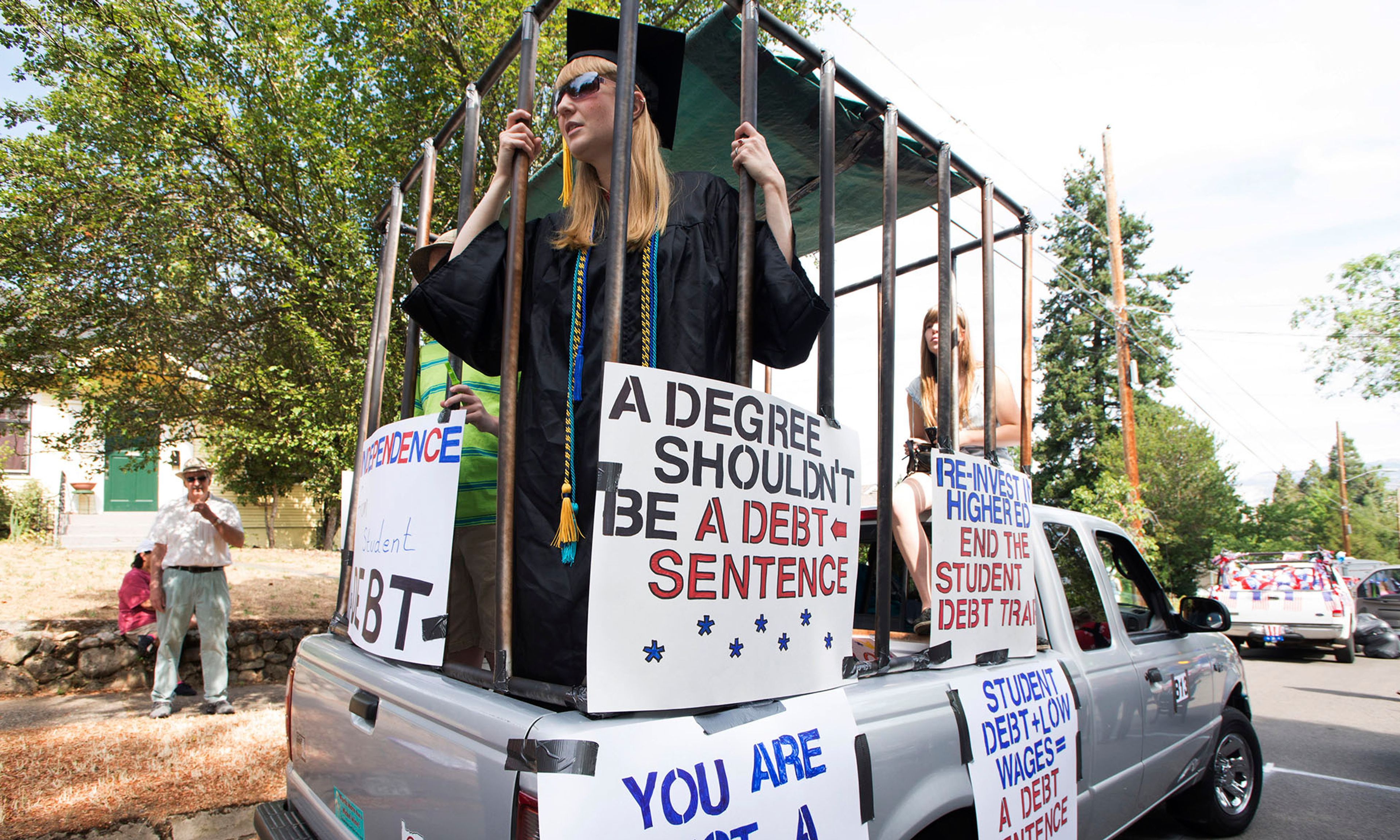
M. H. Miller, an editor at the New York Times, has published a sharp and affecting op-ed on his experience as a young, debt-burdened college graduate in the post-crisis era. Though covering some of the same ground as his earlier essay for The Baffler, which offers a more detailed account of how he and his family were pummeled by job losses (both of his parents were laid off in quick succession in late 2008), the foreclosure of his childhood home (which soon followed), and graduating with a mountain of student-loan debt at a time when remunerative entry-level employment opportunities for aspiring writers were even scarcer than usual, he offers his own experience as emblematic of his generation’s. And in his anger and sense of betrayal, he is indeed capturing the sentiments of millions of younger Americans who feel as though they’ve lost ground they’ll never fully recover.
My question, though, is about what comes next. To Miller’s credit, he doesn’t end either piece with a glib, op-ed ready “fix” for the problems he identifies. Others, though, will surely offer fixes of their own. In that admittedly pat spirit, I’d like to offer a few tentative thoughts.
First, there is no gainsaying Miller’s talent as a writer, and it would be hard-hearted to discount the gravity of what he and his family have gone through. He is impressively self-aware, suggesting at times that the source of his woes, and those of many others in his cohort, were the perhaps unrealizable expectations of his parents, for whom he clearly has great affection and respect. “Like many well-meaning but misguided baby boomers, neither of my parents received an elite education but they nevertheless believed that an expensive school was not a materialistic waste of money,” writes Miller in The Baffler. “They continued to put faith in this falsehood even after a previously unimaginable financial loss, and so we continued spending money that we didn’t have—money that banks kept giving to us.” As you read Miller’s essay, you might find yourself frustrated by some of the choices he and his parents made. But they’ll never lose your sympathy.
How might this family’s story have turned out differently? Remember that Miller’s experience reflects the compounding effect of successive reversals, and they’re hardly alone in that regard. Because I can’t claim to understand the circumstances of the Miller family, I’ll just note that entering the workforce in a recession has a scarring effect, as does having a parent who loses a job, a home, or both. In other words, this is about much more than student-loan debt.
So is the answer to the woes of families like this one forgiving student-loan debt, or a more permissive approach to student lending in general? I’m skeptical. In Game of Loans, Beth Akers and Matthew Chingos offer a measured perspective on student-loan debt, which Chingos summarized in recent congressional testimony. In short, the burden of student-loan debt on graduates of selective colleges and universities like Miller is less of an issue than the completion crisis (the fact that so few students who enroll in higher education complete degrees, let alone valuable degrees), a closely related default crisis (there’s a large number of young people who default on their student-loan debt, but they tend to have small amounts of debt, as they’re far less likely to have actually graduated), a repayment crisis (tied to the fact that we don’t have simple, reliable access to income-based repayment for student loans), an information crisis (most families don’t really know what they’re getting into, mostly because colleges and universities have successfully resisted disclosure requirements that would give students and parents a better sense of a given institution’s track record of guiding students to completion and of helping them secure remunerative employment), and a cost crisis (as the cost of loan-forgiveness programs balloons). Modest reforms could go a long way towards addressing these interrelated crises. However, no higher-education reform, up to and including, say, two tuition-free years at a community college or four-year public university (or my preferred approach, boosting the quality and lowering the cost of public higher education), is going to shield young people from the effects of having their families go through a steep drop in income at the same time the labor market has been ravaged by a Great Recession.
One could look to other obstacles to families looking to recover from a serious economic setback. Miller’s parents, for example, moved from southeastern Michigan to New York City, where finding affordable accommodation is notably difficult. As David Schleicher has argued in Democracy Journal, we ought to make it easier for people to move from struggling regions to buoyant ones by, for one, relaxing land-use restrictions in high-cost metros, thus lowering rents. Going further back, one wonders if the widespread adoption of shared-responsibility mortgages, which have been enthusiastically promoted by the economists Amir Sufi and Atif Mian, authors of House of Debt, might have forestalled the wave of foreclosures that hit communities across the country.
But I suspect the best policy to address stories like Miller’s is also the most banal: As Ramesh Ponnuru has argued on numerous occasions, most recently and comprehensively in his recent piece on “Rethinking the Recession,” what we really needed was better monetary policy — one that would not have “converted a housing correction into a housing crash, financial stress into a financial crisis, and a mild downturn into the worst recession we have had since the 1930s.” And by extension, this “market monetarist” approach might have prevented, or at least greatly mitigated, the crisis of faith in market democracy we’re living through today.





Comments