Jeepers:
Jonah,
Just finished your book, and I don’t even have the correct words of praise suitable enough for either an e-mail or a formal letter. It’s intellectual, scholarly, learned, and it’s so thorough that I agree with the other e-mail writer that scholars are going to have to make a choice: try to ignore your work while simultaneously picking up your extremely well-developed themes (thus begging the question of “where’d I see that before”…to their readers) or give you the requisite credit that you deserve.
But, one thing that I’ve not seen mentioned yet, and for (I believe) you deserve immense credit, is your whole revision (about time) of the entire notion of Arthur Schlesinger’s false construct and book of the same name “The Cycles of American History.”
How’d you do it? I’ll try to explain.
For decades, Arthur Schlesinger, Jr (RIP), along with most of the American historical profession (implicitly, as well as sometimes explicitly) made sure we Americans imbibed the idea that all of American history was accompanied by periods of, for lack of better terms, “Progress” and “Reaction.” Thus, there were periods in American history when we had, so he and most other US historians informed us, “weak” Presidents (Taft, Harding, Coolidge, and Eisenhower, even in his “Modern Republicanism”) along with “strong” Presidents ( Wilson, FDR, Truman – in certain areas -, JFK & LBJ). (Actually, Truman himself tried a variant of this, running against the mis-named “Do-Nothing” Republican-controlled Congress of 1948. They did plenty, just not the top-down, economic nationalization kind of stuff that he wanted, and made sure that unions, rightfully, were partially brought to heel, among many other things).
But, in case a reader needed elucidation, the always helpful Schlesinger and his legions of historians recited, the (always “landmark” and “historical”) amount of legislation signed by various of these “strong” Presidents along with their (often unconstitutional) executive orders, and compared them to the relative paucity, or even non-existence, of the same with those “weak” Presidents (who had this startling revelation that signing laws does not, in and of itself, effect “progress” or needed “reform” or that, bereft of definition or beyond the bounds of the Constitution, might just be unconstitutional) named already.
Thus, governmental action by the “strong” President, in these historians’ eyes, equalled the national strength and cohesion of the United States itself. Moreover, these actions were, incredibly, presented as the actual inherited tradition of the founding principles! (Somehow, I guess. Emanations from Penumbras, perhaps?)
To add historical insult to injury, these historians then presented, ipso facto, the “idealism” of The New Freedom, The New Deal/Fair Deal, The New Frontier, and the Great Society as the authentic American eras in contrast to those NON-authentic (by implication), NON-idealistic, “conservative” interludes (the 1920s, the 1950s, the 1980s onward) interspersed in-between.
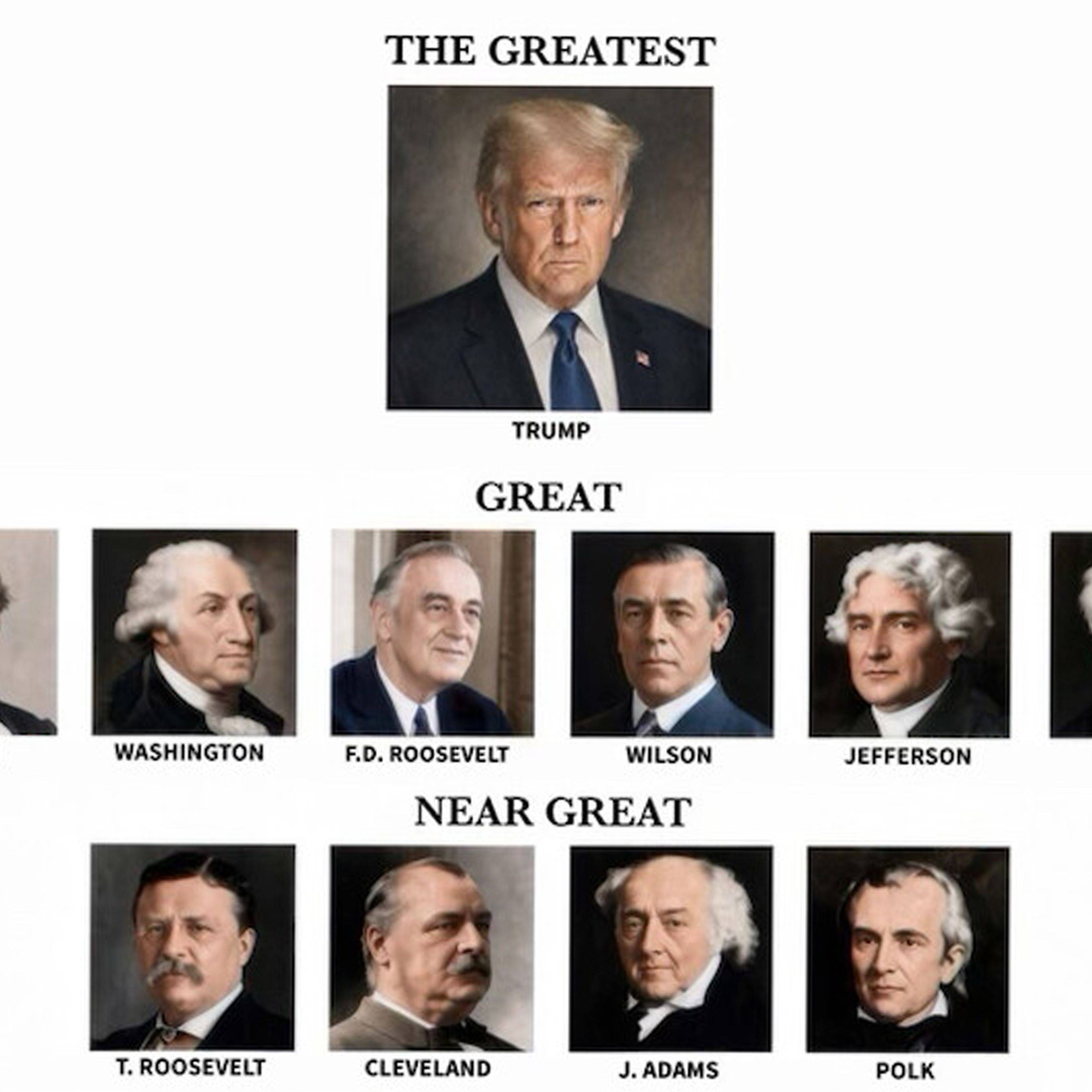
Just to make sure that Americans got the idea, the American Historical Society (I think) commissioned the first ever poll of American historians on the first-ever “ranking” of American Presidents. Of course, this happened right as the 1960 election was happening, and, wouldn’t you know it, Ike and other “conservative” Presidents were ranked far less than Wilson, FDR and even Truman, who’d had a recent “drubbing” in the Eisenhower era, and the wish of a new, “strong” President in 1960 was clearly a factor with this poll’s timing.
That poll was then updated continually throughout the years to make sure that OTHER would-be Presidents in the future would “get the idea” to make sure their policies were on the “strong” side of the ledger, if they wanted to get historical “credit.” (One person who didn’t get the hint and rejected the premise was Ronald Reagan, but we’ll return to him below).
This smugness was brought home to me in my freshman year in college in the late 1980s as my political science professor remarked to our class, without a hint of irony, that “Liberals make changes and the Conservatives come along and protect the changes that the Liberals made.”
Does anyone believe that the “change” that any of these history or political science professors hinted at/believed was inevitable was personal Social Security accounts?
With your book, then, the “Cycles of American History” can now be seen in a more, truer light.
The intellectual traditions can thus be interchanged: there were Presidents, and eras, which sought to impose top-down, late 19th/early 20th century European political ideas (Wilson, FDR, Truman, JFK-a little, and LBJ) and there were those who understood, and tried to remain faithful, largely, to the remnant of the American founding tradition and principles (Taft, Harding, Coolidge, Eisenhower-sometimes).
It is THIS historical dichotomy that, to my mind, is still in force today, and not the false narrative that the American people have been spoon-fed for at least four generations (possibly more).
Congratulations, Jonah! To me, you’ve set the “Cycles of American History” back within a far more complete and accurate framework for the first time in many, many decades. As The Gipper, who, as you note in your book and on this blog, was the one who first pointed out to the incredulous mainstream press in 1981 about the Fascist tendencies and sympathies within the New Deal, might remark on your effort to shed light on this entire intellectual history, it is a “very American thing to do.”
I apologize for any errors in this e-mail (there are probably very many), and thank you profoundly for your book.
Sincerely,





Comments