Twenty years after the invasion of Iraq, historians, foreign-policy analysts, and former U.S. officials involved in this sad story are still trying to answer fundamental questions: What on earth were we thinking? How could we allow ourselves to be driven by sensationalism, fear, hubris, and naïveté in the making of policy?
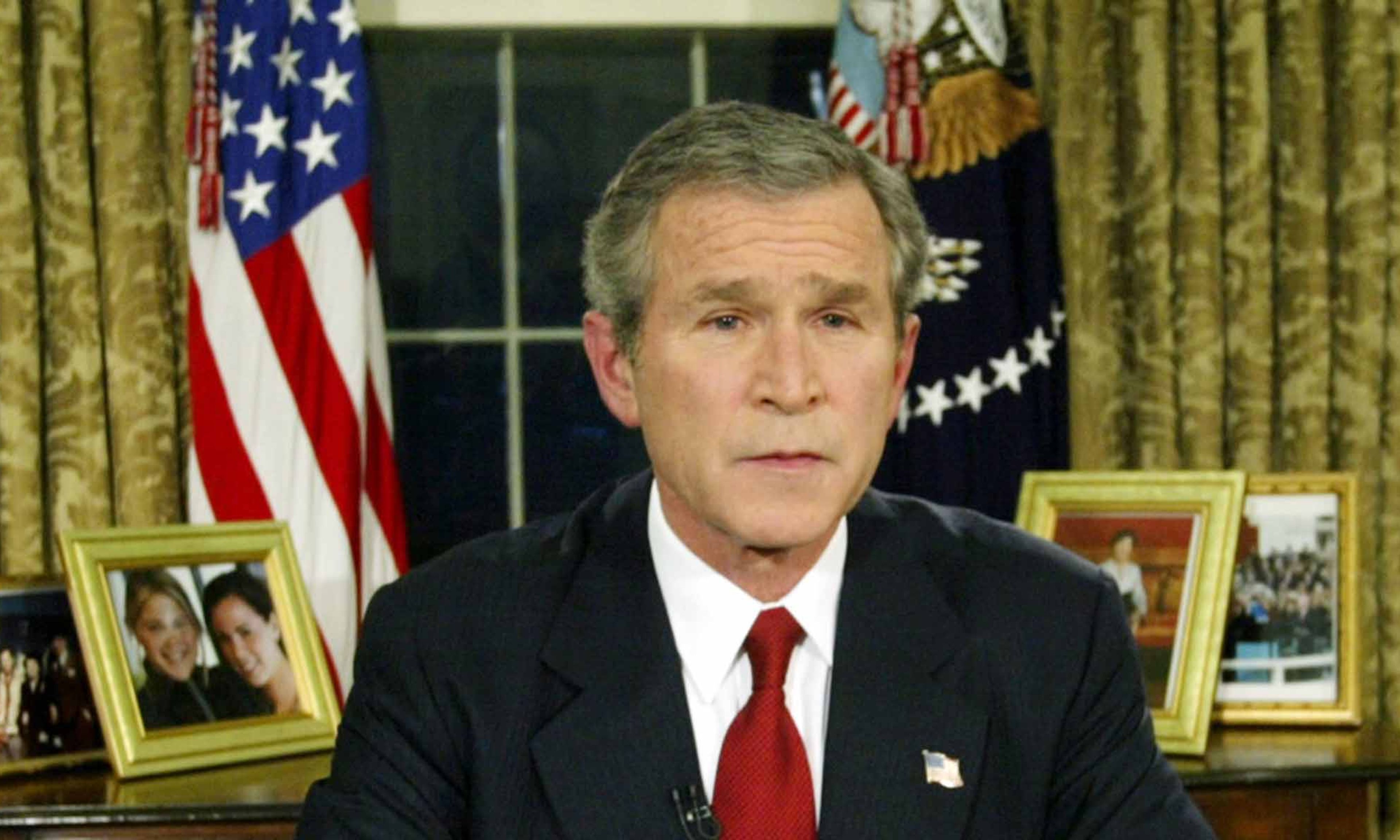
President George W. Bush addressed the nation on March 19, 2003, to declare that the operation to overthrow Saddam Hussein and liberate the Iraqi people was in motion. That speech, like so many others given by Bush and senior national-security officials at the time, was full of self-confidence about how the war would go; they were clear-headed about the mission and serious about the stakes. All of it unraveled in mere days after Saddam’s ouster from the presidential palace.
Bush’s speech on the eve of the war was the culmination of a monthslong, highly disciplined public-relations strategy to convince the American public and the international community that Saddam, a bloodthirsty dictator who terrorized his subjects and had invaded two of his neighbors (Iran and Kuwait) — all true, of course — was not only a menace to his own people but an imminent threat to U.S. interests. Condoleezza Rice, Bush’s national-security adviser, went on CNN in January 2003, two months before Operation Iraqi Freedom commenced, to report that the Iraqi dictator could be only six months away from possession of a crude nuclear device. “There will always be some uncertainty about how quickly he can acquire nuclear weapons,” Rice said, “but we don’t want the smoking gun to be a mushroom cloud.” The next month, as he was making the case for war at the U.N. Security Council, Secretary of State Colin Powell held up a vial of anthrax and dramatically argued that Saddam had as much as 25,000 liters of the toxin. The administration, terrified of another 9/11 on its watch, would go on to allege not only that Saddam and Osama bin Laden’s al-Qaeda were in cahoots, but that Saddam himself could hand over his weapons of mass destruction to terrorists.
Powered by the drumbeat of WMD claims, many opinion journalists were no less certain about the need to rid Iraq of Saddam. Although he might be deterrable, New York Times columnist Thomas Friedman wrote in January 2003, the U.S. should still muscle him out because we could be truly safe from the terrorist scourge only if democracy and hope spread over the Middle East. “Regime transformation in Iraq could make a valuable contribution to the war on terrorism, whether Saddam is ousted or enticed into exile,” Friedman wrote. In the Washington Post, the late Charles Krauthammer asserted that the U.S. no longer had a choice but to disarm and overthrow Saddam’s regime; to do anything less would ruin Bush’s credibility as a leader and “shatter the credibility of post-9/11 American resolve.”
At a time when the American people deserved a rigorous debate about whether war was indeed necessary, the mainstream media — including the Washington Post editorial board, retired U.S. generals turned cable-news commentators, and the editors of the New Republic — instead repeated what they deemed credible, irrefutable administration talking points.
Taking out Saddam meant different things to different people. For Defense Secretary Donald Rumsfeld and Vice President Dick Cheney, it was largely about reminding allies and adversaries alike that America was the unquestioned hegemon, with both the capability and the intent to project force as it saw fit. For Deputy Defense Secretary Paul Wolfowitz, it was about righting a historical wrong and doing what the elder Bush should have done during the 1991 uprisings against Saddam after the Gulf War: assist the Iraqi people militarily to free their country of a megalomaniacal ruler. For others, such as Undersecretary of Defense Doug Feith, the mission was a golden opportunity to sever the supposed link between Saddam and al-Qaeda, even though U.S. intelligence officers at the time dismissed the notion that the two were substantively connected. Saddam was the fulcrum of all these preoccupations.
But the arguments for a war of choice were misplaced, resting on faulty assumptions about Saddam’s military capability, rabid delusions about what the U.S. military could accomplish, and a poor understanding of the ethnic and sectarian ruptures that would afflict Iraqi society after the strongman was deposed. The drive to Baghdad may have been a tactical success — against the third-rate Iraqi army — but it failed to produce the United States’ long-term political objectives. Former national-security adviser Brent Scowcroft and former State Department assistant secretary (now CIA director) William Burns warned of the many horrible, counterproductive things that could happen during and after an invasion. Distraction from the war on terrorism, disorder within Iraq itself, intra-Iraqi violence that would drag the U.S. in deeper, an insurgency led by members of Saddam’s former regime, and an Iranian-sponsored revolt in Iraq’s southern regions were only some of the very real possibilities.
Ultimately, those warnings were either discarded or minimized in the planning process. Very few seemed prepared to consider the alternative argument: that Saddam didn’t pose a direct security threat to the U.S.; that his fixation with his own status and personal power meant that handing over WMD to nihilistic terrorists would be the definition of insanity; that even if he did possess WMD, they were likely intended to deter foreign aggression and ensure his regime’s survival; and that installing democracy in a country that had never had it wouldn’t be as simple as gifting Iraq to Ahmed Chalabi.
Advocates of the war in Iraq defend the misadventure to this day. But the record is clear: The regime-change campaign was the worst U.S. foreign-policy mistake since Lyndon Johnson’s Vietnam troop surge nearly four decades earlier.











Comments