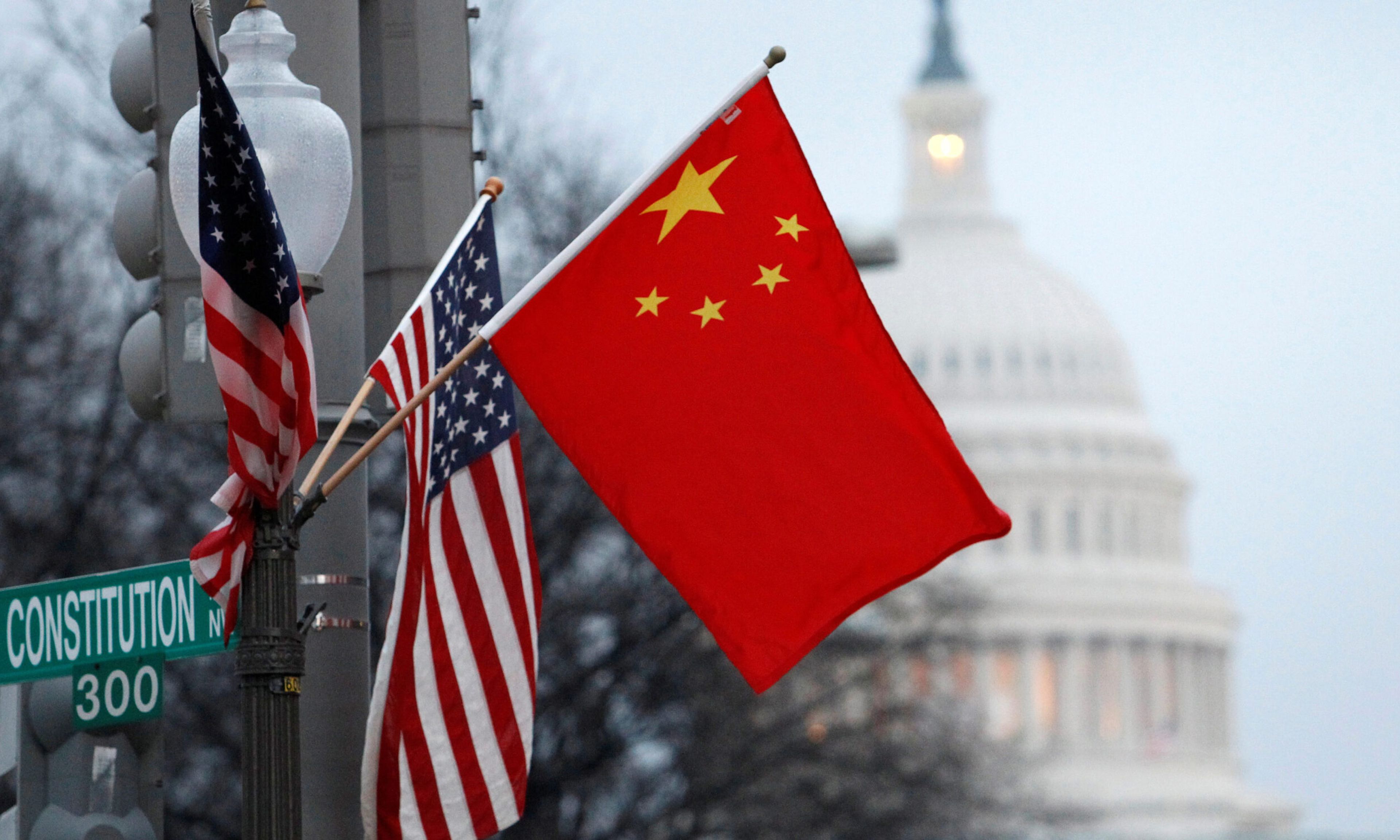
The United States faces a new cold war, this time with China, that will determine the future of our nation and of the world. This cold war will turn much more on economic competition than did the first, with Soviet Russia. While we must maintain our military advantage over the People’s Liberation Army, we also must recognize that much of China’s power results from its trade and economic influence around the world.
To prevail, the United States should pursue a policy that decouples key strategic sectors of the American and Chinese economies, to reduce our reliance on the People’s Republic of China for essential supplies and advanced technology. At the same time, we must combat the forces of economic appeasement and avoid the extreme of economic total war — both of which could spell disaster.
Economic appeasement dominated our China policy for 30 years. Leaders in Washington adopted a policy of cheap goods at any price and ignored China’s rampant lying, cheating, and stealing. American policy-makers and business groups insisted that one-sided free trade would eventually result in a liberalization of China’s communist political system.
But instead of rewarding American openness, China exploited what it saw as weakness. Through massive industrial subsidies, unprecedented intellectual-property theft, and sadistic labor practices, it gained a dominant market position in everything from wood furniture to rare-earth minerals and high-tech manufacturing. In spite of America’s insistence and China’s promises, China never fully opened its market to U.S. companies. Meanwhile, Beijing has continued to pursue a ruthless mercantilist economic model that devastates foreign competitors. Our naïve policy has had the predictable consequence of enriching the Chinese Communist Party (CCP) and massively weakening the U.S. industrial base — and America as a whole.
Nor has China moderated politically, as Beltway elites promised. (If anything, 30 years of economic entanglement has made America’s elites more like China’s, as they’ve embraced censorship and deplatforming on an astonishing level.) The CCP’s shadow of oppression has darkened at home and lengthened to envelop the once-free city of Hong Kong. It is now inching ever closer to Taiwan.
Appeasement does not work and has never worked, but will always retain its allure. The appeal of deferring adversity and postponing responsibility should not be underestimated, especially in Washington. The vast majority of Americans have nonetheless awoken to the danger that China poses. We must now prevent entrenched bureaucrats, weak-kneed diplomats, and a new China lobby — composed of paid CCP mouthpieces in corporate boardrooms, Hollywood studios, and university classrooms — from continuing the policy of appeasement.
Unfortunately, the advocates of accommodation have many friends in the current administration. President Joe Biden is one of Washington’s oldest architects of economic appeasement with China. Since taking office, he has lifted restrictions on CCP satellite campuses at American universities, gutted Trump-era rules protecting the U.S. electrical grid from Chinese influence, and shut down a State Department investigation into the origins of the coronavirus. Despite recent tepid moves to restart the U.S. government’s investigation, Biden has made clear that his administration will not hold China accountable for the pandemic it unleashed upon the world.
In March, Secretary of State Antony Blinken and National-Security Adviser Jake Sullivan held a summit in Anchorage with Chinese representatives. This meeting ranks among the most humiliating diplomatic engagements since President Kennedy was relentlessly browbeaten in his disastrous 1961 summit with Nikita Khrushchev in Vienna. U.S. representatives in Anchorage were similarly berated by their Chinese counterparts and only meekly protested their disrespectful treatment, as a shocked press corps watched. But the self-inflicted humiliation does not stop there.
Our ambassador to the United Nations, Linda Thomas-Greenfield, has similarly undermined America’s diplomatic competition with China. Instead of aggressively condemning China’s malicious allegation that America is fundamentally racist, Ambassador Greenfield has echoed this lie. In a recent speech she stated that white supremacy is woven into our founding principles. This shocking self-flagellation strikes at the heart of our society and system of government. Not only is it demoralizing and divisive at home, it also inhibits our ability to draw a clear contrast with China abroad. Our U.N. ambassador should speak proudly for America and strongly condemn communist tyrannies. Instead, she is giving the world the impression that this is a disagreement between a racist state and an authoritarian power. China could not ask for less compelling or less effective advocates of American interests.
This appeasement-minded administration might make unacceptable economic concessions to China in the months and years to come. Congress can acquiesce to the executive’s prerogative or it can pick a path of aggressive economic confrontation. I strongly urge the latter.
The most radical option in confronting China would be a policy of economic total war. This strategy would employ massive tariffs and trade barriers against all $400–$500 billion in annual imports from China — to include products that bear little to no relation to national security, including T-shirts, toys, and plastic lawn furniture. It would also necessitate near-total restrictions of China’s access to American financial institutions. The goal of this strategy would be to shock the Chinese economy into crisis and expose long-standing vulnerabilities in the foundations of its state-run system. But although China deserves it, this policy would be unwise at the current time.
While appeasement invites aggression through weakness, economic total war invites aggression through provocation. China could lash out against our economy and partners in the region, especially Taiwan. This strategy would also be the least likely to rally international support, which is as important in this cold war as it was in the last.
China needs us far more than we need it. We can buy our T-shirts elsewhere; China cannot substitute a market comparable to ours. Yet broad-based retaliatory trade actions by China could still inflict significant harm on our economy, resulting in job losses and shortages in critical sectors.
The blunt-force nature of economic total war has some appeal, but a head-on collision of our two economies could have significant collateral damage, at home and abroad. It would force both sides to use all their leverage against the other, which in turn would inflict tremendous damage on both nations and the global economy. While China would likely sustain more damage from such a confrontation, the United States should not underestimate the dependencies that the CCP could exploit to harm sectors of our economy, from agriculture to electronics.
A targeted decoupling of our economy from China’s is the more practicable strategy to defeat China. In the coming years, we must capitalize on Chinese vulnerabilities and sever points of Chinese leverage, while maximizing our strength and addressing broader Chinese abuses. Earlier this year, I released a report detailing exactly how we ought to proceed.
We must first and foremost ensure that we dominate and reshore the technology of tomorrow. Last year, I introduced legislation to support advanced semiconductor-manufacturing projects in the United States. My proposal passed into law by an overwhelming bipartisan vote, and funding for these projects recently passed the Senate. Similar initiatives can be adopted to keep our country on the cutting edge of development and production in other areas of advanced technology and essential supplies.
Simultaneously, we should blunt China’s advance in the technological arms race. China is making strides in the fields of artificial intelligence and 5G technology, possesses 200 of the world’s 500 fastest supercomputers, and produces 70 percent of the world’s drones. In these and other cases, the United States should curb imports of Chinese advanced technology, prevent U.S. outbound investment in China’s strategic industries, and prohibit Chinese firms from acquiring U.S. businesses and technology in key industries.
We must also prevent Chinese influence or investment in our domestic buildup of research and development and high-tech manufacturing; China must reap no benefit from our advances. This is one reason I opposed the recently passed U.S. Innovation and Competition Act. While I support the bill’s efforts to accelerate American high-tech manufacturing, I worry that the money we send through the front door of businesses and government agencies will go out the back door in the form of technology pilfered by Chinese spies.
America has been both the largest customer of and the most generous investor in our greatest enemy. That should come to an immediate end.
We must especially end our reliance on China for the essentials of our society. China currently produces two-thirds of the active ingredients in our generic drugs and supplies 80 percent of the rare-earth elements used in our electronics. It also dominates production of personal protective equipment and machine tools, which are indispensable to public health and industrial production. To address these vulnerabilities, we should initiate a bold program of American rebuilding that gives the manufacturers of these products the tax incentives, financial support, and trade countermeasures necessary to prosper right here in America. Many of these companies once called our shores home. They can do so once more if we provide them with the proper inducements.
Additionally, the United States should stop educating China’s scientists and engineers of tomorrow, who often steal intellectual property at American labs and on American campuses. Students and researchers who are Chinese nationals should be prohibited from studying in STEM fields at the graduate and postgraduate level. This prohibition would also up-skill our own people, who would have more opportunities to attend prestigious STEM programs. Contrary to the economic-total-war approach, we should still allow Chinese students to study in non-STEM fields. Then they could still see firsthand the exceptionalism of the United States and the superiority of a free and open society over the repression of totalitarian tyranny.
Finally, the United States should revoke China’s permanent most-favored-nation trading status. This relic of appeasement is technically known as “permanent normalized trade relations” (PNTR) — poll-tested jargon that reflects our elites’ desire to trade with China at all costs. This privilege accelerated our economies’ entanglement following China’s accession to the World Trade Organization in 2001. Terminating PNTR would allow Congress and the president to review China’s trade status each year, giving Washington additional leverage to punish and highlight the regime’s trade and human-rights abuses. This action, paired with targeted sanctions and other retaliatory measures, might dissuade China from its wholesale abuses — including hundreds of billions of dollars’ worth of intellectual-property theft each year.
If the United States implemented such an ambitious agenda, it would place us on solid ground for the economic long war that lies ahead. These proposals are fully warranted defensive measures against decades of illegal aggression from the Chinese Communist Party. Targeted decoupling can also garner international support from partners who fear the rise of an increasingly belligerent China.
China’s economic predation has yielded extraordinary profits for decades thanks to an ample supply of easy prey and neglectful shepherds. An American strategy of strength shaped by economic reality — not by the wishful thinking and defunct ideologies of appeasers — would starve China of its ill-gotten wealth and ensure our success in this cold war. A policy of targeted decoupling will help us beat China and usher in a new and prosperous American century.












Comments