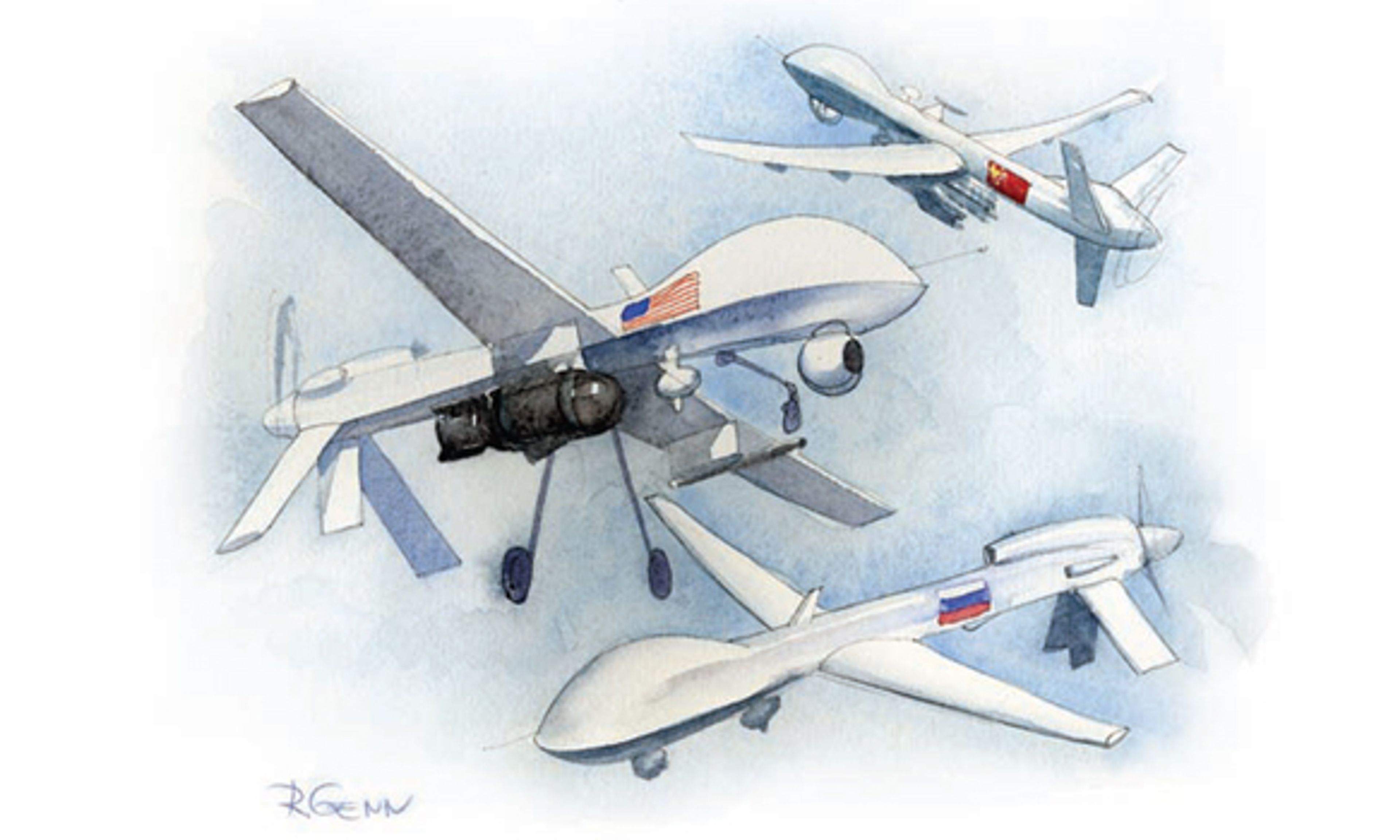
The most important military revolution of our time, the development of unmanned aerial vehicles (UAVs), is well under way. In 2000, our military had 60 UAVs. Today it has at least 6,000, with more to come. From the Hellfire-missile-carrying Predator to the Global Hawk with its wingspan of 130 feet to the tiny Raven, which carries a camera the size of a peanut, UAVs are becoming ubiquitous, and drone strikes increasingly precise. Many people wonder where this technology is heading — and whether we need new laws and international agreements to keep the drone revolution from flying out of control.
Former New York Times editor Bill Keller has proclaimed that drones are “propelling us to the day when we cede . . . lethal authority to software,” while legal scholars question whether death by drone might violate international law. Radford University philosophy and peace-studies professor Glen T. Martin has written that this technology is “attacking the heart of civilization itself,” while two authors recently opined in the Wall Street Journal that, thanks to drones, “the West risks, however inadvertently, going down the same path” as the one that led to Auschwitz. These fears are misplaced and overstated. History shows that the best safeguards against the abuse of new technologies are new technologies themselves.





Comments