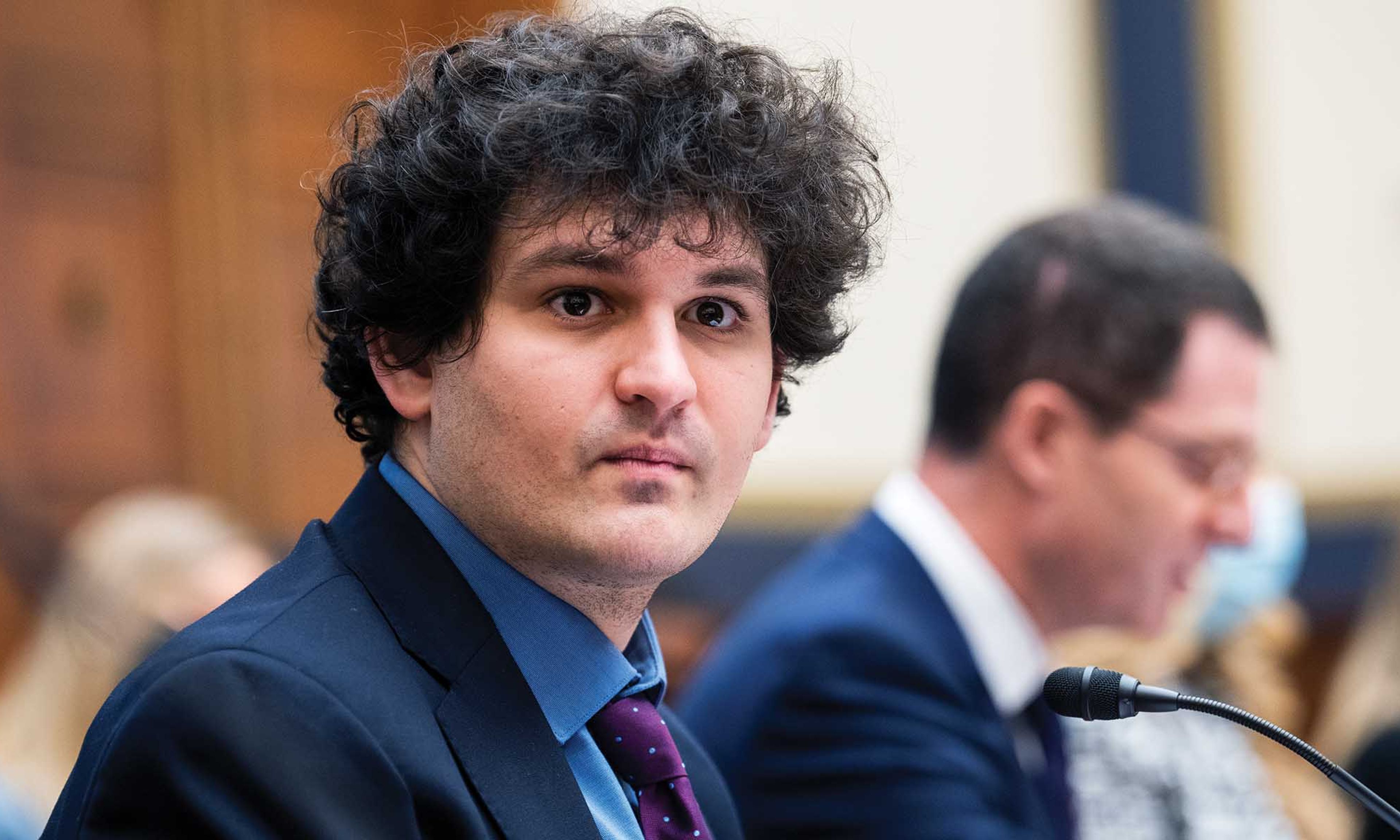
FTX, a cryptocurrency exchange, and Sam Bankman-Fried, its 30-year-old now-former CEO, were supposed to change the world. They may have, but not in the way they expected.
There was nothing world-changing about FTX’s business or the fraud it seems to have perpetrated. The fundamental problem with FTX was quite simple: Its liabilities were real but many of its assets were not. How it got that way is more complicated. As Matt Levine wrote for Bloomberg Opinion, “FTX took its customers’ money and traded it for a pile of magic beans, and now the beans are worthless.”
The simplest way FTX could work is just as an exchange. You want to buy a crypto token for $10; FTX acts as a middle-man to find someone who has that token and wants to trade; FTX makes the trade happen and charges a fee. But, of course, FTX could make more money by investing your $10 and then borrowing to execute the trade. If it gets a higher rate of return on the investment than it pays in interest to borrow, it keeps the difference as profit. There’s nothing inherently wrong with that, and lots of finance works that way.
The problem arises when the thing you’re borrowing against isn’t actually there, which is where the magic beans come in. Levine describes it as similar to a bank borrowing against its own stock. If the bank runs on hard times, its stock will go down, which means the collateral vanishes into thin air. At that point, everyone on the liability side of the ledger is going to want his money back, which will send the entire enterprise into a death spiral in about five minutes.
That’s essentially what happened to FTX. About two-thirds of the value of FTX’s “assets” was in two tokens that FTX had created, called “FTT” and “Serum.” Since it created the tokens, their value was a function of the market’s confidence in FTX, similar to a stock price. As the market caught on to Bankman-Fried’s shenanigans, the value of FTT and Serum tanked, as did any hope that FTX had of paying back its customers.
All of that would have been entirely foreseeable, except that FTX’s balance sheets were not public. Now we know from the bankruptcy filings that FTX didn’t really keep financial records in any recognizable form for much of its business. Once even the faintest details became public through one Excel spreadsheet, guys like Levine (and even guys considerably less smart than Levine) could pick things apart immediately. The technical term in finance for what FTX was doing is “obviously dumb.”
But Bankman-Fried was able to dodge skepticism by talking about effective altruism and by being a good Democrat. Effective altruism — so called to distinguish it from, you know, altruism — is an application of utilitarian philosophy to charitable giving that says amassing personal wealth is a good thing, so long as you plan to efficiently give it away to help the poor. (It’s rather convenient that the amassing-personal-wealth part comes first.) The intellectual forefather of effective altruism is Peter Singer, the philosopher famous for arguing in his book Practical Ethics — so titled to distinguish it from, you know, ethics — that infanticide can sometimes be morally justified.
Bankman-Fried is an elite leftist in good standing. He’s the son of two Stanford Law School professors and went to Crystal Springs Uplands School near San Francisco (2022–23 tuition is $56,620, which might sound steep, but it does include “daily snacks,” according to the school’s website). Trained by his parents to be able to give a philosophical defense of abortion at age twelve, he went vegan and led a student campaign against the agriculture industry as a freshman at MIT. In the 2022 election cycle, the only individual who donated more money to Democratic candidates than Bankman-Fried was George Soros.
So once Bankman-Fried got rich, he was supposed to save the world with rationalistic utilitarianism, and progressives would cheer. That was the stated plan all along, and you were supposed to believe it was the best thing since quarterly dividends. Now, the FTX Foundation, the charitable Gosplan tasked with carrying out Bankman-Fried’s vision, has said it won’t be able to honor many of the grants it has made, and the entire executive team leading the foundation has resigned.
When Bankman-Fried was once asked whether he would be the world’s first trillionaire, he did not rule it out, but he has promised to never purchase a yacht. (I, too, promise to never purchase a yacht — you have my word.) This promise was supposed to make him a better kind of baron, but we should prefer conspicuous consumption to whatever it is that Bankman-Fried was doing.
Part of the promise of crypto-currency was that intermediaries would be unnecessary and decentralized finance could play out on its own with no big banks or middlemen. But until we reach that greener pasture, apparently, exchanges like FTX will make their executives filthy rich. FTX spent like a massive company, buying advertisements on the shirts of MLB umpires, naming rights to the Miami Heat’s arena, and a Super Bowl commercial featuring Larry David.
Part of the purpose of this spending was likely to make FTX seem a much bigger deal than it actually was. Financial markets in general were largely unaffected by FTX’s collapse, as mainstream financial institutions have wisely avoided becoming too heavily involved with crypto firms.
Just about every news story mentions that FTX was once valued at $32 billion, but that was only a transitory valuation, and in the grand scheme of the American economy, $32 billion is really not much. It’s about the same as the market capitalization of Dollar Tree or Old Dominion Freight Lines. It’s about half the market capitalization of Sherwin-Williams or Colgate-Palmolive. (And, unlike FTX’s, those companies’ assets really, truly exist.) For a different point of reference, consider that CVS took in $32 billion in revenue in less than two months last year, or that the federal government spends $32 billion in less than two days.
Members of Congress aren’t too informed on most subjects, but they are especially out of their depth on relatively new, high-tech issues such as crypto. Making FTX seem really important would help Bankman-Fried’s case for regulating the cryptocurrency industry, which he made as often as he could in Washington — at the White House, the Capitol, and elsewhere. The regulation would be needed only now that he was already a billionaire, of course, and, as the top dog that had recently bought up other crypto firms, FTX would be best positioned to comply with the rules its founder was helping structure.
But no regulation saved Bankman-Fried. His deceptions have been exposed because people started asking questions. The ultimate motivation behind those inquiries was good business sense. The market, through ordinary mechanisms based on now-accurate information, reduced his net worth from over $20 billion to zero in about a day.
The market likely would have seen through his lies earlier had people not been so taken by his high-minded talk and engaging personality. (To be frank, his personality should have tipped more people off — he played video games during interviews, casually used profanity in his speech, and once forthrightly described something close to a Ponzi scheme when asked about his business model — but the press ate it up.) FTX’s primary aim, in the eyes of the people who worked there, was the good it would do through the donations it would make.
We’re all familiar with moral compromises made in the selfish pursuit of money. What FTX’s failure demonstrates is the moral compromises that can take place in the purportedly selfless pursuit of money. It seems that they aren’t so different. If you actually believe you can enhance human reason with artificial intelligence, create an operational plan to feed the world after a nuclear war, and invent an impartial and trustworthy way of doing cost–benefit analysis on everything (all ideas that on its website the FTX Foundation says it is — was — interested in funding), then the only hurdle is raising enough capital to fund it all, and if you can raise that capital by trading virtual assets back and forth and doing a little financial chicanery, it might be iffy, but the world will thank you in the end.
The people who should be most afraid in the aftermath of FTX’s collapse are not in crypto, though crypto investors should feel some concern over the possibility of heavier regulation and the effect FTX may have in tarnishing the entire concept of cryptocurrencies. FTX is far from the only business that has put some utopian vision of social betterment ahead of the provision of products to paying customers. Other businesspeople were likely not as egregious as Bankman-Fried in doing so, and their collapse would not be so spectacular. But FTX proved that an entirely market-based reckoning of stated goals vs. actual business is not only possible but can be relatively quick and easy. Other C-suite do-gooders who believe the world will thank them in the end should beware.











Comments