On a June New York evening in 1976, Senator Jim Buckley — William F. Buckley’s brother — won renomination to seek a second term, and Pat Moynihan won the Democrats’ Senate nomination. At his headquarters, Jim said: “I congratulate Professor Moynihan and look forward to running against Professor Moynihan, who will, I am sure, run a campaign worthy of a Harvard professor.” Back at Pat’s headquarters, a journalist said: “Pat, Jim is referring to you as ‘Professor Moynihan.’” Pat said drolly: “Ah, the mudslinging has begun.”
This episode involved two of my friends. Jim Buckley recently died at 100, not far from where I live. Having Pat Moynihan as a friend was a highlight of my 54 years in Washington. I have mentioned this Buckley–Moynihan episode as a prelude to a confession. In conformity to the rules of ruthless full disclosure, and in the spirit of today’s confessional culture, I herewith acknowledge a dark secret: I once was a college professor.
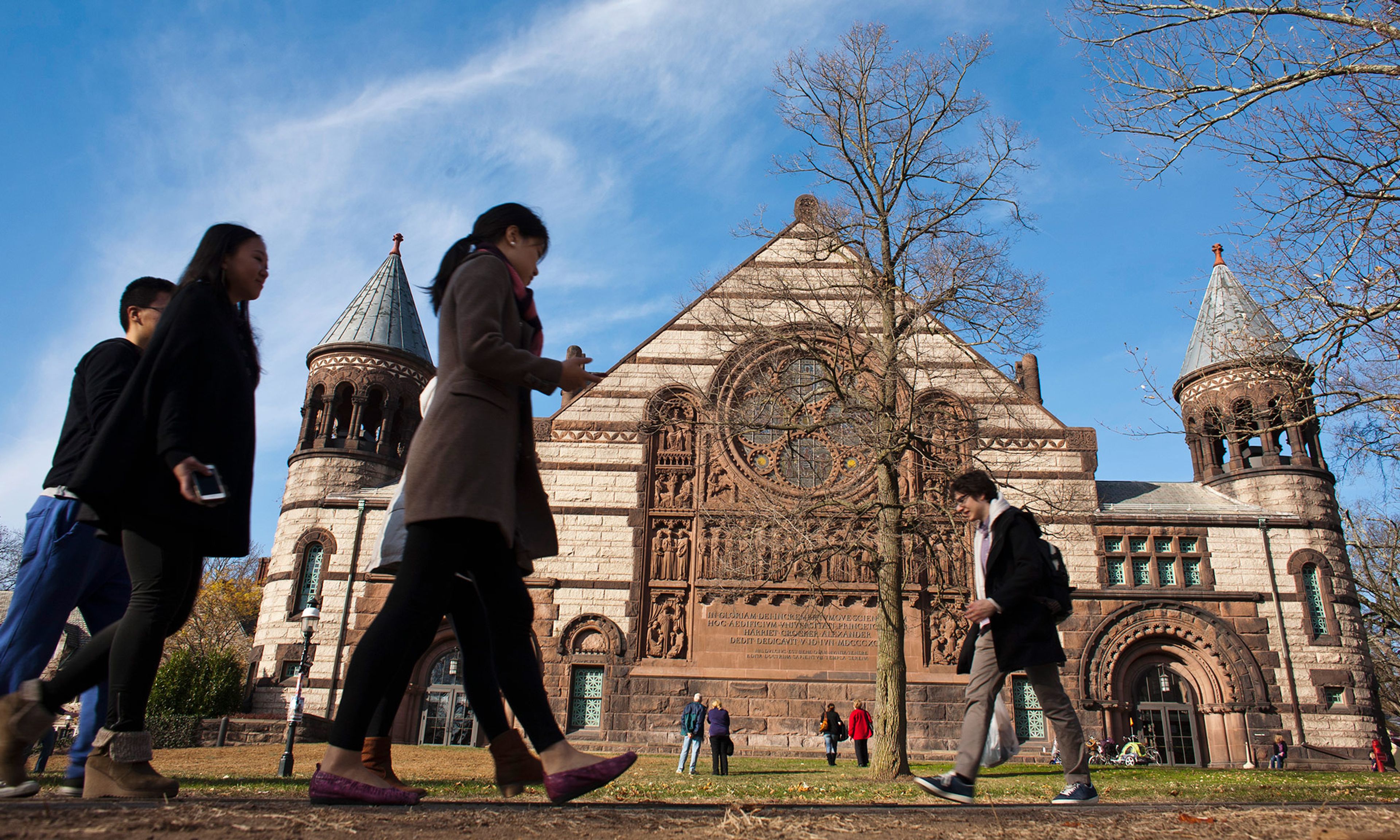
As I ended my two years at Oxford, I was undecided as to whether I wanted to become an academic, as my father was, or a lawyer. So, I applied to a distinguished law school and to Princeton’s philosophy Ph.D. program. I think I chose Princeton because it was midway between two National League baseball cities. Which gives you an idea of my academic seriousness. There is a book titled “Baseball, I Gave You All the Best Years of My Life.” Baseball gave me, indirectly, my wonderful Princeton years.
I want to establish a premise for my remarks tonight. I grew up around the campus of a great land-grant university, the University of Illinois, where my father taught philosophy for 39 years. I have been privileged to receive degrees from two of the world’s most esteemed universities, Oxford and Princeton. I believe that the great research universities are the finest ornaments of Western civilization.
They evolved, precariously, through 800 years of ecclesiastical and political thickets, fending off interference. Their magnificent legacy can, however, be squandered in a generation, destroyed from within, not by outside forces. They can fall under the control of people unsympathetic, even hostile to the universities’ noble and timeless mission of free and fearless inquiry and disputation. And under the modern tenure system, this caste of hostile people can reproduce itself, reinforcing an authoritarian grip that cannot easily, if at all, be pried loose.
It is, therefore, urgent to think clearly about the intellectual sources of today’s anti-intellectual distempers on campus. And about the strange emergence of a large cohort of young people who are not only fragile and easily frightened, but are unashamedly so, even proud of their brittleness. They advertise their susceptibility to being “triggered” by “microaggressions,” and by the “trauma” of encountering ideas they do not like. The ubiquity of the word “trauma” in common campus discourse is telling.
Today, I want to acquaint the fragile with two ideas they will not like. I will do so by explaining today’s campus turmoil with two hypotheses.
My first hypothesis is that the very idea of an open society is being rejected by people who think that such a society is a naïve — indeed, a perverse — aspiration. Such people are, whether they know it or not, inhabiting a dangerous, illiberal mental world that began to gain adherents two centuries ago.
My second hypothesis is that hostility to an open society appeals to people — particularly but not exclusively young people — who are haunted by an exaggerated sense of the harms from which they think they need protection. I shall return to the concept of harm anon.
It is because of my first hypothesis, to which I shall now turn, that such people feel constantly and permanently threatened — and justified in not tolerating those whose ideas and speech offend them. So, to my first hypothesis.
Late in the 1940s, when American conservatism began to acquire intellectual heft, one of its canonical texts was Richard Weaver’s book Ideas Have Consequences. Indeed they do. In fact, I believe that only ideas have large and lasting consequences. Today’s tormented academia is the consequence of an idea. The illiberalism permeating campuses, and engulfing some of them, is a 21st-century echo of a 19th-century development in political philosophy. This intellectual development was born as an explicit repudiation of the thinking of Thomas Jefferson, and hence of this nation’s foundational principle. The repudiated principle was — and is — the doctrine of natural rights.
Jefferson, in the common terminology of his day, said we are endowed by our creator with these rights. It is not, however, necessary to anchor the idea of natural rights in any theism. Rather, it suffices to say, as rule utilitarians do, that natural rights are those rights that have been found, by long historical experience, to be conducive to the flourishing of beings with our natures. Natural rights define every person’s sovereignty. The most neglected word in the Declaration of Independence is “secure.” Government, Jefferson wrote, is instituted to “secure” natural rights. That is, natural rights precede, and exist independently of, government. As Georgetown Law professor Randy Barnett tirelessly insists: First come rights, then comes government.
Absent a doctrine of natural rights, rights are mere zones of sovereignty granted to individuals by the grace of government — and revocable by government and any majority that sustains it. President Calvin Coolidge (the last president with a constitutional understanding of his office) spoke in Philadelphia during the 1926 celebration of the sesquicentennial of the Declaration of Independence. Coolidge said: “About the Declaration there is a finality that is exceedingly restful.”
Coolidge said: It is often asserted that new ideas have given us great advancements beyond the thinking of America’s Founders. Not so, said Coolidge: “If all men are created equal,” Coolidge said, “that is final. If they are endowed with inalienable rights, that is final. . . . No progress can be made beyond these propositions.”
But what if there is no such thing as human nature? What if human nature is a fiction, a pre-modern superstition? What if human beings are merely creatures that take whatever shape is imposed on them by the impress and promptings of the culture in which they are situated? If so, then controlling the culture becomes imperative. And politics must saturate every nook and cranny of life. And this saturation will, inevitably, mean controlling what people say and hear and read and think and teach. Shaping the consciousness of the people — purging the people of what Marxists call “false consciousness” — becomes the great, the encompassing political project.
Once curating consciousness becomes a political project, the jurisdiction of politics becomes enormous — indeed, illimitable. And the aspiration for, the very idea of, limited government disappears. The politics of consciousness promises glittering possibilities. Therefore, muscular progressive politics must not be circumscribed by any limits on coercion. Particularly, any speech, any idea that contributes to false consciousness, must not be tolerated, lest progress be delayed. Such delay would be an intolerable harm. So, censorship is, to the censors, strictly speaking, progressive. And censorship becomes a categorical imperative when the duty to control culture is reinforced by a sense of crisis. Or, to use the adjective that nowadays is promiscuously bandied, an “existential crisis.”
The widespread suppression of anti-war speech during Woodrow Wilson’s “wartime fascism” was justified by equating dissent about World War I with a grave harm — treason threatening the nation’s very existence. When Princeton decided to come to terms with Wilson’s racial views, I offered to President Eisgruber to come to campus to teach a course on how to more comprehensively repudiate Wilson. He, after all, declared: Disloyalty, by which he meant dissent concerning the war, “must be crushed out.” And the disloyal had “sacrificed their right to civil liberties.” The “Red Scare” and the Palmer raids immediately after the war were fueled by continuing hysteria. As was the intolerance of dissent during the McCarthyite hysteria of the early Cold War. Today, it is said that the “existential” crisis that justifies censorship is “systemic racism.” Or climate change. There is always something.
When the Silicon Valley Bank, only the nation’s 17th largest, was brought down by its own mismanagement, a United States senator, Mark Kelly, the Arizona Democrat, pressured federal regulators to censor social media to silence speech that might raise doubts about the solvency of banks. The Senate Commerce Committee recently approved, unanimously, the Kids Online Safety Act, which would empower government officials — state attorneys general and the Federal Trade Commission — to sue to force social-media platforms to remove content in order to prevent “harm to minors.” And, we are told, content can harm a child by making the child feel “anxious.” This idea of harmful content could be a loophole in the First Amendment as large as Montana.
Once censorship becomes an accepted instrument in the government’s toolbox, the occasions for it will multiply. One step down this slippery slope was the enactment of the McCain-Feingold campaign-finance regulations. Essentially all campaign spending is for the dissemination of political speech. Therefore, by limiting campaign contributions and spending, government rations political speech. It stipulates the correct quantity of such speech, and even regulates the content and timing of some of it. And remember: All campaign-finance laws have one thing in common — they are all written by incumbent legislators. You can guess whose interest these laws invariably serve.
There will be future justifications of regulating, rationing, and suppressing speech. There always are supposedly urgent reasons given for being especially aggressive, and repressive, about keeping the culture on “the right side of history.” This endlessly repeated phrase is less an argument than a way of short-circuiting argument.
In 1980, I was invited to deliver the Godkin Lectures at Harvard. I did so, based on my Princeton doctoral dissertation. The lectures became a book that was read by dozens. Its title is “Statecraft as Soulcraft.” Its subtitle is “What Government Does.” Not what government should do, but what government unavoidably does: Any government, any regime, any system of laws and education that encourages some behaviors and discourages others, will shape the consciousness of the citizenry. The goal of a citizenry competent for self-government, and tolerant of differences within itself , is not new.
Two things are, however, new. One is the enveloping nature of government, wielding modern means of mass communication — and manipulation. The other new thing is the ambition — insinuated into liberal, open societies — to nationalize the citizenry’s consciousness in the name of progress, as defined by whatever portion of the political class is ascendant at the moment.
Nineteenth-century intellectuals who made fine-tuning everyone’s consciousness a political project also decided that history — History with a capital “H,” History as a proper noun — is an autonomous thing, unfolding according to its own iron laws and inner dynamic. These intellectuals said that a small clerisy of people like them — people who understand History and want to be on “the right side” of it — should govern. This conception of History as an entity with a mind of its own, as something to which intelligent people should defer and conform, we can blame on Marx. Or we can blame Hegel for Marx. But the man who was to wield this concept of History as a history-making cudgel was Lenin.
He defined the Communist Party as the “vanguard of the proletariat.” By the “vanguard” he meant the clear-sighted, thinking minority. The party would be controlled by a cadre of advanced thinkers who were the repository of true consciousness, and who were diligent about stamping out false consciousness. In today’s China, which is a party-state, Marx explains nothing, Lenin explains everything.
The Leninist temptation — the totalitarian temptation — comes in many flavors and intensities. But it always rests on a denial of human nature. If there is no settled, fixed human nature — if human beings are always and only creatures who are created by the marks made on them by the culture in which they are raised and live — then the stakes of politics are, always and everywhere, enormous. The stakes are, literally, everything — including the sort of beings that humans will be. And everything is, inevitably, politicized. Everything: from work to leisure. What we read, what we eat, how we are entertained. And what is allowed to be said and read and thought and taught.
Ultimately, this idea is the source of totalitarianism, which is the totalizing of politics. Leon Trotsky understood this. He embraced Lenin’s “dictatorship of the proletariat,” which he was certain would produce wonderful results. Trotsky concluded his 1924 book Literature and Revolution with an ecstatic paean to a shimmering future. He said that under communism “man will become immeasurably stronger, wiser and subtler; his body will become more harmonized, his movements more rhythmic, his voice more musical. The forms of life will become dynamically dramatic. The average human type will rise to the heights of an Aristotle, a Goethe, or a Marx.”
About Trotsky, and the fanaticism of his acolytes, I will add only this. While I was at Oxford, the Oxford University Press published the third and final volume of Isaac Deutscher’s rather too worshipful biography of Trotsky. The Oxford Marxist Society held a celebratory reception for Deutscher, which I attended. During his remarks, Deutscher said: “Proof of Trotsky’s farsightedness is that none of his predictions have come true yet.” This is the mentality of people immune to evidence.
I digress, but shall here add one interesting historical detail. In his 1964 biography of Lenin, Louis Fischer, an American foreign correspondent, recalled that when Lenin died, a participant in the autopsy performed on Lenin’s body said that the blood vessels in Lenin’s brain were so calcified that “when struck with a tweezer they sounded like stone.” This is a metaphor for what happens to all brains closed off from stimulating controversies.
Well. Trotsky’s autointoxication was laughable — but not funny. Scores of millions of people have died at the hands of people possessed, as Trotsky was, by the belief that human beings are mere creatures of culture, and hence are plastic to the firm smack of politics. Again, the root of this evil is the idea that human beings are defined by their malleability, there being no fixed human nature. That human beings are whatever the culture molds them to be.
People who believe this will naturally believe that politics can — and has a duty to — shape the culture, unimpeded by any limits on the power of the state. And they will believe that censorship — the minute regulation of speech — must be the foundation of the state. For people who believe, as Trotsky did, that the mission of politics is so godlike; who believe that infinite progress is possible by pounding the public’s consciousness into a new shape congruent with the unfolding of History — for people who believe this, no amount of coercion is unthinkable. In fact, censorship and other coercions, in the name of idealistic intolerance, are a duty.
Which brings me to my second hypothesis, which is this: People who believe that culture determines the nature of everyone and everything, and who therefore believe that politics must control culture — everything that is said and read and thought and taught — such people will necessarily believe that they are directly harmed by any speech and all ideas that retard progress, as they understand this. So, they will claim what Jonathan Turley of George Washington University Law School calls a “license to silence.”
Such thinking is incompatible with the principle of an open society, as enunciated by John Stuart Mill in his essay “On Liberty.” Mill’s harm principle is this: “The sole end for which mankind are warranted, individually or collectively, in interfering with the liberty of action of any of their number, is . . . to prevent harm to others.” Mill’s principle was supposed to protect a vast sphere of freedom. But an endlessly elastic and metastasizing concept of harm has turned Mill’s principle into a truncheon with which to bludgeon defenders of free speech. Suddenly, censorship is being defended not as an act of aggression, which it patently is, but rather as self-defense by persons who feel harmed by heterodoxy.
Professor Turley, writing in the Harvard Journal of Law and Public Policy (“Harm and Hegemony: The Decline of Free Speech in the United States”), argues that, in a perverse inversion, Mill’s harm principle is being used to empower those enemies, by this sinister reasoning: They say that everything said or read or written or thought or taught affects the culture — the social system that envelops, and shapes, everyone situated in it. So, everything affects everyone’s interests. So, anyone can claim to be harmed by anything said or read or written or thought or taught. For people who think like this, the problem today is not the danger to free speech, it is the danger from free speech.
What Turley calls “a wildly attenuated harm analysis” breeds anxiety because unfettered discussion means that harm is potentially ubiquitous. So, everyone’s welfare is constantly precarious. Therefore, on campuses everyone needs “safe spaces” in which to shelter while the speech police and “bias-response teams” fan out to sniff out and extinguish harmful speech.
Off campus, throughout the larger society, an indiscriminate harm analysis is today fueling demands for what is called, in an Orwellian locution, “robust content moderation,” meaning government pressure to control the content of social media by disfavoring ideas thought not to be on the right side of History. This government project to define and protect us from what the government decides is “disinformation” or “misinformation” is the most dangerous assault on freedom of expression in our national experience. It is how campuses — and totalitarian societies — become, in Professor Turley’s phrase, “echo chambers for orthodoxy.”
Today, many colleges and universities promote orthodoxy two ways. One is by taking institutional stands on political questions. When the Supreme Court’s Dobbs decision overturned Roe v. Wade, numerous institutions condemned this. Academics might be taken more seriously if they did not take themselves so seriously with their delusion that the larger society is interested in their advertisements of their predictable politics. And when an institution takes a political stance, it necessarily excommunicates those on campus who disagree. It places them at the margin of, or even outside of, the community.
A second way academic institutions enforce orthodoxy is by requiring those seeking faculty positions to submit affirmations of their commitment to “diversity, equity, and inclusion.” This requirement is not morally superior to, or easily distinguished from, the loyalty oaths sometimes required by universities during the McCarthy era.
All this is a reminder that the essence of totalitarianism is not that the individual cannot participate in politics; rather, it is that the individual cannot not participate in politics. Furthermore, orthodoxy makes people stupid. Kipling said, “What do they know of England, who only England know?” Similarly we can say: Those who know only their own thoughts do not really know those, because these thoughts have not been challenged.
The metastasizing harm principle wielded by hypersensitive people is the opposite of Jefferson’s relaxed attitude regarding religious differences. As he famously said, “It does me no injury for my neighbor to say that there are twenty gods or no god. It neither picks my pocket nor breaks my leg.” Jefferson’s laconic dismissal of the idea that he is harmed by diversity of opinion contrasts markedly with the prevailing view on campuses. There many people, young and not so young, cower and tremble in fear of intellectual pluralism. I will leave it to others to explore the oddity that this is occurring simultaneously with campus “diversity” bureaucracies sprouting like invasive fast-growing kudzu.
I have returned to where I began, to academia. I began my remarks today by citing Pat Moynihan’s good-natured response to Jim Buckley’s good-natured teasing of Pat for being a professor. I will close with an observation.
Beginning with the arrival of the Kennedy administration in 1961, it was said that the Charles River that flows by Harvard also flows into the Potomac. Washington was, for a while, enamored of academic luminaries. Of whom there were many: Moynihan himself, his Harvard colleagues John Kenneth Galbraith and Arthur Schlesinger, the Rostow and Bundy brothers, Eric Goldman, George Shultz, James Schlesinger, Henry Kissinger, Edward Levi, who left the presidency of the University of Chicago to become Gerald Ford’s attorney general, and many more.
Today is different. There still are academics serving in Washington, but eminent academics are no longer as coveted as they once were for the prestige they conferred as ornaments in several administrations. Academia has squandered its prestige by seeming to adopt an adversarial stance toward American society. And toward this society’s traditional values, including those affirmed by the First Amendment — which is first in the Bill of Rights for a reason.
Everything, from the pursuit of truth to the pursuit of happiness, depends on freedom of speech and inquiry, especially on campuses. It is especially necessary for those who espouse ideas that challenge majority orthodoxies that, when unchallenged, become lazy and stale. And lapse into bullying. So, a final word about majorities, and majority rule.
I grew up in central Illinois, in the twin cities of Champaign–Urbana, home of the University of Illinois. According to local lore, it was in the Champaign County courthouse in 1854 that a prosperous railroad lawyer from Springfield, Illinois, Abraham Lincoln, learned that Illinois senator Steven Douglas had succeeded in passing the Kansas-Nebraska Act. The act was intended to solve the explosive problem of whether the territories that were not yet states would, or would not, allow slavery. Douglas’s solution was “popular sovereignty” in the territories. Let the people of the territories decide. Douglas, and the many who supported him, said: Vote slavery up or vote slavery down — the outcome is, if not a matter of moral indifference, morally secondary. The primary point was that the principle of majority rule — the principle that Douglas and many considered the essence of the American project — must prevail.
Lincoln’s ascent to greatness began with his instant, implacable, and canny opposition to such thinking. America, he said, is not about a process, majority rule. Rather, America is about a condition, liberty. Lincoln did not say, but could have said, that a written constitution is a counter-majoritarian instrument. It circumscribes the power — the sweep — of majorities. The First Amendment says Congress shall make no law abridging the freedom of speech. No law. No matter how many people might want one.
The foundational conservative insight can be expressed in two words: Nothing lasts. The Roman empire is gone. As are the Carolingian, Holy Roman, Spanish, Portuguese, Hapsburg, British, French, and Soviet empires. The study of history is, in large measure, the study of ruins. Which is why, were I dictator, the only permissible college major would be history.
And yet, the conservative conviction that nothing lasts might not be quite true. In 1859, with clouds of civil war and dissolution lowering over the nation, Abraham Lincoln addressed a Wisconsin gathering, to which he told the story of an Oriental despot who challenged his advisers to devise a proposition to be carved in stone, a proposition to be forever in view — and forever true. The proposition the advisers settled on was: “This, too, shall pass away.”
And yet, Lincoln argued, if we Americans cultivate the moral and intellectual world within us as assiduously as we cultivate the physical world around us, our nation need not pass away. That cultivation depends, ultimately and utterly, on an enlightened culture that sustains freedom of speech.
The First Amendment was produced by a Princetonian, Princeton’s first graduate student, James Madison. So, it is altogether fitting and proper that, propelled by Princetonians for Free Speech, this university can spearhead a nationwide rebirth of freedom — freedom of speech, the freedom that matters most, because all others depend on it.
Thank you.
This article is a slightly edited version of a speech that the author gave on September 13, 2023, to Princetonians for Free Speech. The speech was co-sponsored by the James Madison Program and its Initiative on Freedom of Thought, Inquiry, and Expression.










Comments