Point Pleasant, W. Va.
There are those who believe that, on November 15, 1966, a huge, winged humanoid made its first appearance in this small Appalachian town. Whether or not it did, it has never really left.
Point Pleasant sits at the confluence of the Kanawha River and the Ohio River. It’s directly up against the Ohio border; that state’s land begins on the opposite shore. Since 1966, Point Pleasant also has sat at the confluence of local folklore and mass-culture mythology, and on the border of the natural and the supernatural. And it’s all because of the Mothman.
Local tradition holds that George Washington gave the town its name when, on a surveying trip to the area in 1770, he described it as a “pleasant point.” Whether the name originated with him or with another source, a modern visitor who comes to that same point and looks out on the vast waters before him and the verdant surrounding land cannot help but agree with the description. Its choice location may be one reason that Point Pleasant became the site of a major battle in 1774 between colonists and Native Americans. The fate of a nation-to-be may well have been determined at “tu-endie-wei” (Wyandotte for “the point between the waters”). Here, forces dispatched by Virginia governor Lord Dunmore and led by French and Indian War veteran Andrew Lewis ultimately defeated a coalition of Native Americans led by Shawnee chief Cornstalk. The chief survived the battle but was captured and killed several years later. He is now buried in Tu-Endie-Wei State Park.
But if local legend is to be believed — and in this country, all such stories ought at least to be acknowledged, if not held as certain — then his is not a happy rest. “Some say that before Chief Cornstalk died, he uttered a curse, a curse for the immediate area (Point Pleasant) to be stricken with hard times and sorrow for what they had done to his people,” wrote Donnie Sergent Jr. and Jeff Wamsley, Point Pleasant natives and longtime students of the Mothman, in Mothman: The Facts Behind the Legend. For two centuries would this curse linger, the legend goes.
For most of those next two centuries, however, Point Pleasant seemed no more — or less — cursed than other communities of its kind. It rode the historical currents, much as the many boats that traversed its waters did. A new bridge, known as the “Silver Bridge,” went up between the town and Ohio in 1928. During World War II, global events affected Point Pleasant: What had been a wildlife refuge a few miles out of town became a munitions-manufacturing area but one made to appear, as much as possible, like its prior form, for the sake of secrecy. Among the factories and power plants, igloo-shaped mounds dotted the landscape. Innocuously covered with dirt and grass, these structures stored explosives.
After the war, munitions manufacture ceased and this “TNT area” was gradually abandoned. The buildings emptied and rusted. The igloos’ camouflage decayed with time, exposing them again to the world; they fell into the hands of chemical companies and the local government. Eventually the area attracted local youths, who used it as a dating spot, a drag-racing venue, and a place just to hang out.
It was here that the Mothman legend began. Two married couples, the Mallettes and the Scarberrys, had come to the TNT area on that mid-November night in 1966 hoping for some fun. The vicinity appeared to be otherwise unpeopled that night. But that is not to say no other living beings were there.
They were by an old power plant when they saw the Mothman. Grayish in color, “it was shaped like a man, but bigger,” Roger Scarberry later told journalist John Keel, who investigated paranormal phenomena. “Maybe six and a half or seven feet tall. And it had big wings folded against its back.” But the most striking feature of the creature was its eyes. Bright red, like “automobile reflectors,” Roger’s wife, Linda, told Keel. The couples fled the TNT area and raced back into town. The Mothman followed them, effortlessly matching their 100-mph speed. Unsure what to do, and still pursued by the creature, they went to the local police, who were initially skeptical but came to accept their sincerity, if not their exact account.
Had this been the only sighting, it might have been easy to categorize as an odd one-off. But it was only the beginning. Dozens more encounters followed, on both sides of the Ohio River. In addition to the Mothman — the name was inspired by the Batman TV show — there were unexplained lights in the nighttime sky in and around Point Pleasant. People came from across the nation, hoping to get a glimpse of either.
The most curious visitors of all were the men who started appearing in the area dressed in dark suits, driving older-model cars somehow in pristine condition and speaking in an almost robotic cadence. Often, these “men in black” tried to intimidate those interested in the phenomena that had come to beset the Ohio Valley. The men in black visited, among others, Mary Hyre. A newspaper reporter for the Athens Messenger in Ohio, she claimed to have begun having a strange dream: of people drowning and Christmas gifts floating in the Ohio River.
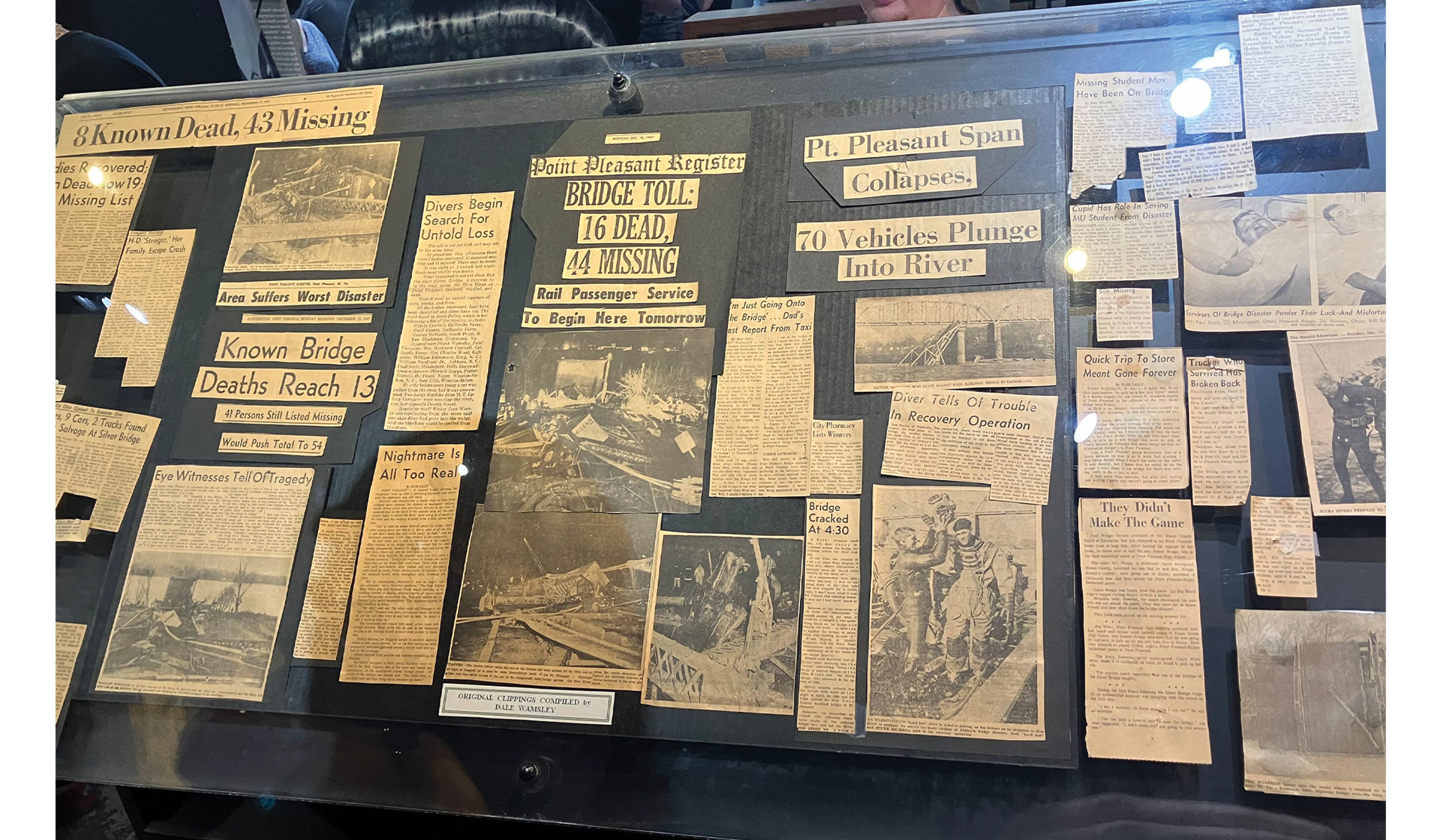
On December 15, 1967, with unexplained activity still swirling around Point Pleasant, Hyre’s vision came tragically to life. The Silver Bridge collapsed under the strain of rush-hour, holiday-shopping traffic. (Later investigation revealed a faulty eyebar was to blame.) Cars plunged into the river below, trapping or crushing their occupants. Forty-six people died that day. Thereafter, the frequency of the bizarre occurrences rapidly diminished. Claims of Mothman sightings were made over the next decade or so, but only spottily. The end of Point Pleasant’s paranormal period was as inexplicable as its beginning.
The events of 1966–67 indelibly affected Point Pleasant, down to the very shape of the town: The span that replaced the Silver Bridge does not stand where the original did. A large wall now occupies what was once an entry to the Silver Bridge; a mural on the wall depicts the bridge in its prime. Nearby is a memorial to those who died in its collapse.
The Mothman also lingered. Though he had made himself physically scarce, occasional sightings, and the original events, continued to arouse curiosity in the town and elsewhere. In 1975, Keel published The Mothman Prophecies, his account of the strange happenings. In 2002, the book was (loosely) adapted for a film of the same name starring Richard Gere. Though it was filmed in Pennsylvania, a documentary released in tandem was filmed in Point Pleasant. Interest in the Mothman legend had persisted through the decades, but “things really started ramping up” after the Gere film, says Wamsley. It was enough for Wamsley and some other residents to wonder whether there would be an audience for an event honoring the legend. So in 2003 they launched the first Mothman Festival. A few hundred people attended. That same year, a life-size statue of the Mothman was unveiled in the center of town. There was a “slow build” of interest in the festival, Wamsley says. The internet has helped the Mothman legend grow. Now attendance is in the thousands each year, Wamsley believes. The town of roughly 4,000 people (as of 2020) as much as quintuples in population in late September. When I went this year, it was difficult even to get a hotel; the closest option was more than a half hour away, and I was not the only festival attendee staying there. Traffic clogged the bridge into town as early as 10:30 a.m., when I showed up. I was lucky to find decent parking. Mothmania even had local churches and car washes paying homage with signage about the creature. The main drag of Point Pleasant, closed to cars, was lined with booths of a paranormal bent, hawking wares both Mothman-themed and not.
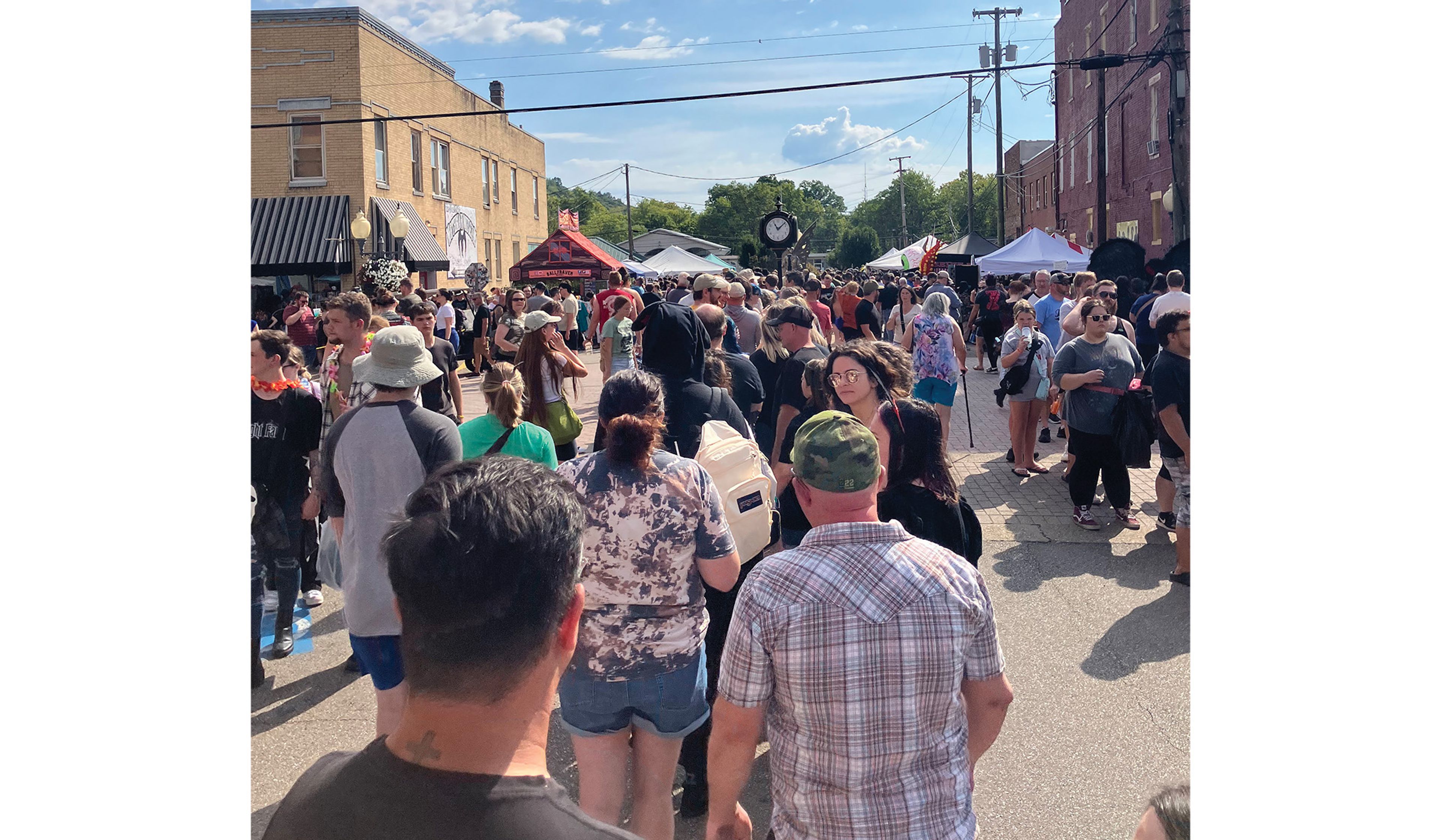
The festival’s many attendees thronged throughout. Most people I met were from West Virginia or neighboring states. They sported Mothman shirts bearing such slogans as “The Mothman stole my carburetor,” “The only man I need is Mothman,” and “Mothman for President.” Some dressed as the Mothman itself; a male–female pair went as a moth and a lamp. One man sported a tinfoil hat. Broader popular culture seeped in as well. People dressed as Michael Myers and Jason Voorhees peacefully stalked the festival grounds. Star Wars cosplayers forced their way through the crowd. A large contingent dressed in gear inspired by the postapocalyptic Fallout games puzzled me until a festival attendee explained that Fallout ’76 is set in what (in the game’s universe) was once West Virginia and that the Mothman appears in it.
Others repped their own areas’ cryptids like people wearing local sports jerseys. Bigfoot commingled with Wisconsin’s Hodag; the Flatwoods Monster (another West Virginia native, now with its own celebration) with my own hometown’s cryptid, the Loveland Frog. My decision to wear a shirt bearing its likeness formed an instant point of commonality with other fans of the amphibious humanoid.
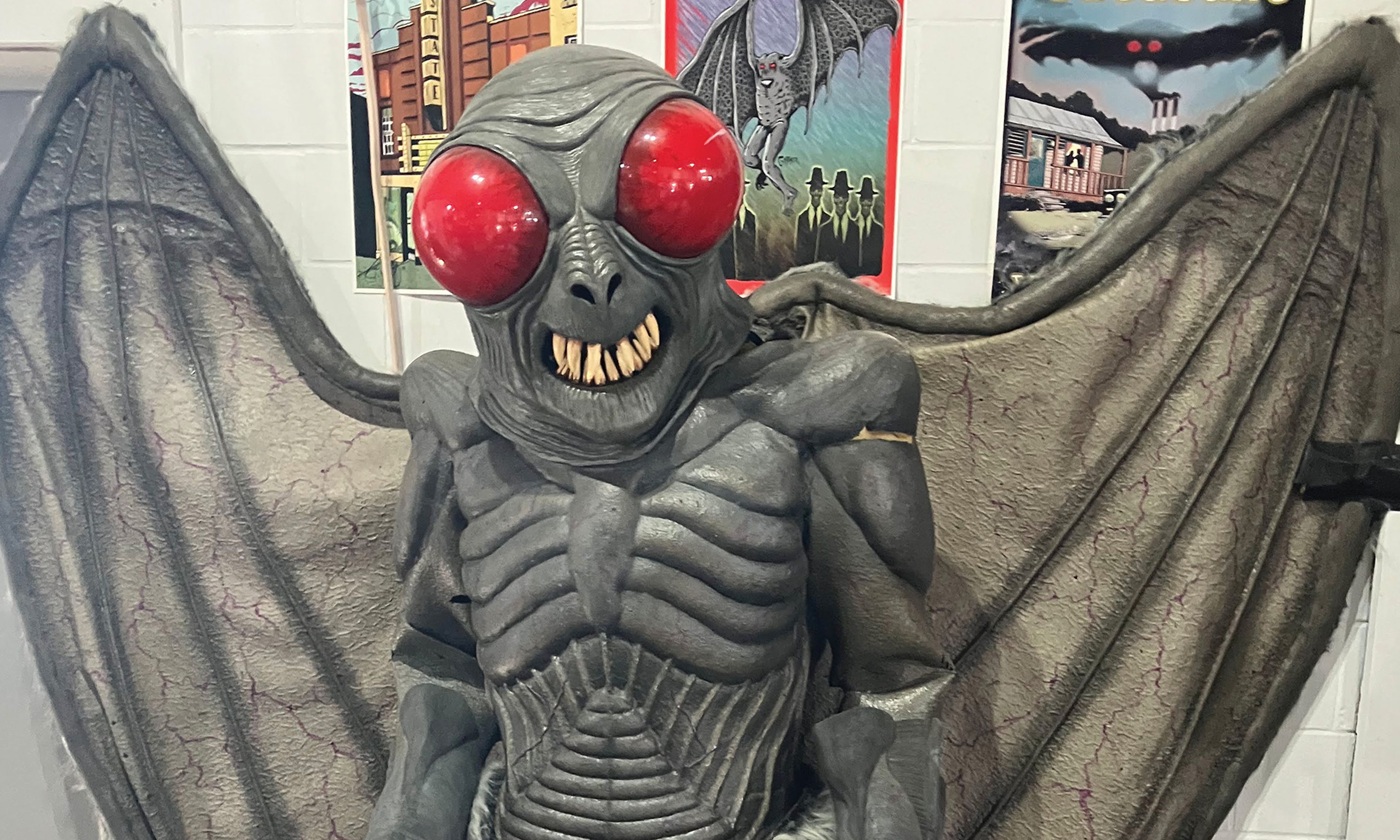
Two attractions dominated the festival, and huge lines formed for both. First was the Mothman Museum, founded by Wamsley in 2006. It’s full of contemporary newspaper clippings, props from The Mothman Prophecies, and other historical artifacts and replicas (including a life-size Mothman figure). On sale were Mothman-themed souvenirs and books. Waiting in line to buy some, I spotted fellows dressed as (?) men in black, looking at a book about their kind. I asked them what they thought of the book. It’s “inaccurate in the way it’s supposed to be,” one replied. “Lots of red herrings.”
And then, of course, there was the Mothman statue. During the festival, people wait all day to get their picture taken with it. They also leave offerings. Wayne Worth, proprietor of On the Road in West Virginia, a website dedicated to the wonders of the state, had brought a pepperoni roll and Mountain Dew, symbols of West Virginia culture: The pepperoni roll, conveniently portable, was favored by miners; Mountain Dew is known throughout Appalachia as “hillbilly champagne.” Others, likely inspired by Fallout ’76, leave cans of beans. Still others leave coins — some wedged in the statue’s well-sculpted posterior. It’s a site of great significance to Mothfans: On the day I was at the festival, I witnessed two marriage proposals.
What brings all these people to Point Pleasant every year? It’s not just that the creature has become the town’s “calling card,” as Wamsley puts it. Or that it’s something of a “family reunion” for repeat attendees. They are certainly attracted, in a kind of cultural federalism evident throughout this great country (even — perhaps especially — in its folklore), to the regional uniqueness of a creature that now has a nationwide and even a worldwide reputation. But they also see in it a fascinating testament to the enduring mysteries of reality itself. “We’re so small in the grand scheme of things,” an attendee from Louisa, Ky., told me. “I think it’s ridiculous to think things like Mothman don’t exist.”
Perhaps that’s why, in 2001, Linda Scarberry was still thinking about it. “None of us have ever been the same after the first sighting,” she told Donnie Sergent Jr. Point Pleasant has never been the same, either. Whatever the Mothman was (or was not), wherever he is now (or is not), this West Virginia town will remain not just at the confluence of two rivers but in that blurry realm between what we know about the world around us — and what we don’t.












Comments