Dublin
‘Here lies Dublin’s invisible prince,” says an inscription at the base of the granite slab that covers the tomb of Joseph Sheridan Le Fanu. It also gives the years of his birth and death — 1814 and 1873 — and describes him as a “novelist and writer of ghost stories.”
I had peeled away from my family in June to visit Mount Jerome Cemetery, the resting place of Le Fanu, whose name can’t compete with the giants of Irish literature, such as James Joyce and William Butler Yeats. Yet I prefer him to them, and this was my chance to indulge my interest in a minor writer. We were on a big family trip, three generations of us, to see an ancestral land — but not mine, because, as far as I know, I don’t have a drop of Irish blood in me. So while my Irish-American wife, kids, and in-laws toured a whiskey museum and strolled through Temple Bar, I made like a fanboy and chased down places associated with the guy responsible for the greatest story ever written about a diabolic monkey. It’s called “Green Tea,” and it’s excellent, but I’m getting ahead of myself.
Descending on the haunts of dead horror writers is one of my peculiar hobbies, and it has taken me to the grave of Edgar Allan Poe in Baltimore, the homes of H. P. Lovecraft in Providence, R.I., and the sites of Shirley Jackson’s daily life in North Bennington, Vt., where last year I bought a bag of locally roasted coffee beans from the grocery store she shopped at in the 1940s. During one fateful trip to that store, she came up with the idea for “The Lottery,” whose shock ending left a permanent mark on my imagination in high school. (The coffee was tasty. Thanks for asking!)
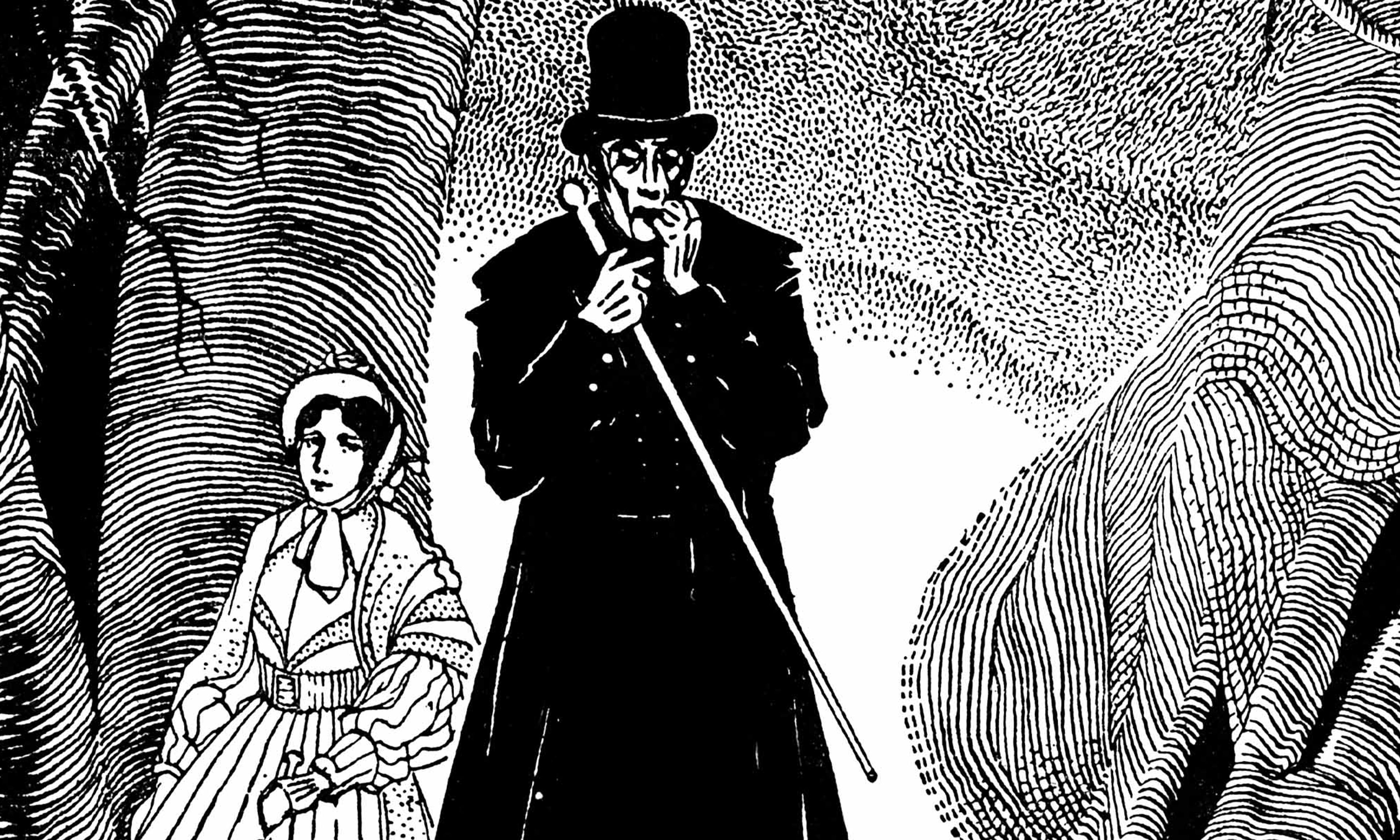
Le Fanu’s name may be obscure today, but that’s not why he’s called the “invisible prince.” The moniker goes back to a misfortune in the author’s life. As a young man, Le Fanu had embarked on a career in journalism and politics, with an occasional foray into fiction. Then his wife died at the age of 34, in 1858. Le Fanu secluded himself in his house at what is now 70 Merrion Square, where a small circular plaque memorializes him. From this retreat, he turned prolific, composing a series of creepy stories and mystery novels that feature apparitions, abductions, pacts with the devil, a disembodied hand that crawls and climbs, and a rat with the face of a person. According to biographer S. M. Ellis, the author often rose to write by candlelight at 2a.m., “in that eerie period of the night when human vitality is at its lowest ebb and the Powers of Darkness rampant and terrifying.”
Le Fanu, whose French surname is a relic of his Huguenot heritage, was probably less invisible than his sobriquet suggests. As the owner of the Dublin University Magazine, he had a business to manage. As a widowed father, he had four children to raise, and they were playmates of the young Oscar Wilde, who grew up on the other side of Merrion Square. Le Fanu also corresponded and published with Charles Dickens, though he once turned down a chance to meet the famous Victorian novelist, in a refusal that contributed to his reputation as a recluse.
Whatever his hardships and oddities, Le Fanu left behind a body of work that is both impressive and disturbing. In one early story, “Strange Event in the Life of Schalken the Painter,” a ruthless uncle sells his niece to a demon lover, who whisks her away to an unholy matrimony. Years later, Schalken, who had been a suitor to the niece, has a vision of the young lady. She leads him into a church crypt, where he seems to witness an unspeakable act. As a tale of lust after death, it’s better than “Ligeia,” a favorite of Poe aficionados. It’s also not for everybody. Many of those who enjoy the literature of supernatural horror, however, regard it as a spooky classic.
In “The Familiar,” another of Le Fanu’s finest stories, Captain James Barton offers a good summary of what animates the genre: “There does exist beyond this a spiritual world — a system whose workings are generally in mercy hidden from us — a system which may be, and which sometimes is, partially and terribly revealed.” The greatest writers often have played with this idea. Shakespeare did it with the ghost in Hamlet and the witches in Macbeth. For Le Fanu, it’s a major theme, and Barton learns the truth of it as he fails to escape from a strange and vengeful entity that persecutes him for what seem to be the misdeeds of his past.
“The Familiar” is sometimes interpreted as a cautionary tale about lacking faith, and many readers know it from In a Glass Darkly, a collection of stories published late in Le Fanu’s career. The title alludes to a line from 1 Corinthians: “Now we see through a glass, darkly,” writes Paul, in the King James Version. By switching a word and removing the comma, argues Robert Tracy in his introduction to an Oxford edition of In a Glass Darkly, Le Fanu alters the meaning of the phrase. The glass is not a window that limits our perceptions, as Paul would have it, but “a mirror in which we glimpse our own darker nature.”
Another story from In a Glass Darkly may be Le Fanu’s masterpiece: “Green Tea.” It’s about a reverend who is tormented by a spectral monkey that only he can see. If that sounds silly, get over it: The tale has a couple of genuinely chilling scenes, a brutal ending, and an ambiguous message that could involve anything from the menace of addiction to the perils of intellectual pride to the awful possibility that suffering is random and meaningless. “Green Tea” appears in bunches of anthologies and shows up on a lot of lists of all-time best ghost stories. It was the first story by Le Fanu that I encountered, more than 30 years ago, and it hooked me. I’ve been thinking about it ever since, and I spot something new with each reading.
An indispensable guide on my travels was Literary Walking Tours of Gothic Dublin, by Brian J. Showers. It covers, in addition to Le Fanu, two other Dublin-born writers: Charles Maturin, a Gothic novelist who may be even less known than Le Fanu, and Bram Stoker, the celebrated author of Dracula. It’s possible to think that Stoker and his famous creation needed the example of Le Fanu. A quarter century before Stoker conceived of his Transylvanian bloodsucker, Le Fanu wrote Carmilla, a novella about a female vampire in Central Europe. What’s more, Le Fanu helped invent the occult detective — the investigator of the paranormal who is now a stock character on page and screen. Le Fanu’s prototype is Dr. Martin Hesselius, a German who plays a part in “Green Tea.” He is a forerunner to Stoker’s Dutch vampire-hunter, Dr. Abraham Van Helsing, as well as to latter-day protagonists in The Exorcist, The X-Files, The Conjuring, and more.
The book by Showers led me to the setting of what he calls “one of Le Fanu’s most memorable Dublin ghost stories,” which is “An Account of Some Strange Disturbances in Aungier Street.” It describes a haunted house on what is today a busy urban byway with stores and restaurants. If Le Fanu had a particular building in mind as he wrote, it probably no longer stands. I had to satisfy myself with a photograph of a street sign. Likewise, Le Fanu’s reputation faded as time passed. In 1888, Henry James mentioned him in an offhand line in “The Liar”: “There was the customary novel of Mr. Le Fanu, for the bedside; the ideal reading in a country house for the hours after midnight.” By the end of the 19th century, however, the invisible prince was vanishing from sight and perhaps ready to disappear.
His rediscovery began in the 1920s, when ghost-story writer M. R. James collected a dozen of Le Fanu’s stories in a single volume. Today, Le Fanu’s best tales and one novel, Uncle Silas, are easily available from Oxford University Press. Across the last century, however, amateur scholars have sustained Le Fanu’s reputation. Two of the most knowledgeable are midwesterners: the Wisconsin-born, Dublin-based Showers and Jim Rockhill, a retired infection preventionist in Michigan. They are responsible for the plaque I saw at Le Fanu’s tomb, which they installed with the cooperation of his living relatives in 2014, on the bicentenary of his birth.
Two days after Le Fanu died in 1873, his daughter wrote about it in a letter: “His face looks so happy with a beautiful smile on it.” This appears to be the most reliable account of how Le Fanu departed from this world, and a peaceful passing is always a pleasant thought.
Yet there’s a more fitting tale, from an account by biographer Ellis that is otherwise unverified. At the end of Le Fanu’s life, according to this legend, nightmares afflicted the author, who dreamed of a decrepit mansion collapsing on him. “So painful was this repeated horror that he would struggle and cry out in his sleep,” wrote Ellis. Le Fanu mentioned the trouble to his doctor, who later was present in the home on Merrion Square when the writer died with “terror-stricken eyes.” Said the doctor: “I feared this — that the house fell at last.”
This little tale of terror may not be true. But what a way for a fellow like Le Fanu to go out.












Comments