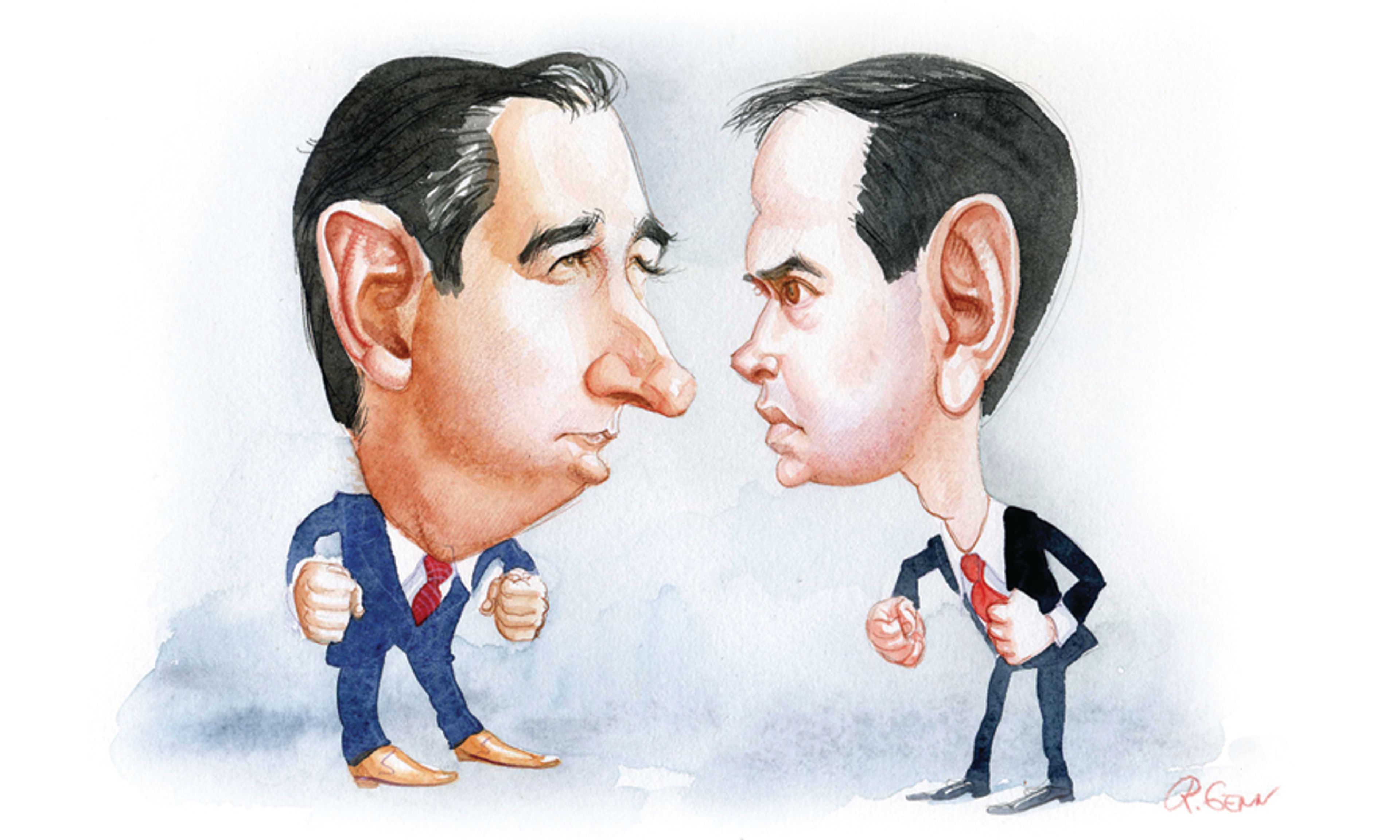
Freud wasn’t talking about party primaries when he coined the phrase “the narcissism of small differences,” but he might as well have been. The similarities between Senators Ted Cruz and Marco Rubio are demographic, biographical, and ideological. Both are young Cuban-American conservatives who won election to the U.S. Senate by defeating more established Republican politicians. They agree on nearly everything. Listening to them now, though, you would think their worldviews are fundamentally at odds. Cruz’s version of Rubio is an amnesty-loving warmonger; Rubio’s version of Cruz is a pandering isolationist. In reality, the candidates disagree more on political strategy than on policy.
The backbiting could get more intense. Many analysts think the Republican primary race could turn into a contest between the two men, with Cruz representing the more conservative factions of the party and Rubio the “party establishment.” It is a theory that so far has more adherents than evidence to back it. It depends on Donald Trump’s fading away, so that it’s not a three-way race. It also assumes that Rubio will become a more serious contender than polls currently suggest. Cruz — who has, I should note, been a friend of mine for two decades — is ahead in Iowa in some polls; Rubio isn’t ahead in any state. Cruz also seems to be doing better among the most conservative Republicans than Rubio is doing among the less conservative ones: Jeb Bush, Chris Christie, and John Kasich are competing for those same voters and are not far behind Rubio in the polls.











Comments