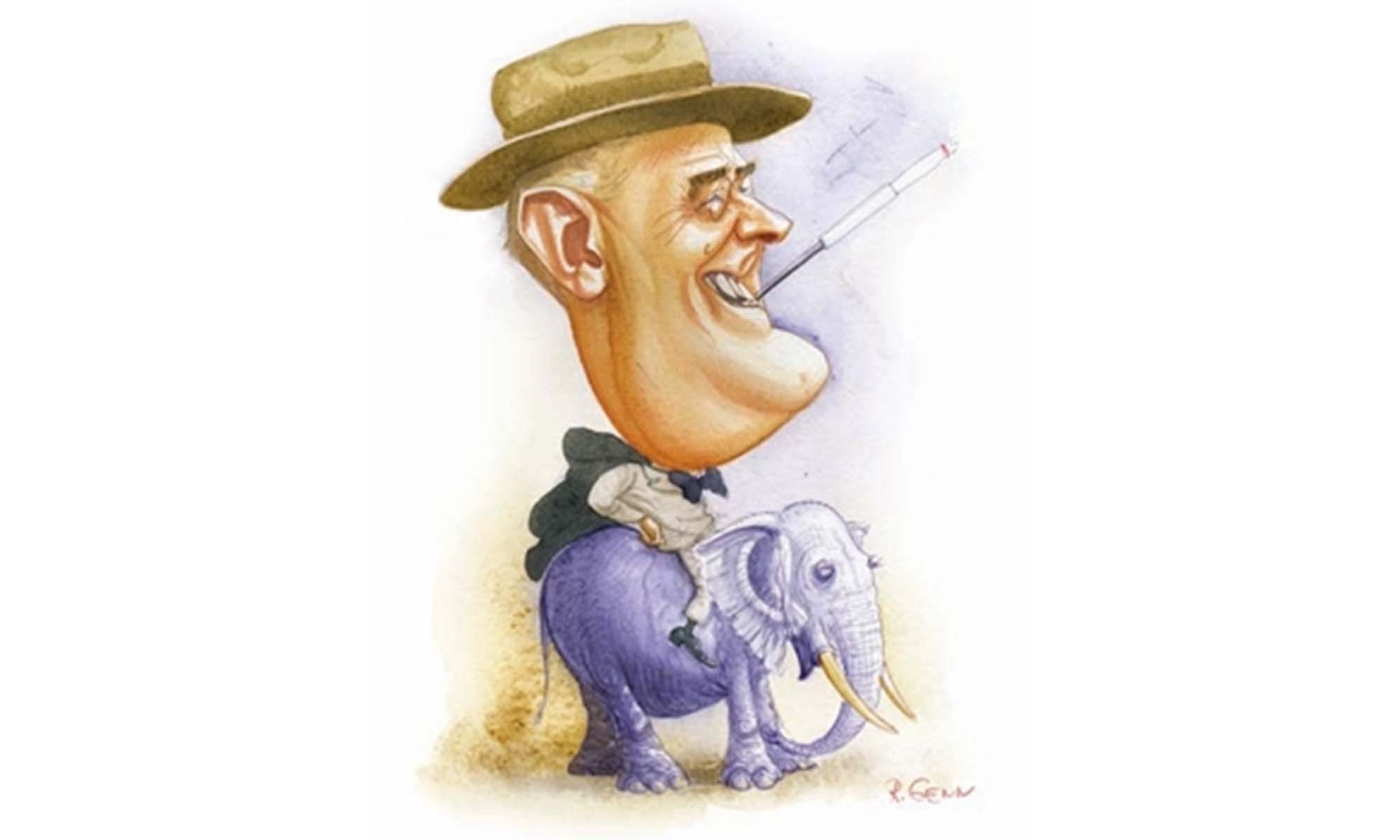
In the 1950s, President Dwight D. Eisenhower dismayed conservatives by announcing his intention to accept, more or less whole hog, the New Deal. The Right, led by this magazine, lined up against him, and finally won the day in 1980 with the nomination and election of . . . a self-described New Deal Democrat, Ronald Reagan, an FDR man who famously proclaimed that he hadn’t left the Democratic party but the party had left him, by making common cause with New Left radicals, hippies, peaceniks, freakniks, closeted and not-so-closeted reds, blame-America-firsters, and the rest of the rogues’ gallery that ascended to voguish prominence at the beginning of the 20th century’s latter half.
At the end of the Reagan years, the Soviet Union was dead on its feet, the United States was a resurgent force in the world . . . and spending and deficits both were up, thanks to the White House’s inability or unwillingness to put a leash on Tip O’Neill and congressional Democrats. The public sector was larger and more arrogant, there were more rather than fewer bureaucrats and bureaucracies, and nobody had made so much as a head fake in the direction of reforming such New Deal legacies as Social Security or even Great Society boondoggles such as Medicaid.
We did not undo the New Deal in the 1980s. We are not going to undo the New Deal before 2017 either. But there is much that can be done, if the newly empowered Republicans have the wit to do it.
Conservatives have a great deal for which to be grateful and enthusiastic as the Republican party prepares to exercise control of both the House and the Senate. But the fact remains that the American people are not as conservative as conservatives would like them to be, nor are they always conservative in the way conservatives would like them to be.
Political scientists are sometimes puzzled by the apparent disconnect between the numbers of Americans who describe themselves as “conservative” or “liberal” and the policy preferences those Americans express. The usual take on this is that American voters prefer to think of themselves as conservative even as they prefer policies more closely associated with liberals. But the greater the detail in which one examines Americans’ policy preferences, the less paradoxical this appears. American voters who describe themselves as “conservative” are, by and large, “conservative” in the same sense that Ronald Reagan was, not in the sense that Robert Taft was, or in the sense that Barry Goldwater was. They intuit that the federal government is overly large and intrusive, they resent the slackers and idlers who exploit that situation, and they worry that our long-term finances are upside down, but they do not wish to repeal the New Deal.
Example: A majority of voters believe that something must be done to rectify Social Security’s finances, and a plurality of voters believe that a combination of benefit cuts and tax increases should be adopted to achieve that. At the same time, strong majorities — precisely equal majorities of 56 percent, strangely enough — oppose Social Security benefit cuts and Social Security tax increases, according to Gallup. No doubt many of these voters think of themselves as conservatives; support for the Social Security status quo is, in the current context, not understood as a liberal position. In fact, it is likely that the great majority of self-described conservatives would support continuing current Social Security policies indefinitely — if they believed it fiscally possible. The current Left–Right divide on Social Security is not a question of what we ought to do, but of what we can do. Entitlement reform is desirable, and it is needful, but it will be politically difficult. Franklin Roosevelt’s great antagonist Senator Taft, the conservatives’ conservative, eventually came to support Social Security, even as he wrote off the rest of the New Deal as a socialist fiasco.
On the question of federal health-care and economic policies, deciding what is liberal and what is conservative is a bit more complicated than is commonly appreciated. Support for continuing Medicare as it existed until the day before yesterday may feel conservative to many voters after the advent of Obamacare. Preferring the familiar entitlement to the unwieldy progressive innovation does not make one a “conflicted conservative,” in the popular phrase of political scientists Christopher Ellis and James Stimson, any more than Reagan’s explicit support for Social Security in his “A Time for Choosing” speech made him a progressive. Populist measures are, to the surprise of nobody except scholars of political science, popular, hence the support among a majority of registered Republicans for raising the minimum wage. The political topology is both more complicated and less complicated than is generally understood.
Like partisans of any political movement, conservatives must attempt to sway public opinion in their direction. But conservatives serving in the new Republican congressional majorities also have the opportunity to meet the public where it already is on a number of issues, beginning with immigration and President Obama’s plan to issue an arguably illegal executive amnesty. Voters are solidly on the conservatives’ side on this issue, with 80-odd percent majorities supporting stronger border controls, the mandatory use of E-Verify or similar systems, and like measures. Voters also support a path to citizenship, but not the loosey-goosey version Democrats propose. If a fight over executive amnesty is to be the first skirmish between the Obama administration and the new Republican majority in Congress, then conservatives command the high ground.
The so-called Affordable Care Act presents a different sort of problem. Obamacare is unpopular, but not because Americans desire a return to the status quo ante — or a utopian free-market program, either. Republicans lost the health-care fight because they insisted that the pre-ACA regime represented “the greatest health-care system the world has ever known,” as Senator Jeff Sessions and a thousand others put it, while voters felt differently. Americans were, understandably, dissatisfied with insurance arrangements that left them not knowing whether any given health problem was going to set them back $50 or $50,000. Obamacare was based on a false promise, but the underlying popularity of such health-care-reform proposals has always been rooted in addressing the lack of security in coverage and predictability in medical expenses, using the government to give Americans a stronger hand in dealing with the health-insurance companies they despise, often with good reason. “Full repeal” is a slogan, not a health-care program.
As with Social Security, Americans are plagued by wishful thinking on the issue of health care. Subsidies and requirements to cover preexisting conditions are popular, while penalties and individual mandates are not — and never mind that the preexisting-condition requirements necessitate the individual mandate. Conservatives have some excellent proposals for health care, but we must take into account why so many Americans thought the ACA or something like it was a good idea in the first place. If we fail to address the twin problems of insecurity and unpredictability, we will fail to achieve meaningful reform, and the political pendulum will swing back toward centralized, statist approaches.
The electorate’s attitudes are often contradictory, but they are not random. For instance, Americans will generally say that they support spending more on things such as roads and education, but support for that spending declines sharply when the question is paired with the issue of raising taxes to pay for it. Republicans have not had a great deal of recent success with their traditionally potent proffer of tax cuts, but making the case against tax increases should not be very difficult, and neither should making the sensible case that more spending means, at some point, more taxes. This will present some challenges for Republicans who want to increase military spending, inasmuch as seeking offsetting spending cuts while protecting the popular entitlements that comprise the majority of federal outlays gets more mathematically difficult as proposals get more intellectually serious. Cutting unpopular foreign-aid spending all the way to zero would barely pay for four Ford-class aircraft carriers, never mind the aircraft they carry. On the other hand, simply paring food-stamp spending back to Bush-administration levels could pay for adding four nuclear submarines to the fleet every year, even accounting for the $1 billion–per–unit cost overruns afflicting the Pentagon of late.
But the dollars-and-cents issues have always been on conservatives’ side. What about the vast realm that lies beyond the borders of economics? Democrats were encouraged by the rejection of anti-abortion “personhood” amendments in the last election, and the proportions of Americans who describe themselves as “pro-life” and “pro-choice” have run neck-and-neck for many years. At the same time, crushing majorities support abortion restrictions of the sort that Republicans have been pressing for at the state level, such as bans on late-term abortions and requirements that abortion clinics be regulated in the same way as surgical facilities. Neither congressional Republicans nor their counterparts who control both legislative houses in 27 states are going to be able to categorically ban abortion in the near future, but they do have the opportunity to enact meaningful restrictions — and to force Democrats to defend grisly, inhuman practices generally opposed by nine out of ten voters.
Conservatives can look forward to taking a perverse comfort in our inevitable disappointment: Plus ça change, etc. But we can also take comfort in The American Prospect’s March 2008 augury:
The deck is stacked in the Democrats’ favor this November, but the more important question is whether the next four or eight years will mark a new era of progressive governance. If a Democratic president could prove that government can solve some of our country’s most pressing problems, then success will build on success, and the conservative case will be that much harder to make in coming years.
That did not happen, and the defining project of the Obama-Pelosi-Reid government remains deeply unpopular, politically crippled, and vulnerable to Republican subversion — assuming that the Supreme Court does not euthanize it first. Republicans should resist the temptation to pay tribute to the Democrats by making a mirror-image imitation of their errors. The American public is in many ways conservative, but in many ways it is not, and its conservatism often is not the conservatism of Milton Friedman or Phil Gramm but that of somebody who fears the national debt and dreads bureaucracy but rather likes his Social Security check. While Republicans need not be slaves to the polls, as good conservatives they must defer to certain realities, the unpleasant ones above all.











Comments