• We’ll never think about a motion to table in the Senate the same way again.
• For the past three years, prosecutors, courts, and congressional committees have attempted do-overs of the failed second impeachment, for January 6, of Donald Trump. But there is no legal shortcut: His fitness to be president is now for the voters to decide. It would be particularly explosive to disqualify Trump from the ballot after more than a year of campaigning, at the end of which he leads in the polls. Such a drastic step should be taken only on the most definitive legal grounds. The Colorado supreme court, in trying to disqualify Trump under Section 3 of the 14th Amendment, has no such mandate. Incitement has never been a basis for disqualification under Section 3, so the court had to stretch its language to claim that Trump “engaged in” an insurrection on January 6 through his lassitude and a few tweets during the riot. But as U.S. attorney general Henry Stanbery wrote in 1867, “the force of the term to engage carries the idea of active rather than passive conduct.” The 4–3 decision divided even the Colorado supremes, all of them appointed by Democratic governors. It likely now heads to the U.S. Supreme Court ahead of the January 5 deadline to set the Colorado primary ballot. We still hope that Republican primary voters reject Trump’s candidacy and put disputes over insurrection behind us. Trying to short-circuit that decision in the courts, however, is likely to make things worse rather than better.
• Over Thanksgiving, President Biden was shopping on Nantucket when Lucas Tomlinson of Fox News shouted a question at him: “Mr. President, are you too old to be running for reelection?” Biden responded, “That’s stupid.” A gargantuan majority of the American people disagrees; leave it to Biden to dismiss the electorate’s biggest concern about him as “stupid.” A national poll conducted by Monmouth in October found that 76 percent of Americans, including 56 percent of Democrats, think Biden is too old to serve another term. An Economist/YouGov survey asked in December, “How much of an effect do you think Joe Biden’s health and age would have on his ability to fulfill his duties as President, if he were re-elected in 2024?” Fifty-five percent said it would “severely limit his ability to do the job”; among registered voters, the number jumps to 57 percent. A CBS News/YouGov survey in September found that just 34 percent of respondents thought Biden would finish his second term if reelected. His shuffling walk, meandering remarks, and foggy memory have given Americans plenty of reason to worry about an 81-year-old president and candidate. Ages 82 through 86 aren’t likely to be a smoother road.
• Hunter Biden’s response to a congressional subpoena was a media statement on Capitol Hill, orchestrated by Representative Eric Swalwell (D., Calif.). Biden thus invited a contempt citation… but not before proclaiming that his father “was not financially involved” in his business — another shift of the goalpost, forced by derision of the White House mantra that the president had no involvement at all. Unamused House Republicans later voted unanimously to approve a Biden-impeachment inquiry: a victory for Speaker Mike Johnson. Upon returning from the holidays, Republicans should press the impeachment probe, issue a criminal referral for Hunter, and impose discipline on Swalwell (possibly by stripping more committee assignments from him) for facilitating Hunter’s contempt of Congress.
• Jack Smith should be careful what he wishes for. He has asked the Supreme Court to intervene prematurely in his election-interference case against Donald Trump, who claims he has immunity from criminal prosecution for actions taken as president. Trump may be wrong about that, but the Supreme Court has never ruled on the question. Of more immediate importance: Immunity rulings are appealable pre-trial — important because Trump’s strategy is to delay the trial until after the election. When Judge Tanya Chutkan ruled he had no immunity, Trump appealed to the D.C. Circuit. Once a case is on appeal, the trial judge loses jurisdiction over it. If the appeal dragged out, that would jeopardize Smith’s presumed goal of convicting Trump prior to the election. So in an unusual move, the prosecutor asked the Supreme Court to decide the immunity issue now. The justices directed Trump’s counsel to respond to Smith’s gambit — and then announced they would entertain the claim of several January 6 defendants that the criminal-obstruction statute is unconstitutional. That statute is at the heart of Smith’s case against Trump — and his theory is more of a reach than is the application of the statute to rioters. Plus, in a case last term throwing out two corruption convictions of cronies of former New York governor Andrew Cuomo, the justices warned prosecutors not to push the limits of fraud (also central to Smith’s case) and other ambiguous laws. Smith just wants to argue about immunity; the last thing he intended was to invite pre-trial Supreme Court scrutiny of his dubious charges.
• A federal jury in Washington, D.C., ordered Rudy Giuliani to pay $148 million, including $75 million in punitive damages, to two Fulton County, Ga., poll workers for defaming them in the aftermath of the 2020 election. A judge had already ruled that Giuliani’s statements were defamatory, and Giuliani declined to testify in his defense with criminal charges pending against him in Georgia. The former New York City mayor and Trump-campaign attorney identified the two women in security-camera videos from a ballot-processing facility and falsely claimed they had inserted a USB drive into election machines and were adding fake ballots to the vote count to boost Joe Biden. After these claims were publicized by Giuliani and the website Gateway Pundit, the women, who are black, received a torrent of threats and harassment, often racist. The mistreatment of these private citizens is emblematic of why it’s gotten so much harder to find public-spirited volunteers to staff elections around the country. Even if the courts properly reduce the $148 million figure, the outcome is likely to wipe out what’s left of the fortune Giuliani amassed in the years after he left Gracie Mansion. The damage Giuliani has done to his once-sterling reputation will be even harder to repair.
• The ten Wisconsin Republicans who cast provisional “electoral votes” for Donald Trump for use in post-election challenges in Congress have settled a lawsuit against them filed by two of the state’s Biden electors. While the electors did not pay the money damages sought in the suit, and the settlement includes no admission of guilt or culpability, it admits that the electors’ actions were “part of an attempt to improperly overturn the 2020 presidential election results.” The “electors” also acknowledged Joe Biden as the rightful winner: “We hereby reaffirm that Joseph R. Biden, Jr. won the 2020 presidential election and that we were not the duly elected presidential electors for the State of Wisconsin for the 2020 presidential election. We oppose any attempt to undermine the public’s faith in the ultimate results of the 2020 presidential election.” The electors were pawns in Trump’s legal and extralegal efforts to overturn the election, but they were not unwitting ones. They are not the first participants in that effort to admit, when forced to face the music in court, that Trump’s claim of a “stolen election” was untrue.
• Kevin McCarthy (R., Calif.) is leaving Congress. We can’t blame him for being bitter at how a backbench rebellion by just eight members of his caucus ousted him after nine months on the job to which he had spent his whole career climbing and in which he did his best at playing a weak hand. His comportment on the way out, however, has vindicated his critics on all sides. He is abandoning his House seat mid term, leaving his straitened caucus with an even narrower margin and his constituents unrepresented until a special election can be held. What opportunity is so pressing that he couldn’t have waited a year? McCarthy then endorsed Donald Trump — something that he no longer needs to do for caucus unity but that might help him angle for a job in a Trump cabinet. The coda reflects poorly on McCarthy’s core beliefs, or lack of them.
• Bipartisan majorities of Congress want to continue funding Ukraine’s defense, but whether a new aid package will be approved is still in doubt. At issue is the amount of funding, what transparency and accountability provisions are appropriate, and how to satisfy demands that the funding be coupled with policies to address illegal immigration across the southern U.S. border. To dump Ukraine now would be an egregious abandonment of our ally and an act of strategic self-sabotage, in exchange for relatively small fiscal savings. Many Republicans demand that H.R. 2, the strongest immigration-enforcement bill ever passed by a chamber of Congress, be included in any Ukraine package, but Senate Democrats are insurmountably opposed. A more achievable immigration goal would involve serious restrictions on the parole of unauthorized migrants and mandates for more detention space for them. With the House gaveled out of session, there likely won’t be much movement until early in the new year. It would be remarkably shortsighted not to take the opportunity to advance two important goals at once. But, since this is Congress, failure is always an option.
• A cleavage has opened up on the left. Traditional Democrats such as President Biden and Senate Majority Leader Chuck Schumer are unambiguously pro-Israel. At the White House Hanukkah party, Biden proclaimed himself a Zionist. “You don’t have to be a Jew to be a Zionist, and I am a Zionist.” Schumer gave a heartfelt speech on the Senate floor denouncing antisemitism and defending Israel. In front of the White House, some of Biden’s own staffers held a “vigil” to urge Biden to support a “permanent cease-fire” in the Gaza war. (The participants wore sunglasses and masks.) According to polls, Biden is hemorrhaging support among Democrats on this issue. The young in particular do not share the views of Biden, Schumer, et al. An article in the New York Times said, “The young Biden ’20 voters with anti-Israel views are the likeliest to report switching to Mr. Trump.” We’ll see if they mean it next year. Yet if a politician is going to lose, there are less honorable ways of doing it than to support Israel in its time of peril.
• In the usually humdrum environment of pre-Christmas Washington, a video of a Senate staffer in flagrante delicto in a hearing room emerged and circulated widely. The staffer was soon identified as Aidan Maese-Czeropski, from the office of Ben Cardin (D., Md.). It was then found that Maese-Czeropski was also the previously unnamed staffer who had shouted “Free Palestine” at Representative Max Miller (R., Ohio), who is Jewish. Maese-Czeropski responded to the latter charge with lawyerly prose that made his culpability ambiguous. On the former charge, however, he defiantly invoked his homosexuality: “I have been attacked for who I love to pursue a political agenda,” he said. Admitting past “poor judgment,” the (inevitably) now-former staffer asserted he would never “disrespect” his workplace. One wonders what he thinks would qualify.
• Liz Magill, Claudine Gay, and Sally Kornbluth look to become the Dylan Mulvaneys of woke higher ed. After their clumsy and hypocritical testimony before the House on the storms of antisemitism that have blown on their campuses, Magill, president of Penn, and Scott Bok, chairman of the board of trustees who backed her, resigned their positions. Harvard’s board of governors stuck by President Gay, despite embarrassingly credible allegations that her slight sheaf of academic papers was marred by plagiarism. Harvard has a $51 billion endowment, tax free, so it can ride out negative alumni reactions, but the smudge on its reputation remains. The House voted, 303 to 126, to condemn the presidents’ testimony as “evasive and dismissive.” (The resolution was moved by two Republicans and two Democrats, though all but one of the nays were Democrats.) Further congressional investigation is sure to follow. There can be no thoroughgoing reform until campus diversity-equity-and-inclusion bureaucracies are abolished. Since the racial discrimination that DEI embodies — anti-white, anti-Asian, anti-Jewish — violates the Civil Rights Act, federal pressure could help. But the underlying intellectual paradigm of construing all human interactions as racial, and all history as colonial or anti-colonial, will have to give way to some new fashion, probably no more correct but, one hopes, less pernicious.
• In Wisconsin, meanwhile, DEI has lost a round, thanks to assembly speaker Robin Vos. Over the summer, Vos said assembly Republicans would not approve funding for capital projects or pay raises unless the University of Wisconsin system made cuts to DEI, which, he added, really stands for “division, exclusion, and indoctrination.” The Democratic governor, Tony Evers, line-item vetoed the DEI cuts that Republicans had included in the state budget. After months of negotiations, Vos’s stance materialized into a deal with the university system. In exchange for funding raises and new buildings on campus, the UW system would freeze all DEI hiring, reassign 43 DEI officials to other jobs, and create a position at the flagship campus in Madison for the study of conservative political thought. An affirmative-action hiring program and a requirement of diversity statements in student applications would be abolished. UW would adopt a race-blind admissions program in which Wisconsin students who finished in the top 5 percent of their high-school class would be guaranteed admission at Madison and students who finished in the top 10 percent would be guaranteed admission at other campuses. The board of regents initially rejected the deal in a 9–8 vote. Vos stood his ground. Realizing he was serious, the regents approved the deal five days after the initial vote. A win for Vos, and for Wisconsin’s students.
• For years now, Donald Trump has told “sir” stories. He says that someone said to him, “Sir…” — and the tale proceeds from there. He told a doozy the other day. He said that a general had extolled him for taking the debate stage against Hillary Clinton in 2016 after the release of the Access Hollywood tape. (On this tape, Trump could be heard making vulgar remarks about women.) Trump, giving no indication of joking, said the general had said to him, “Sir, I’ve been on the battlefield. Men have gone down on my left and on my right. I stood on hills where soldiers were killed. But I believe the bravest thing I’ve ever seen was the night you went onto that stage with Hillary Clinton after what happened.” If there is a tape of a general saying this, as there is for Trump’s Access Hollywood remarks — we’d like to hear it.
• Kate Cox’s unborn child was diagnosed with trisomy 18, which, given current U.S. medical practices, usually leads to death in the womb or in the first year after birth. If she carried the baby to term, she would have to have her third C-section. A Texan, she sought a medical exemption from the state’s abortion ban. Her lawyers noted such risks as that 0.9 percent of women need hysterectomies after a third C-section. (Cox wants to have more children.) Texas law, however, allows abortion only in life-threatening conditions. Cox left the state to have an abortion. Abortion advocates exploited this sad story by misrepresenting it, falsely claiming both that the baby was guaranteed an early death and that the Texas supreme court, in denying her an exemption, had put her life in danger. We can debate whether abortion should be available in cases of major fetal abnormalities, as even some states that generally prohibit abortion have decided — but not if that debate is pervasively dishonest.
• Boston mayor Michelle Wu sent an invitation for an “electeds of color” holiday party to state officials who didn’t meet that criterion. She publicly regretted the faux pas. She did not regret, but certainly should have, her agreement to host an “electeds of color” gathering in the first place. Individuals have the right to associate with or dissociate from whomever they wish, however divisively, but public servants — in their capacity as public servants — shouldn’t self-segregate from their colleagues and fellow citizens. The mayor is a Massachusite and a Bostonian first, and in her public role she should identify with her entire political community.
• A series of attacks on American shipping interests compelled the Congress to consent in 1794 to the commissioning of six frigates tasked with putting an end to the Barbary pirates’ marauding. The U.S. Navy assumed responsibility for the preservation of the maritime-trade regime from the British at the end of the Second World War, and it has so far done a commanding job of maintaining that linchpin of the global economy. Since the October 7 massacre in Israel, Iran-backed Houthi militants have reportedly fired ordnance in the “general direction” of U.S. ships in the Red Sea and have downed an American drone. They have targeted commercial shipping vessels with high explosives. The unacceptable threat to their assets compelled multinational shipping giants such as MSC, Maersk, and British Petroleum to reroute their ships away from the Houthis’ reach. But avoiding the Bab el-Mandeb Strait — a narrow waterway between the Horn of Africa and the Arabian Peninsula that leads into the Red Sea and, eventually, the Suez Canal — is no minor inconvenience. The firms that have already announced they are steering away from the strait account for roughly 60 percent of global maritime trade. Hundreds of billions of dollars and the stability of the global supply chain are now in the balance. The Pentagon announced that it was creating a new multinational task force with the goal of protecting ships transiting through the Red Sea. That sounds like a valuable enterprise save for the fact that U.S., British, and other Western naval assets are already engaged in that very mission. What is needed now is offense.
• Alexei Navalny may be Putin’s most dangerous opponent from the depleted ranks of Russia’s democrats. While he has disavowed some ugly earlier rhetoric, he remains a Russian nationalist, placing him on territory that Putin considers to be his own. And his attacks on Putin’s corruption resonate in a country where justified cynicism about those in charge stretches back to the tsars. An assault in 2017 left Navalny partially blind in one eye, and in 2020 he had to receive treatment in Germany after being poisoned. Even knowing that he faced arrest on trumped-up charges, he flew back to Russia rather than accept exile, a mark of his belief that Putin’s system can be defeated. Since Navalny came back, he has been held in increasingly harsh conditions (his health has suffered as a result) and handed longer and longer sentences of imprisonment. He is not due for release until 2038. He was set to be transferred to a brutal “special regime colony.” As of now, he has “disappeared” within the system. This secrecy may be a matter of routine cruelty, or it could signal something worse. Either way, he must not be forgotten.
• The show trial of Jimmy Lai, the 76-year-old Hong Kong pro-democracy icon and former newspaper owner, recently began. If Lai is convicted — a near certainty, given the Chinese Communist Party’s grip on Hong Kong’s previously autonomous legal system — he could spend the rest of his life in prison. The persecution of Lai is part of the party’s merciless campaign to crush the remaining freedoms of the island city. Demonstrators no longer take to the streets. Major figures in the pro-democracy movement have been forced to flee or face arrest. Independent media have been shut down; Lai’s Apple Daily was raided and forced to close. Americans, Hong Kongers, Taiwanese, and everyone else in Communist Chinese crosshairs should regard the sham proceeding as a warning of things to come.
• Nicolás Maduro appears to have backed down from his dangerous preparations to seize the natural-resource-rich Guyanese territory of Essequibo by force. His government held a referendum recently to drum up popular support for annexing the territory and claimed victory. A successful annexation would strip Guyana of more than half its land, throw the region into chaos, and threaten U.S. oil companies there. The good news is that the Venezuelan dictator met recently with Guyana’s president and the two vowed not to use force. But Maduro’s word is worth as much as his country’s currency.
• COP28, the U.N.’s latest climate jamboree, is over, the last private jets carrying VIPs home from Dubai flown off. COP28 disappointed the climate fundamentalists, who were always going to be disappointed that more was not done to stave off apocalypse. Some were also disappointed that nuclear energy was finally mentioned as part of the solution to climate change. In another, less welcome first, the conference agreed that fossil fuels should be phased out, although no timetable was set, and neither was any explanation given of how this goal could be achieved. Talk of a massive expansion of renewable energy — in advance of technological feasibility — was another reminder that realism plays little part in deliberations such as these. More attacks on cheap, reliable energy in the West will enrich OPEC+, damage Western economies, give a geopolitical boost to Xi and Putin, and do little or nothing for the climate.
• News outlets far and wide reported that the Vatican had declared that priests might bless same-sex unions. Many Catholics protested that it was closer to the truth that the Vatican had said that priests might bless people in same-sex unions. The document explicitly states that same-sex marriage will always be a contradiction in terms and that “any rites and prayers that could create confusion [around] what constitutes marriage… are inadmissible.” But the Vatican did not rush to clear away any of the confusions that the statement itself created, while progressives seeking thorough doctrinal change claimed victory. It has become the standard procedure in this pontificate: Francis never embraces heresy but often winks at it.
• In summer 2020, James Bennet was the editorial-page editor of the New York Times. He decided to publish an op-ed by Senator Tom Cotton (R., Ark.), who suggested federal force to stop the riots occurring alongside the George Floyd protests. The newspaper’s staff responded by erupting in a panic and outrage, and publisher A. G. Sulzberger tossed Bennet out. Three years later, Bennet has offered his side of the story in 17,000 words for the Economist. His assessment of what ails the Times will leave third-degree burns. Choice excerpts include “The Times’s problem has metastasized from liberal bias to illiberal bias, from an inclination to favor one side of the national debate to an impulse to shut debate down altogether” and “The reality is that the Times is becoming the publication through which America’s progressive elite talks to itself about an America that does not really exist.” Sulzberger responded by declaring, “I could not disagree more strongly with the false narrative he has constructed about the Times,” but offered no specific refutation of the facts. The idea that narratives can and should float free from facts is of course part of what Bennet is diagnosing.
• Out-of-context image, snap judgment, mass condemnation: By the time facts show that the whole proceeding was baseless, the damage is already done. It’s grievous for anyone to be subjected to this treatment, and it’s especially unjust for the young. The malicious media-driven contretemps over then–high schooler Nick Sandmann at the 2019 March for Life was illustrative of such injustice. Now we have Holden Armenta. Carron J. Phillips, a senior writer for Deadspin, spotted the nine-year-old dressed in team garb and sporting face paint at a Kansas City Chiefs game. Phillips decided to try to make an example of Armenta as a racist by posting a picture that showed only the half of his face that was painted black. But the other half was red, and the face paint was identical to that of countless Chiefs fans over the years. If it matters, Armenta also has Native American ancestry — for real, not like Elizabeth Warren. Phillips weakly defended himself but, amid a welcome backlash, deleted an accusatory tweet and updated his article. When Armenta’s parents, taking a page out of the Sandmann playbook, threatened to sue, Deadspin updated the article further and appended an apologetic statement to it. With luck, we are now one step closer to the end of this kind of false-outrage story.
• Norman Lear, longtime television producer, was an early contributor to Donald Trump’s presidential campaigns. In January 1971 his sitcom All in the Family introduced the Bunkers, bigoted Archie and his flighty wife Edith, and their liberal daughter and son-in-law, to the public. What did this have to do with Donald Trump? Nothing — except identifying, and attempting to shame, his future fan base. Archie was the original deplorable: aggrieved, surly, cantankerously right-wing. Many of the popular show’s viewers probably sympathized with him, especially since his younger family members, who were the show’s moral mouthpieces, were so dull. But Archie was meant to be a boob. He was presented as America’s underside. This was new for sitcoms: Earlier hits showed American family life as cozy, or zany. Various responses to the liberal indictment are possible; Trump’s is to give the middle finger. Lear produced many more shows; ran a liberal pressure group, People for the American Way; and, admirably, owned and exhibited an early printing of the Declaration of Independence. Dead at 101, R.I.P.
• Juanita Castro was a brave woman. She was a sister of Fidel and Raúl. She fully supported the Cuban revolution — but she was appalled by what her brothers did with power. She helped dissidents escape capture and execution. She even worked for the CIA (as she revealed in a memoir published in 2009). “I didn’t betray him,” she said of Fidel. “He betrayed me.” What’s more, “he betrayed the thousands of us who suffered and fought for the revolution that he had offered, one that was generous and just and would bring peace and democracy to Cuba.” In 1964, the sixth year of the dictatorship, Juanita fled to the United States. “I cannot remain indifferent to what is happening in my country,” she said. “My brothers Fidel and Raúl have made it an enormous prison surrounded by water.” In Miami, Juanita opened a pharmacy (Mini Price). It is not easy to break with family, even when that family is monstrous. Juanita Castro did it. She has died at 90. R.I.P.
Not Again
On January 15, Iowa Republicans will caucus to say who the party’s next presidential nominee should be. On January 23, New Hampshire will vote in a primary to do the same. Donald Trump ends 2023 with fat leads in the polls in both states.
His supporters recall good things his administration did: diminishing the flow of illegal immigrants, nominating constitutionalist federal judges and justices, midwifing the Abraham Accords. They find something admirable in his communication style: half strident, half goofy, almost always flowing and informal. Or they think he would be the best candidate to stop a second Biden term.
They are mistaken.
The problems that hobbled his term remain. Trump took conservatism and the GOP in some wrong new directions. His economic ideas leaned toward protection while his foreign policy flirted with isolation, as if the relative prosperity and peace of the post–World War II world required no ongoing structures or effort. His admiration for the world’s dictators, frequently expressed, threatened to blow America’s moral example to smithereens. Trump did not have to be blackmailed or bribed by Putin to like him; he genuinely admired the KGB vet’s style. Add to this the foibles and quirks that made his policies hard to execute: disorganization, laziness, capricious treatment of cabinet secretaries and staff. Even when he was right, he got a lot wrong: Immigration slowed because he made a deal with Mexico to hold wannabes there while they could be vetted; the big beautiful border wall was BS, and immigration law remained the same.
Trump comes now trailing new problems like cans tied to the tail of a dog. He hopes to repeat Grover Cleveland’s feat of winning the White House after first winning and then losing it. But he does not admit he actually lost it in 2020. After filing a raft of futile legal challenges, he sicced a mob of his followers on the Capitol to disrupt Congress’s counting of the electoral votes. This vicious stunt should have discredited him even among his sympathizers. But he has spent the years since repeating his tales of ballot stuffing while grooming denialist yes-men and -women. His obsessions cost the GOP two Senate seats in Georgia in the 2021 runoffs and several more races in the 2022 midterms.
Trump captured attention his first time around, in part, by talking about issues that other candidates scanted: the threat of China, chaos at the southern border. This time around, the issue, always close to his heart but now crowding out all others, is himself. He says he is hated and was kept from his 2020 victory because he is the tribune of his audiences. He showed his real priorities when he pardoned Steve Bannon for defrauding his supporters.
If he were to win, who would help him govern? Capable or at least ordinary figures populated his inner circle last time around, balancing the Bannons and the Stones, the Scaramuccis and the Omarosas. Most left his service slandered by him and disgusted by his antics. A few might volunteer out of concern for the republic; more would be time-servers; the rest would be scraped from the rotten logs of media and politics.
Realistically, how can he win? Polls, which are poor predictors this far out, show him leading Biden in swing states and national averages. They do not account for his likely status next year as the defendant in numerous prosecutions, bound by gag orders, perhaps wrongly or rightly found guilty by astounded juries. Conservatives, Republicans, and the country need a GOP candidate who is younger, smarter, truer, and above all saner. No Trump in 2024.
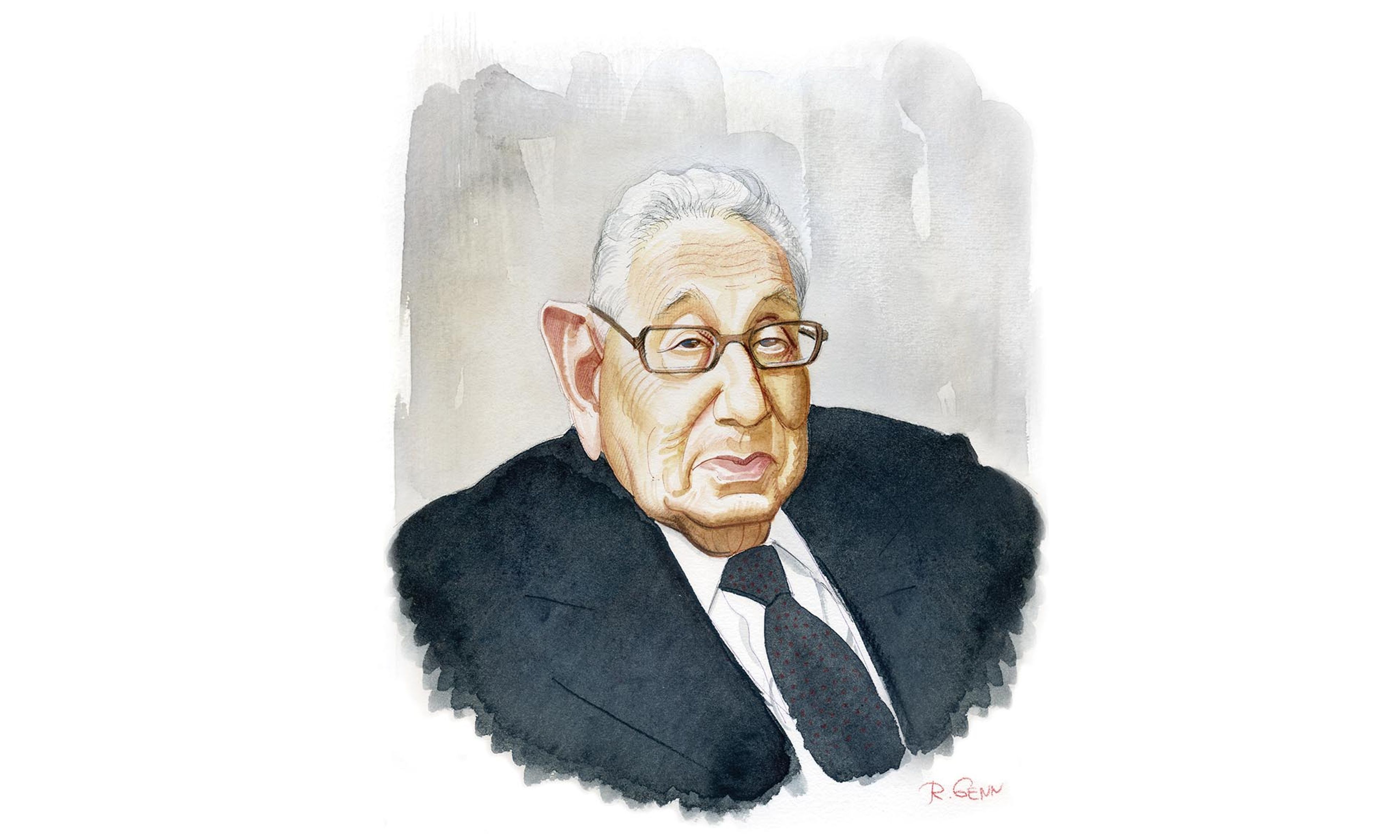
Henry Kissinger, R.I.P.
Born and raised in Bavaria, 15-year-old Henry Kissinger and his family arrived in the United States in 1938, five years after Adolf Hitler came to power, one year before Hitler plunged Europe into war. One of the best recent books on Kissinger, Barry Gewen’s intellectual biography, is titled “The Inevitability of Tragedy.” Turmoil was Kissinger’s, and his generation’s, birthright. Studying it, managing it, trying to tamp it down, became his life’s work. Avoiding it, he knew, was an impossibility.
On the faculty at Harvard, the perch to which his brains and industry brought him, Kissinger was a Cold War liberal of a “realist” bent (his doctoral dissertation had been on Metternich). But he also invited WFB to address his classes. This was out of respect for WFB’s talents and, soon, gratitude for his friendship. But it was also astute politics: One never knew when a friend on the right might be useful. WFB indeed helped introduce Kissinger to Richard Nixon’s circle.
Kissinger’s record as Nixon’s national-security adviser, then as secretary of state, is the foreign-policy record of the Nixon administration. Nixon, intelligent and experienced, set his own course. But Kissinger approved, implemented, and, in professorial media turns, publicized it. The tilt to Pakistan, the opening to China, the Yom Kippur War and shuttle diplomacy, toppling Allende, Vietnam peace talks: All bore Kissinger’s fingerprints. Kissinger’s reading of the Cold War’s power balance and of America’s capabilities was meliorist and struck conservatives as defeatist. (WFB’s NR columns on Nixon’s trip to China were savage.) Kissinger thought he was doing the best that could be done in a bad world.
Ronald Reagan’s ascendancy in the GOP changed the party’s attitude, and the country’s. Reagan’s view of the Cold War, as he told an associate early on, was “We win and they lose.” But Kissinger kept his hand in, as an adviser and commentator — in Washington lingo, a wise man. One of his latest pieces of advice was among his least wise: He was a lifelong advocate of engagement with Communist China. He profited as a consultant, but the more important motive was pride: He could not bear to see his historic opening becoming a dead end. That was a tragedy he could not face.
When WFB retired as editor in chief of NR, Kissinger offered to throw him a dinner at his East Side river-view apartment. You make the guest list, he said. WFB invited all his youngest colleagues to hear the wise man’s tour d’horizon. Two affectionate gestures, two of many.
Dead at 100. R.I.P.
The Stat
2002 — the year federal outlays were roughly the same size as the 2023 federal deficit, according to the Congressional Budget Office.
The federal deficit in 2023 was about $2 trillion. That includes an adjustment of about $300 billion to account for the purported savings from the Supreme Court’s recision of the Biden administration’s student-loan-forgiveness program. According to budget-scoring guidelines, the deficit was $1.7 trillion because the program was included in expected spending, so the Supreme Court’s decision was counted as a spending cut. The “savings” never actually happened, so the deficit was really $2 trillion. The CBO says total federal outlays in 2002 were $2.01 trillion. (The deficit that year was $158 billion.) In 2023, the federal government added as much to the debt as it had spent in total only 21 years prior.
by Dominic Pino











Comments