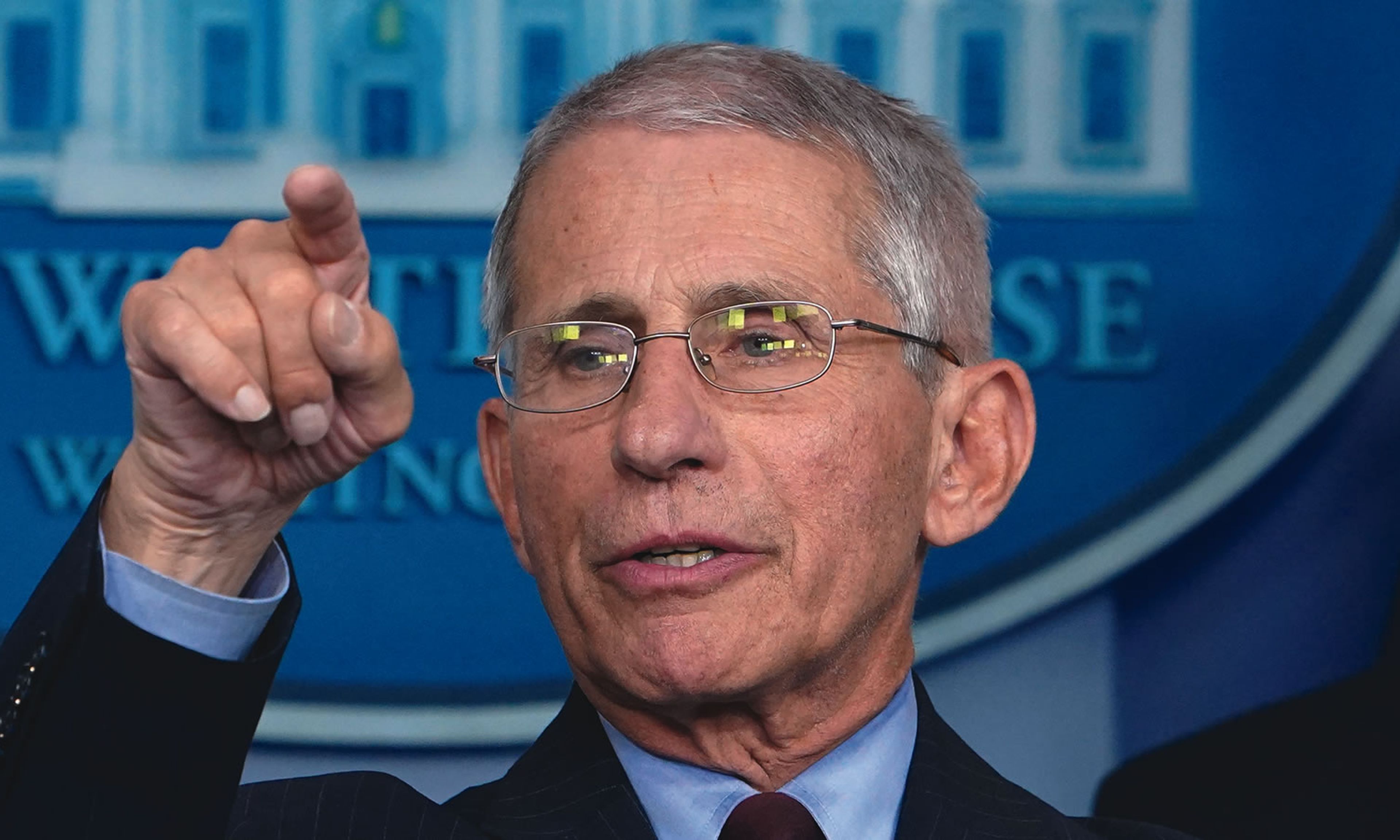
Has Dr. Anthony Fauci been lying about COVID? That’s the accusation that Senator Marco Rubio (R., Fla.) made in the closing days of 2020 about the director of the National Institute of Allergy and Infectious Diseases. Fauci “lied about masks in March,” Rubio tweeted, and “has been distorting the level of vaccination needed for herd immunity.” His conclusion: “Many in elite bubbles believe the American public doesn’t know ‘what’s good for them’ so they need to be tricked into ‘doing the right thing.’”
Media fact-checkers slammed Rubio. “False and misleading,” an article on CNN’s website called his remarks: Fauci’s advice had merely evolved as our understanding of the science of COVID advanced. But the truth is murkier than that.
On February 17, 2020, USA Today quoted Fauci saying that most drug-store masks were worthless and “there is absolutely no reason whatsoever to wear a mask” in the U.S. In a 60 Minutes interview aired March 8 — probably the one Rubio had in mind — Fauci said, “Right now in the United States, people should not be wearing masks.” He offered three reasons for this view: A mask is “not providing the perfect protection that people think that it is”; it will lead wearers to touch their faces more often; and the supply should be reserved for health-care providers and the ill.
A few weeks later, on April 3, he told PBS NewsHour that we now had evidence that many people who showed no symptoms of COVID were transmitting it, and so people should wear masks to protect others. On May 12, he told the same show that mask-wearing would be helpful and that previous advice to the contrary had been based on a temporary shortage of protective equipment for health-care workers. On July 14, he said that he did not regret the early anti-mask advice and had switched to a strong pro-mask line as soon as it became clear that people without symptoms could spread the infection and health providers had enough equipment.
Let’s extend some charity to Dr. Fauci, who has doubtless been working long and stressful hours and not pored over the record of his previous statements. The fact remains that his explanation for his shift has itself shifted, and has failed to explain. The initial comments about fiddling, overconfident mask-wearers fell away, forgotten. The counterintuitive theory that masks might be needed for those at high risk of infection but could be harmful for everyone else was never elaborated. The post hoc story about new information on asymptomatic transmission does not fit the actual timeline: On January 31, 2020, Fauci said at a press conference that it had occurred. CNN reported the same day that he had said — this was the headline to the article — “there’s no doubt” about such transmission.
Fauci’s back-and-forth on masks has led to persistent criticism, including, sometimes, from Donald Trump when he was president. Rubio’s tweet came after a new controversy. On Christmas Eve, the New York Times reported that Fauci had been raising the estimate he gave in public of the percentage of Americans who would have to acquire resistance to the coronavirus for the population to achieve herd immunity. At the start of the pandemic, he had said 60 to 70 percent, but by year’s end his high-end estimate was 85 or even 90 percent.
“Dr. Fauci acknowledged that he had slowly but deliberately been moving the goal posts. He is doing so, he said, partly based on new science, and partly on his gut feeling that the country is finally ready to hear what he really thinks,” the Times reported. He told the Times that as polls found a higher proportion of Americans willing to take a COVID vaccine, he felt comfortable raising the target.
A few days later, Dana Bash asked him about this report on CNN: “Why weren’t you straight with the American people about this to begin with?” He rejected her premise and offered three defenses: We can’t know an exact number (“We have to be humble”); his estimates had never taken a “big leap”; and it was important to encourage more vaccination. Rubio fired his shot later that day.
If we define “lying” strictly as the telling of a known falsehood, there isn’t a slam-dunk case that any of Fauci’s comments counts. On March 8, 2020, Fauci probably thought that most Americans should not try to get masks, just as he told 60 Minutes. But it is not a record of candor, either. At best, he was downplaying the utility of masks out of concern about a supply shortage. His comments about herd immunity were, on his own account, designed at least as much to elicit desired behavior from the public as to share information, or even his considered judgment, with it.
Some of Fauci’s critics have depicted him as a slippery political operator, one made more insufferable by his pretensions to be something else. In July 2020, he told an interviewer from the Financial Times, “I have a reputation, as you probably have figured out, of speaking the truth at all times and not sugarcoating things.” Around the same time, he summed up for the Washington Post what his long career had taught him: “What I learned is don’t be political. Be medical. Be scientific.” Presumably there has been just a little more to his managing to keep his job under seven presidents.
But it would be a mistake to see the twists and turns of Fauci’s commentary during the COVID pandemic merely as evidence about his personal honesty. One reason for his longevity is his excellent reputation within the world of public health. On every issue but one, he has been fully in synch with that world throughout the pandemic. (The one exception was the issue of Trump, whom most of Fauci’s peers detest but he appeared alongside at press conferences.) When he cautioned against panic over COVID, when he discouraged mask-wearing, when he later encouraged it, when he said we would have herd immunity at 60–70 percent: At every point he was speaking from within a consensus.
The question Fauci’s record raises is not just whether he is a truth-teller or a liar. It is whether something in the field of public health militates against blunt honesty: whether, that is, it conditions its experts to think of most people as objects of manipulation rather than fellow adults.
It is an understandable habit of mind. Much of the time, when an epidemic is not the center of attention, public-health experts are working to get people to stop undermining their own health through smoking, or eating too much of the wrong foods, or drinking to excess, or having unsafe sex. During epidemics, our free choices can pose hazards to others. At any time, a large number of us can be counted on to be irresponsible or foolish. Most of us know little about science or medicine, especially compared with those who have degrees in it.
Too many of us, in our lack of expertise, invite paternalism upon ourselves. President Joe Biden speaks for a lot of people when he says we should listen to experts and follow the science. We are to imagine that scientists — or administrators of science, a better descriptor for Dr. Fauci — have access to data that straightforwardly, or at least probabilistically, tells them what should be done. What the experts must really do, especially in hard cases, is provide informed judgments based on their long immersion in a field. But they will pretend that their fallible, value-laden, and subjective judgments are none of those things, if that is what we demand from them, and if it will make us amenable to taking their advice.
So doctors on television will tell us first that science says mask-wearing is useless and then that science says it is vital, rather than saying that our best guess is that it is probably pretty helpful in a lot of situations, especially in hospitals. Or they will work furiously to tamp down speculation, or even inquiries, about the origins of COVID-19 for fear of what effects the diffusion of information could have. Or they will tell us that scientific expertise has reached conclusions about who should get vaccinated first, hiding in the fine print that the conclusions are based on highly disputable premises about racial justice — matters about which no amount of medical training can give anyone special insight.
This attitude toward science is so widespread that even the libertarian reaction to lockdowns has typically sought merely to elevate a different group of experts, who say that what science really tells us is to do the opposite of what most influential scientists are advising.
The pandemic has put the relationship between the public and the scientists to a test. Fauci has lamented how many Americans “just don’t believe science and they don’t believe authority.” But nothing has corroded confidence in Fauci more than his own self-conscious efforts to influence public opinion. Think as ill as you want of President Trump, his response to the pandemic, and his bizarrely tempestuous relationship with Fauci: It’s still true that Fauci’s mask zigzag gave Trump something to ridicule.
Fauci has not given anyone reason to doubt that he is a dedicated and conscientious public servant. If we sometimes have ground for objecting to what he says, perhaps it is because we are asking too much of him.












Comments