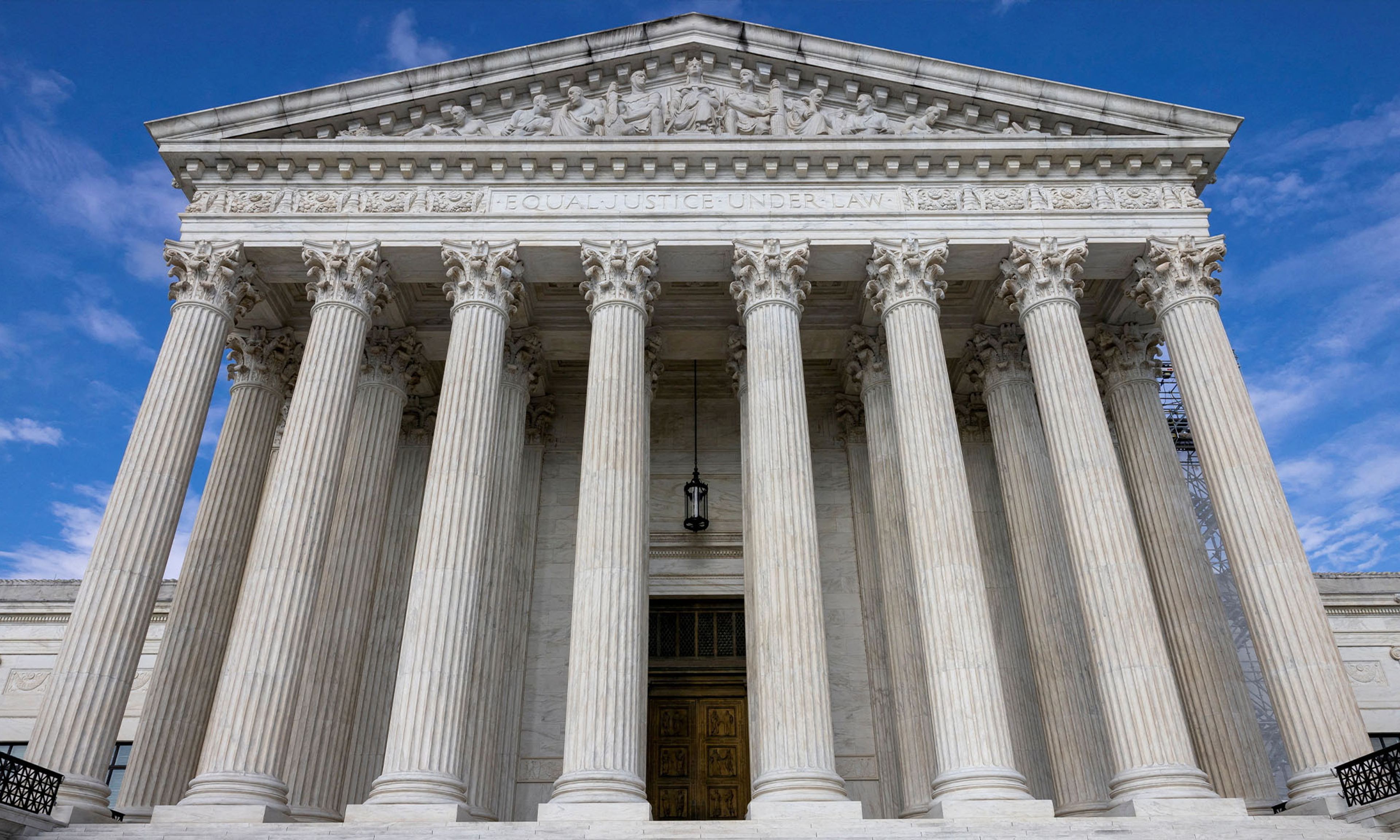
In the wake of the recent election, as I was browsing through the nearly 600 volumes of the United States Reports, it struck me how many apt pronouncements the justices of the U.S. Supreme Court have made over the years — statements worth pondering as we approach a second Trump administration. That’s true whatever your political convictions might be.
We might say, broadly, that there are four major groups among us after the election: (1) those who cheer gleefully and unreservedly at the outcome; (2) those who voted for Trump with misgivings of one kind or another but believed, on balance, that he was the better choice; (3) those who voted against Trump but have resigned themselves to think that our polity can weather whatever lies in store; and (4) those who are utterly disconsolate because the end of the world is nigh. Most NR readers, I gather, fall into categories 2 and 3.
With primarily those readers in mind, I’ve gathered a few sagacious words from SCOTUS over the centuries. Mind you, when choosing pleasure reading, one doesn’t think of the dusty old United States Reports. Those volumes are generally read only by necessity, and only by lawyers. As I wrote in my contribution to The Oxford Companion to the Supreme Court (1992), there is a pronounced inclination toward a “plodding, pedantic style that unnecessarily emphasizes minor points and does not stop when the job is done.”
Yet in these unlikely volumes, there are delightful exceptions: epigrammatic flashes amid all the dreariness. May these rather obscure aperçus either temper your enthusiasm or buoy your discouragement:
Champagne: “Champagne is a beverage singularly grateful to the taste, and is indulged in by those who are supposed to be able and willing to pay the tax upon it.” DeVary v. Arthur, 93 U.S. (3 Otto) 420, 423 (1876) (per Hunt, J.).
Chaos: “Chaos serves no social end.” Tax Comm’n v. Aldrich, 316 U.S. 174, 196 (1942) (Jackson, J., dissenting).
Charity: “Charity kindly throws a mantle of oblivion over these matters of long ago.” Mackall v. Mackall, 135 U.S. 167, 170 (1890) (per Brewer, J.).
Citizenship: “Citizens are the members of the political community to which they belong. They are the people who compose the community, and who, in their associated capacity, have established or submitted themselves to the dominion of a government for the promotion of their individual as well as their collective rights.” United States v. Cruikshank, 92 U.S. (2 Otto) 542, 549 (1875) (per Field, J.).
Clarity: “That may be very clear to one intellect which is far from being so to another.” Ogden v. Saunders, 25 U.S. (12 Wheat.) 213, 339 (1827) (per Marshall, C.J.).
Concealment: “Honesty of purpose prompts frankness of statement. Concealment is indicative of fraud.” Crosby v. Buchanan, 90 U.S. (23 Wall.) 420, 457 (1874) (per Waite, C.J.).
Constitution: “A constitution is framed for ages to come, and is designed to approach immortality as nearly as human institutions can approach it. Its course cannot always be tranquil. It is exposed to storms and tempests, and its framers must be unwise statesmen indeed, if they have not provided it, as far as its nature will permit, with the means of self-preservation from the perils it may be destined to encounter.” Cohens v. Virginia, 19 U.S. (6 Wheat.) 264, 387 (1821) (per Marshall, C.J.).
Dissent: “Those who begin coercive elimination of dissent soon find themselves exterminating dissenters. Compulsory unification of opinion achieves only the unanimity of the graveyard.” West Virginia Bd. of Educ. v. Barnette, 319 U.S. 624, 641 (1943) (per Jackson, J.).
Doctrinaire logic: “There is danger that, if the Court does not temper its doctrinaire logic with a little practical wisdom, it will convert the constitutional Bill of Rights into a suicide pact.” Terminiello v. Chicago, 337 U.S. 1, 37 (1949) (Jackson, J., dissenting).
Freedom: “If there is any principle of the Constitution that more imperatively calls for attachment than any other it is the principle of free thought — not free thought for those who agree with us but freedom for the thought that we hate.” United States v. Schwimmer, 279 U.S. 644, 654–55 (1929) (Holmes, J., dissenting).
History: “A page of history is worth a volume of logic.” New York Trust Co. v. Eisner, 256 U.S. 345, 349 (1921) (per Holmes, J.).
Lawful conduct: “A man does not make conduct otherwise lawful unlawful simply by yearning that it should be so.” Continental Wall Paper Co. v. Louis Voight & Sons Co., 212 U.S. 227, 271 (1909) (per Holmes, J., dissenting).
Patriotism: “In our complex society, there is a great variety of limited loyalties, but the overriding loyalty of all is to our country.” United States v. United Mine Workers, 330 U.S. 258, 306 (1947) (per Vinson, C.J.).
Persecution: “Persecution for the expression of opinions seems to me perfectly logical. If you have no doubt of your premises or your power and want a certain result with all your heart you naturally express your wishes in law and sweep away all opposition.” Abrams v. United States, 250 U.S. 616, 630 (1919) (Holmes, J., dissenting).
Regulation: “It is common experience that men conform their conduct to regulations by governmental authority so as to avoid the unpleasant legal consequences which failure to conform entails.” CBS v. U.S., 316 U.S. 407, 418 (1942) (per Stone, C.J.).
The sexes: “It will need more than the Nineteenth Amendment to convince me that there are no differences between men and women, or that legislation cannot take those differences into account.” Adkins v. Children’s Hospital, 261 U.S. 525, 570 (1923) (Holmes, J., dissenting).
Taxation: “An unlimited power to tax involves, necessarily, a power to destroy; because there is a limit beyond which no institution and no property can bear taxation.” McCulloch v. Maryland, 17 U.S. (4 Wheat.) 316, 327 (1819) (per Marshall, C.J.).
Taxation redux: “The power to tax is not the power to destroy while this Court sits.” Panhandle Oil Co. v. Mississippi ex rel. Knox, 277 U.S. 218, 223 (1928) (Holmes, J., dissenting).
Uncertainty: “We are left to float on a sea of uncertainty.” Green v. Biddle, 21 U.S. (8 Wheat.) 1, 103 (1823) (Johnson, J., concurring).
Uncertainty redux: “Out of the domain of the exact sciences and actual observation there is no absolute certainty.” Hopt v. Utah, 120 U.S. 430, 439 (1887) (per Field, J.).
The cognoscenti among you (but isn’t that all NR readers?) have undoubtedly noticed that I neglected to quote the great Charles Evans Hughes, who served as associate justice from 1910 to 1916 and as chief justice from 1930 to 1941. For him, I prefer an extrajudicial statement he made between his two stints, when he was president of the American Bar Association: “Democracy has its own capacity for tyranny. Some of the most menacing encroachments upon liberty invoke the democratic principle.”











Comments