It wasn’t his fault the date was a bust; it was mine.
On second thought, I’m going to blame it on the birds.
COVID limited our date-location options, so an early-morning hike at a nearby preserve was proposed. Only a few minutes of walking brought us to a rickety boardwalk jutting over the marsh, complete with missing railings, holes in the walkway, and no particularly good way of climbing onto it. Ignoring the “boardwalk closed” sign and spurred on by the sight of other figures ahead of us, we took the leap (or, rather, the undignified squish through marsh mud). I didn’t know it then, but my perception of the world was about to change dramatically.
But first, a little family history. If you’re ever driving and see a bumper sticker reading “Caution! Kinda driving, mostly bird watching,” you’re probably behind a Schutte vehicle. And that bumper sticker says it all. Case in point: While on a birding trip at Ottawa National Wildlife Refuge, my mom was pulled over by a park ranger. Apparently, your kids can’t bird out of the van sunroof. (Worry not. She’d been driving slowly.) Sunroof birding is quite tame, given the lengths to which some birders will go, as those who’ve seen The Big Year would know. A “Big Year,” for the uninitiated, is when, starting January 1 and going until December 31, participants attempt to spot as many bird species as they can within “the 49 continental United States, Hawaii, Canada, the French islands of St. Pierre and Miquelon, and adjacent waters to a distance of 200 miles from land or half the distance to a neighboring country, whichever is less.” (So say the American Birding Association rules.)
Crazy, right?
Maybe. Birding is a slow hobby, requiring patience and time, and the willingness to get more than a few neck aches. You often stand in one place for minutes on end (or even hours, if you want a good picture), straining eyes and ears for just a flash of color or a tiny “chirrup.” While many might find such a hobby frustrating, it is a unique way to enjoy the calm, tranquil side of nature, and it trains your senses to take in the small details of your surroundings that often go unnoticed.
So, back to that unfortunate date. Safely on the boardwalk, we met an older couple armed with bird guides and bins (birder lingo for “binoculars”) and a brother-and-sister photography team laden with powerful lenses. Birders are some of the nicest people you will ever meet. Eager to teach, delighted that others are birding, and often possessing a wealth of knowledge, these people were no exception. In no time, I’d made the acquaintance of a Virginia rail, been laughed at by a sora, seen my first yellow warbler, and witnessed the rare event of eleven baby wood ducks emerging from their box. I was in love. My date? Forgotten.
Though the pandemic made many people realize that there are more birds in the world than robins, cardinals, and those chirpy brown ones, my family had already been mildly obsessed for years. Through homeschooling, my mom found that incredible library service known as the “Teacher’s Collection.” Fill out a form indicating your area of interest and an age range, and the kind librarians fill a bin with all sorts of books for you to pick up at your convenience. One of these collections happened to be on birds, and we were soon identifying the chickadees, nuthatches, and various woodpeckers around the neighborhood. Then with the shutdown came our discovery of marshes, fens, hiking trails, preserves — delightful outdoor gems we found in our area on our quest to see new birds. We even stumbled upon a gigantic preserve located on the property of a defunct and cleaned-up nuclear plant. (Our family jokes that you could go birding there at night. Everything probably glows.)
At many of these places, we’ve met other birders, some amateurs like us, some pros with high-powered bins and long camera lenses. From the couple who spent ten years on a boat (and are now doing a Big Year) to the charming elderly gentleman I met while in Florida who informed me that the slang name for a yellow-rumped warbler is a “butterbutt,” they’ve made us feel as if we’ve stepped into another world.
In some ways, we have. My mom now follows bird-migration patterns. My siblings can spot and correctly name a large number of species. And me? On January 1 of this year, I started a challenge to go birding every single day until December 31, a challenge that is still going strong on Day 175, with over 40 new species spotted. But this experience has also shaped the way we now hear the world. Stepping outside, we are often distracted by a rustle, a chirp, or a warble. Whereas before we would’ve ignored such a sound, now our curiosity is constantly piqued. We often risk tardiness for events as we stand still and search the trees. Is it the joyful warble of an indigo bunting? A chipping sparrow’s rattle? An eastern wood-pewee’s self-referential call?
Were those birds always in our backyard? Or did we just now begin to train our ears to hear what has been there all along?
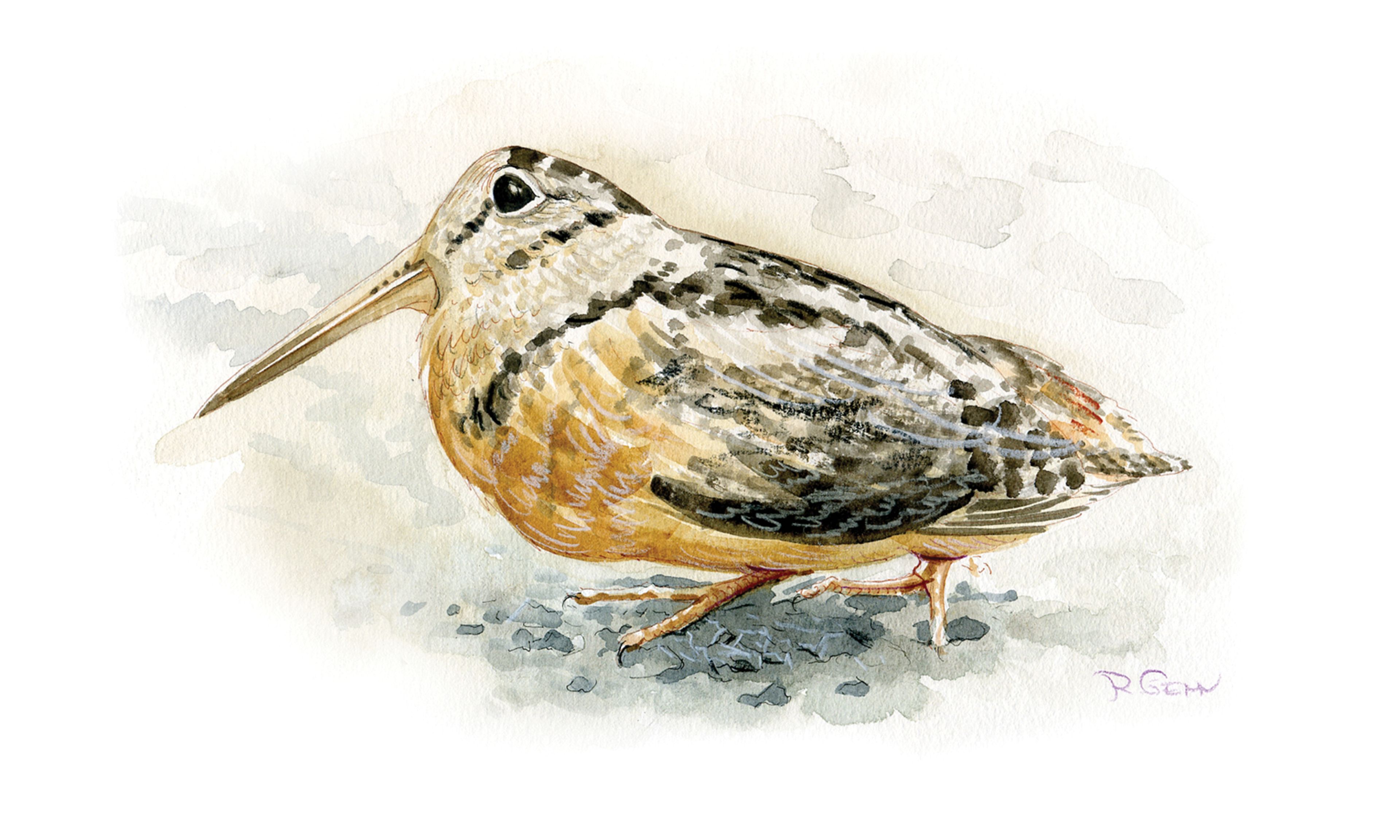
There was one bird call that I was determined to hear as I observed its source in the flesh. On March 17, 2021, at 6:40 p.m., I met up with my mom, and we began a trek through our favorite preserve. Though it was chilly, I was glad to be outside, away from cares and noise, looking for ducks and discussing Jane Austen. Around 7:30 p.m., we decided to try our luck in a nearby field. Our target? The elusive American woodcock. This absurd-looking bird is legendary in our home, having leapt to popularity after our uncle told us about it, and we saw a video of a mother woodcock leading her babies across a road. She bobbed, swayed, and strutted in the most comical manner, and her little ones were desperately trying to imitate her steps — with varying degrees of success. We laughed until we cried. It was, however, the amazing and wildly amusing mating dance performed by these birds that my mom and I were hoping to see.
With the sky darkening by the minute, a light drizzle dampening us, and silence from the trees, we had turned to leave, when suddenly a sound like a duck being stepped on rang out from the woods. Barely able to contain our excitement, we raced back to the field in hopes of a better view, but no luck. Our evasive friend stayed tucked away. With a burst of inspiration, my mom pulled out her phone, opened her birding app, and after scanning the area to make sure we wouldn’t disturb other birders, we played a woodcock call.
The effect was immediate. Our little friend sped up his call and response, trying to communicate with this newcomer, until suddenly he burst forth from the underbrush and sped past us. At this point, we were jumping up and down in uncontained joy as we were treated to nearly 20 minutes of the incredible male-woodcock courting display. While he was exhibiting for what he thought was a pretty lady woodcock, a distant “quack” told us the sad truth. We had stolen a real lady woodcock’s wooer! Guilty but giddy, we soon left the field and hoped the forsaken Miss W. would find a more attentive lover.
In a culture ruined by instant gratification, birding may be the perfect antidote. Some days are discouraging, with few sightings, freezing weather, or poor visibility. But then there are those moments. The breathless surprise upon seeing a bobolink. The gasp of astonishment over a ruby-crowned kinglet. The thrill of success when you finally, finally see a northern parula (this is truly amazing, because, while these birds are often ubiquitous in certain areas, you usually only hear them). It is this breathless wonder and thrill of success that help this hobby span generations. Not only does it promote a lovely way of connecting and sharing, it reminds us to marvel and to ponder.
Here is a final tale, one that will forever remain in the annals of Schutte lore.
The teaching potential of birding is endless, and it was a Canada goose (a dreadful and overrated species) that proved this point to us in no uncertain terms. My parents, along with my ten-year-old brother and 13-year-old sister, were out at a lake early one Saturday. The girls were down by the water, scanning for ducks, and the boys were still in the car. Two geese suddenly began what my sister correctly guessed was a mating dance. Facing each other, one goose would dip its head under the water, and then the other goose would do the same. Without warning, one goose jumped on top of the other. Later that day, my two siblings tried to explain this phenomenon to a third sibling. At the end of the saga, the ten-year-old said, “Wouldn’t it be funny if people mated like that?”
Ah, the innocence of youth.
Curiosity, wonder, and tranquility, punctuated by moments of hilarity. Birding isn’t for everyone, and it requires moving at a slower pace, but it is abundantly rewarding for those with the patience to watch, wait, and laugh at nature’s quirks. Even though this hobby has caused me to burn some dating bridges, at least I’ll always have the birds.












Comments