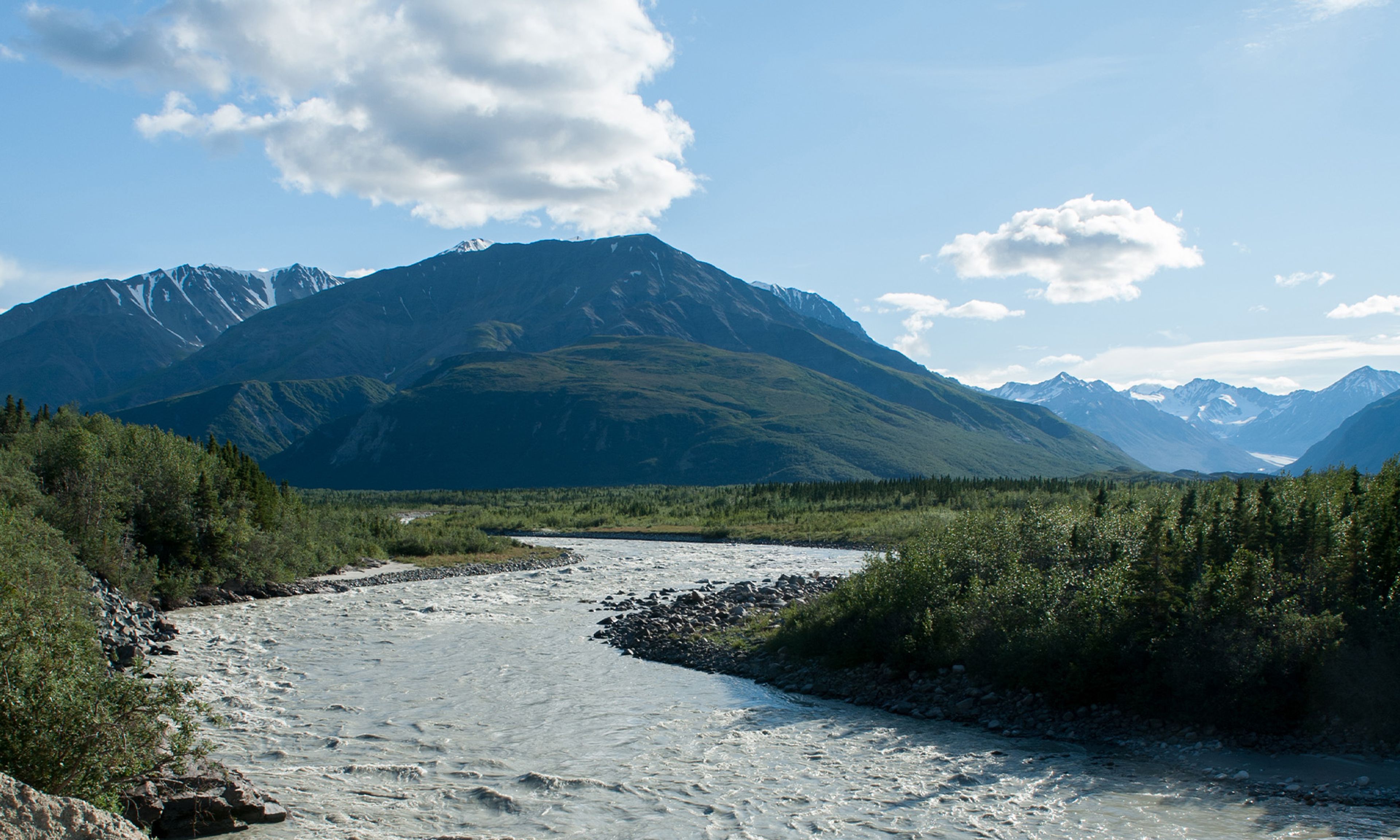
Dave Szumigala had been doing geological fieldwork in Alaska for 20 years before he had his first adverse bear encounter. Plenty of Szumigala’s fellow researchers at Alaska’s Division of Geological and Geophysical Surveys (DGGS) trekked into the bush unarmed, but at his wife’s insistence, Zoom (as everyone up north calls him) carried a Smith & Wesson 44. In 2011, when a black bear charged from 150 feet out, he drew the revolver; when it got within 15 feet, he dispatched it with five shots.
Zoom has amassed plenty of stories — tenting down in the Aleutians, blizzards in July, ice-encrusted helicopter evacs — during his four-decade Alaskan geology career. As I learned when we met in Fairbanks this past winter, though, his work is of national consequence. DGGS, where he serves as a senior exploration geologist, is playing a crucial part in America’s geo-economic strategy. At more than 570,000 square miles, Alaska is the country’s largest geological prize and yet remains its least explored. With help from a nascent U.S. Geological Survey program called the Earth Mapping Resources Initiative (Earth MRI), DGGS is now filling our knowledge void concerning the Last Frontier and advancing the country’s critical minerals industry.
The federal government defines critical minerals as materials that are essential for the country’s manufacturing of vital economic or defense products and vulnerable to global supply disruptions. The list includes well-known materials such as lithium, copper, and graphite, as well as obscure rare earth elements such as neodymium.
Certain critical minerals, including some rare earths, are key inputs for modern technology. They underpin the semiconductors that power AI systems and the high-performance magnets that steer military drones and precision missiles. American businesses pioneered the rare earth industry, and the U.S. was the world’s largest producer as late as 1990. But domestic production and refining have since dwindled.
Part of this decline can be attributed to simple economics. Over the past half century, commerce became globalized, techniques became ever more specialized, and competition heated up; as a result, tight margins pushed capital in the U.S. economy to other sectors. Another culprit is environmental regulations that increased costs domestically while alternatives emerged elsewhere.
Simultaneously, China implemented a critical mineral strategy aimed at bringing the sector within its borders. “The Middle East has its oil, China has rare earths,” Deng Xiaoping said presciently in 1987. “We must be sure to handle the rare earth issue properly and make fullest use of our country’s advantage in rare earth resources.”
China effected Deng’s objective through the 1990s with direct funding, subsidized financing, land grants, and other incentives. By the end of the decade, China had surpassed the U.S. in rare earth production.
China’s mercantilist strategy has afforded it a powerful tool for coercion. Having become the primary challenger to the U.S. and the global market order, Beijing has wielded that tool in zero-sum fashion. Its first globally recognized display of this potential came in 2010 when it suspended rare earth exports to Japan amid a dispute over contested islands. In the 2020s, it has reprised this strategy with tactical export controls on gallium and germanium in 2023 and a broader set of minerals in 2025.
What’s a capitalist country to do?
On the one hand, since geopolitical risk is and always has been a factor in corporate capital allocation, we could simply let market actors price in the potential for Chinese export stoppage and adjust accordingly. That’s not just an optimistic theory drawn up on Econ 101 blackboards. In the middle of the pandemic, the world’s top semiconductor manufacturer, TSMC, responded to market risk dynamics by planning a new plant in Arizona — two years before Congress would pass industrial-policy legislation on semiconductors. In the minerals sector in 2023, six months after China announced its new export controls on gallium and germanium, an American company announced a massive discovery in Wyoming, as I wrote about for National Review Online (“New Wyoming Dig Shows Limits of China’s Export Controls,” January 22, 2024). Consistent with the laissez-faire attitude is trade with non-adversarial countries, environmental regulatory reform, and innovation to reduce the importance of the vulnerable minerals altogether.
On the other hand, the spontaneous order of the market, even with a deregulatory tailwind, doesn’t always meet the timeline of defense imperatives. If the U.S. and China go to war in the coming years, as the U.S. Indo-Pacific Command warns is a real possibility, a peacetime corporate tempo won’t cut it.
To address the critical-mineral vulnerability, Congress and successive presidential administrations have launched a series of new initiatives. In 2019, President Trump defined the production and processing of a list of rare earths as “essential to the national defense.” The second Trump administration has taken an even more aggressive tack, directly investing in domestic producers, including MP Materials and USA Rare Earth. Following the pandemic and the supply-chain risks it brought to the fore, Congress and the Biden administration passed a trio of industrial policy laws to harden America’s economy against future disruptions. Alongside the CHIPS Act and the energy-focused Inflation Reduction Act, Congress passed the Infrastructure Investment and Jobs Act (IIJA) in 2021. Though most of the attention went to the traditional infrastructure considerations of roads and bridges, a less appreciated IIJA provision was its funding of Earth MRI.
Earth MRI is a program that threads the industrial policy needle, avoiding cronyist pitfalls while helping to advance the basic scientific understanding to allow market-based reindustrialization to flourish.
The way the USGS explains it, Earth MRI deploys low-flying, sensor-laden aircraft to detect magnetic, radiometric, and electromagnetic signals at and below the ground. Magnetic data reveal faults and rock types, radiometric data identify elemental signatures, and electromagnetic data show conductivity contrasts. The IIJA gave Earth MRI a deadline of 2031 to complete “an initial comprehensive national modern surface and subsurface mapping and data integration effort” and a budget of $320 million through fiscal year 2026, which ends in September.
This funding pool has positioned Dave Szumigala and DGGS to finally do justice to surveying Alaska’s mineral estate. Since Earth MRI’s inception, Alaska, one of 39 participating states, has been allocated more than $20 million for the effort. DGGS accompanies Earth MRI’s aerial mission with on-the-ground data and sample collection. This joint campaign has paid particular attention to the Yukon-Tanana Uplands and Kuskokwim River mineral belt. The most promising results so far have turned up the signatures of the critical minerals antimony (a battery component), zinc (a steel galvanizer), and silver (a high-value conductor). A 2024 magnetic survey indicated the presence of rare-earth-bearing carbonatite, which has accelerated ground exploration in the area.
When I talked with Zoom and his colleague Travis Naibert at DGGS’s cabin-like headquarters, they gushed over the Earth MRI partnership. As part of the collaboration, DGGS had completed, as of my visit, 2,000 man-days in the field, had collected 2,100 samples for geochemical analysis, and had mapped 13,200 square miles in the Yukon–Tanana Uplands alone.
Despite having taken down that bear, Zoom, rail-thin with white hair and mustache, is more REI than Bass Pro Shops. He and Naibert are both nerdy outdoorsmen. Minutely detailed maps are plastered all over their workspace. While the overlays of color and periodic-table references challenged my recollection of high school chemistry, these maps and their accompanying digital datasets serve a vital purpose: facilitating real-world, private-sector resource extraction and promoting industrial resilience.
As Sage Langston-Stewart, principal geologist for Alaska Silver, a mineral-exploration company, explained to me, Earth MRI has “directly improved our targeting in western Alaska, leading to refined geologic models and contributing to new silver, base metal, and critical mineral discoveries. . . . In practical terms, they have materially changed how we rank targets and position drill holes.”
While Langston-Stewart’s company considers silver its flagship metal (no surprise), the system it’s exploring with Earth MRI data is polymetallic, with promising deposits of copper, lead, and zinc. Gallium, a key semiconductor input, is “emerging as an especially exciting critical-mineral component of the broader system.”
Earth MRI airborne surveys, DGGS groundwork, and mining expertise are now operating in concert to turn Alaska’s potential into genuine mineral output. Erin Campbell, director of DGGS, tells me that 46 new mining claims have been staked thanks to the partnership. “We’ve made great progress on our highest-priority areas,” she says. “But there is still so much to be done in Alaska. It’s a huge state, and there is a lot we don’t know in terms of geology.”
Yet this symbiosis is now in jeopardy. With IIJA funding expiring, Earth MRI’s supplemental annual budget of more than $60 million will evaporate. Letting that happen would be a tragic misstep.
To better understand Earth MRI’s value proposition as it nears this funding cliff, I spoke with Peter Cook, a minerals analyst at the Breakthrough Institute. Cook applies to minerals the classic pro-infrastructure argument: that public investment has an economic multiplier effect, facilitating much larger private activity, economic productivity, and, ultimately, public revenue.
“We need to realize from other countries that spending on public geologic data is an investment, not an expense,” he said. “The dollars spent not only help secure supply chains by finding more ore that can turn into a mine, they also return the investment with increased tax revenue that would otherwise not have happened.” He gives the example of the state of South Australia, which spent $40 million over ten years on public exploration. “That encouraged an extra $700 million in co-investment from industry. It generated an additional $2.4 billion in state revenue and discovered 16 new deposits, too.”
The Trump administration, despite its gutting of the IIJA in 2025 with the One Big Beautiful Bill Act, supports Earth MRI, citing it as among the tools that foster “American mineral dominance.” Others include the aforementioned equity stakes, plus Project Vault — a minerals stockpile for American businesses — and the Forum on Resource Geostrategic Engagement (FORGE), an international mineral supply-chain consortium.
Yet Earth MRI remains underweighted. Vault and FORGE expend federal resources to procure minerals; the equity stakes feed capital directly to companies. Earth MRI, distinctly, positions private industry to produce without favor. It is, Breakthrough’s Cook argues, “irreplaceable,” because taking the “first step of the learning curve absorbs a lot of risk” and “empowers industry to make the most out of our domestic mineral resources” — a dynamic borne out by Alaska Silver.
The best articulation of what we might call “industrial policy with American characteristics” is that it will attract the creative energies of a capitalist system to the production of essential economic and defense products and the intermediate goods they require. This version of industrial policy is consistent with the supply-side economic arguments that anchored Republican economic thinking for decades.
Given the stakes, the decades of policy folly, and the aggressive strategy of America’s geopolitical challenger, more than market liberalization is required in some endeavors — critical minerals among them. China’s model drove the U.S. rare earth industry, specifically, to extinction. We need not mimic China’s wasteful version. Instead of pouring resources into selected projects only to find them overcapitalized, industrial policy with American characteristics can play a firmly neutral role that invites private investment. The public data generated by Earth MRI are available to all comers, enhancing opportunities for private enterprise rather than prefiguring government-determined arrangements.
Replenishing Earth MRI’s coffers to enable it to pursue its 2031 mapping goal will generate more of the data that private industry needs, will build more American resilience against China’s geoeconomic weapons, and, with luck, will lead to more great Zoom stories from the Alaskan wilderness.












Comments