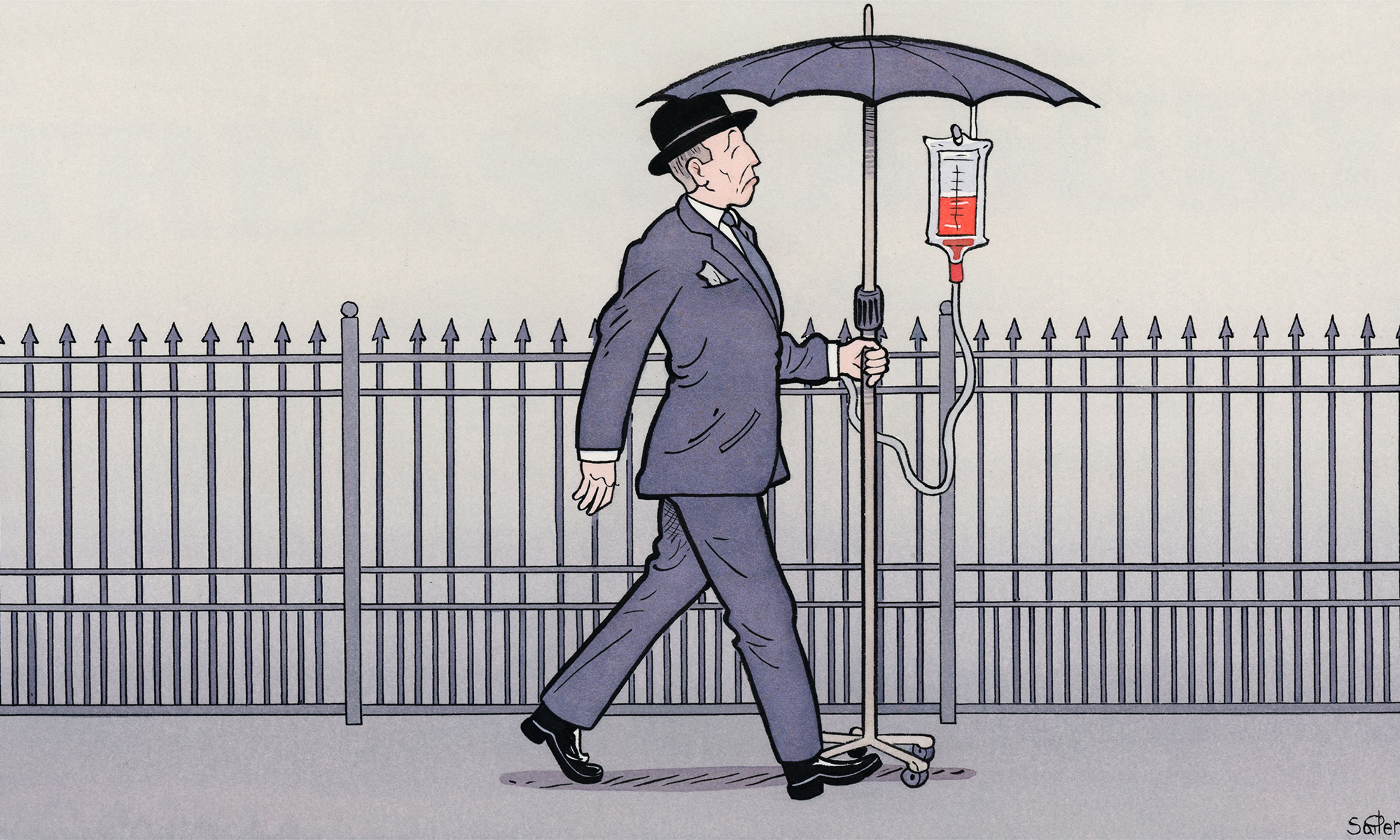
British historian A. G. Hopkins describes his latest book, The Land Where Nothing Works, as an attempt to “explain the current malaise” gripping his homeland and mine. He writes that it “infects every aspect of British life: its economy, polity, social order, regional imbalance, sense of well-being, and place in the world.” That is, unfortunately, not an exaggeration. The United Kingdom is in the running — it’s a crowded field — to be the sick man of Europe for reasons both political and economic. Regarding the latter, I’ll give just one dismal statistic: British GDP per capita has barely grown since 2007 in real terms.
According to Hopkins, his book is not a “potted history” of events between 1945 and 2024. Rather, he wants to tell the tale of how Britain came to its current predicament. But Hopkins is too sure of his convictions (on the left, communitarian, moralistic) to fulfill that role. Instead, he reveals himself as an advocate of a somewhat dated (he was born in 1938) version of the thinking that is now shoving Britannia beneath the waves. A skilled writer, he would make a fierce prosecutor or able defense attorney. As an impartial judge, he does not cut it.
Describing the decades that followed Labour’s electoral landslide in 1945, Hopkins acts mainly for the defense. That’s unsurprising and (superficially, anyway) undemanding. Broadly speaking, both Labour and Conservative governments were either advancing or, in the latter case, going along with a roughly social democratic approach. Living standards rose sharply, as did social welfare.
Then again, that was so throughout most of the West at the time. But Britain’s largest neighbors, France and West Germany, were growing faster. Hopkins rightly points out that these countries were building on a lower base, but this excuse has its limits. By 1970, both countries boasted a higher GDP per capita than the United Kingdom’s. Hopkins accepts — as he must — that Britain did not do as much as it could to improve its economic performance. This, he maintains, was out of fear that boosting productivity (presumably by “too much”) risked “destroying the sense of community that bound class and country together.” Perhaps it’s unkind to observe that, despite all this fellow feeling, more than 2 million Britons emigrated in the postwar years. (Admittedly, some of this emigration was subsidized.) It’s also worth adding that historically huge rates of immigration have subsequently done much more damage to Britain’s “sense of community” than speedier economic growth in the 1950s and 1960s would ever have done.
Some of the reasons for Britain’s failure to keep up — such as poor productivity — bedevil the country to this day. Others, including lumbering nationalized industries, penal levels of taxation, and belligerent labor unions, can be tied specifically to the social democratic regime. Given the way that Hopkins can look at political financing through narrowed eyes, it’s disappointing that he refrains from commenting on the fact that unions both provided a good portion of the Labour Party’s cash and were embedded within its power structure. That was an arrangement that, especially as Britain’s unions embraced a more contentious political agenda, raised troubling questions about their ranking in the democratic order.
This issue, along with much else, came to a head in the 1970s. That decade was scarred by two oil shocks, an inflationary surge, wave after wave of strikes, the harsh (if necessary) spending cuts that were the price of a bailout by the International Monetary Fund, higher levels of unemployment, an ominous shift to the left within the Labour Party, and a viciously intensified conflict in Northern Ireland. The economy grew, but unevenly, and a strike-torn “winter of discontent” persuaded an exhausted electorate to try its luck with Margaret Thatcher and her partially redesigned Conservatives. Her electoral victory in 1979 is the hinge in the story that Hopkins tells. Thatcher had not, cautions Hopkins, come out of the blue: “She was brought to power by a counter-revolution led by those who saw an opportunity to consolidate and extend their existing privileges.” Okey dokey.
For all the changes that Thatcher’s governments introduced — which were generally, if at times unevenly, for the better (though Hopkins would, uh, disagree) — they have only limited relevance to the morass into which the U.K. finds itself sinking some 40 years later. In fact, Thatcher had, with some assistance from North Sea oil revenues, rescued Britain from the increasingly destructive consequences of its postwar consensus. However, many of the positive elements of her legacy have been squandered by her successors. Labour, notwithstanding a market-friendlier moment during Tony Blair’s heyday, has drifted to the left economically. At the same time, it — or, more accurately, the broader left — has strengthened its long-standing cultural and more recent institutional hegemony. Meanwhile, the Conservatives have been floundering. The result, I suspect, has contributed to the alienation of some voters from the mainstream political class.
For many of them, that sense that they have been left out (or behind) owes a great deal to the decline in British manufacturing, which accelerated significantly under Thatcher. This decline, a crucial element of Hopkins’s critique of Thatcher’s reforms, is bolstered by his belief that the rapid expansion of the British financial sector, which is concentrated in England’s affluent southeast, was no substitute for the vanished manufacturing enterprises either geographically or in substance. Never mind that the U.K., by focusing on financial services, was playing to its competitive advantage.
Hopkins’s jaundiced view of finance has obviously not been improved by the dot-com crash and the 2008 global financial crisis. However, despite its scale, the former was not an entirely atypical episode in the commercialization of a new technology. A touch grudgingly, Hopkins acknowledges that “of course there were gains, too: companies, such as Amazon and Google, survived.” Of course — and there was a lot more than that. As for the financial crisis, a critical cause (in some instances) was not that regulation was too light but that it offered perverse incentives that encouraged risky behavior.
The shrinking of the manufacturing base was painful, very painful (unemployment peaked at just under 12 percent in 1984), but it was going on long before Thatcher. Moreover, as Hopkins notes, it was underway in other developed economies too, if not at the same pace. Indeed, it is still continuing in Britain and elsewhere. The futile “green” energy transition, which is — how odd — spared Hopkins’s indignation, only adds to the toll.
Many of those who felt “left behind,” angered also by mass immigration, threw their support behind Brexit. Hopkins regards Brexit as an “act of national self-harm.” We’ll see. It’s too soon to come to a final conclusion, but the Conservatives’ choice of a (very) hard Brexit has certainly made Britain’s adjustment to life after the European Union much more difficult than it needed to be, and at a very bad time.
Meanwhile, a market panic over the United Kingdom’s wretched fiscal position may be brewing, and the country’s politics are in an alarmingly febrile state. Islamic sectarianism is on the rise, while nationalist discontent is stirring on the Celtic fringe. And in England, a growing number of people are looking at more radical alternatives to the established parties that they feel — sometimes with good reason — have failed them.






Comments