Does everything need explanation, a backstory, a neat and tidy timeline of how it came to be? Imagination feeds on lacunae, on extra stories half-glimpsed in the background of the main one, on fragments of a world that make it seem bigger than just the main adventure, on mysteries at the heart of that adventure that linger unexplained.
To me, Aragorn singing an old elven lay in Lord of the Rings is worth most of the pages of actual elven history in The Silmarillion, and one of the saddest parts of the Star Wars prequels was the way they took resonant phrases (“You served my father in the Clone Wars . . .”) and great little characters (the inscrutable Boba Fett) from the original trilogy and told us so much about them, in such boring and uncreative detail, that a lot of their original romance was leached away.
Which makes the entire project of Alien prequels that Ridley Scott is undertaking in his sunset years (he’s 79) seem like a fairly dicey business. Scott’s original Alien and the James Cameron sequel are a perfect diptych, and their main character, the nightmare xenomorph that takes out the crew of the Nostromo and then a platoon of starfaring marines — only to be defeated, in each case, solely by Sigourney Weaver’s dauntless Ripley — draws some of its horror from the mystery of its origins. Because if the slime-dripping, acid-bleeding, multi-jawed H. R. Giger monster is just the kind of thing the cosmos produces naturally, then the universe may be much more of a Lovecraftian horrorscape than our experience of earthly nature has taught us to believe. Show us that the monster was built or bioengineered instead, and some of that shivering horror is necessarily lost.
But the engineering of the Alien is the story that Scott has set himself to telling, first in 2012’s Prometheus and now in Alien: Covenant, with two more films to go before we link up chronologically with Ripley somewhere in the early 22nd century. Or at least it’s one of the stories he’s telling: The distinguishing feature of these latter-day Alien movies is their sweeping ambition, their pileup of narratives and themes, their desire to build a true epic around the xenomorph instead of just pursuing the stripped-down predator–prey stories of the earlier installments.
In prequel number one, Prometheus, Scott dispatched a crew of explorers to a distant world in search of the beings who first seeded earth with life — our own creators, or at least our demiurges, whose existence had been uncovered in ancient Lascaux-type paintings and star maps. Alas, what this crew discovered instead was some sort of strange laboratory, long abandoned by our makers, filled with things that slither, infect, impregnate, and transform. They were not quite the Alien itself, but they were still deadly enough to eventually kill off all the crew save two, the lead scientist Elizabeth (Noomi Rapace) and the silky android David (Michael Fassbender), who escaped on board an alien ship and set a course for what they hoped was the real home world of our Engineers.
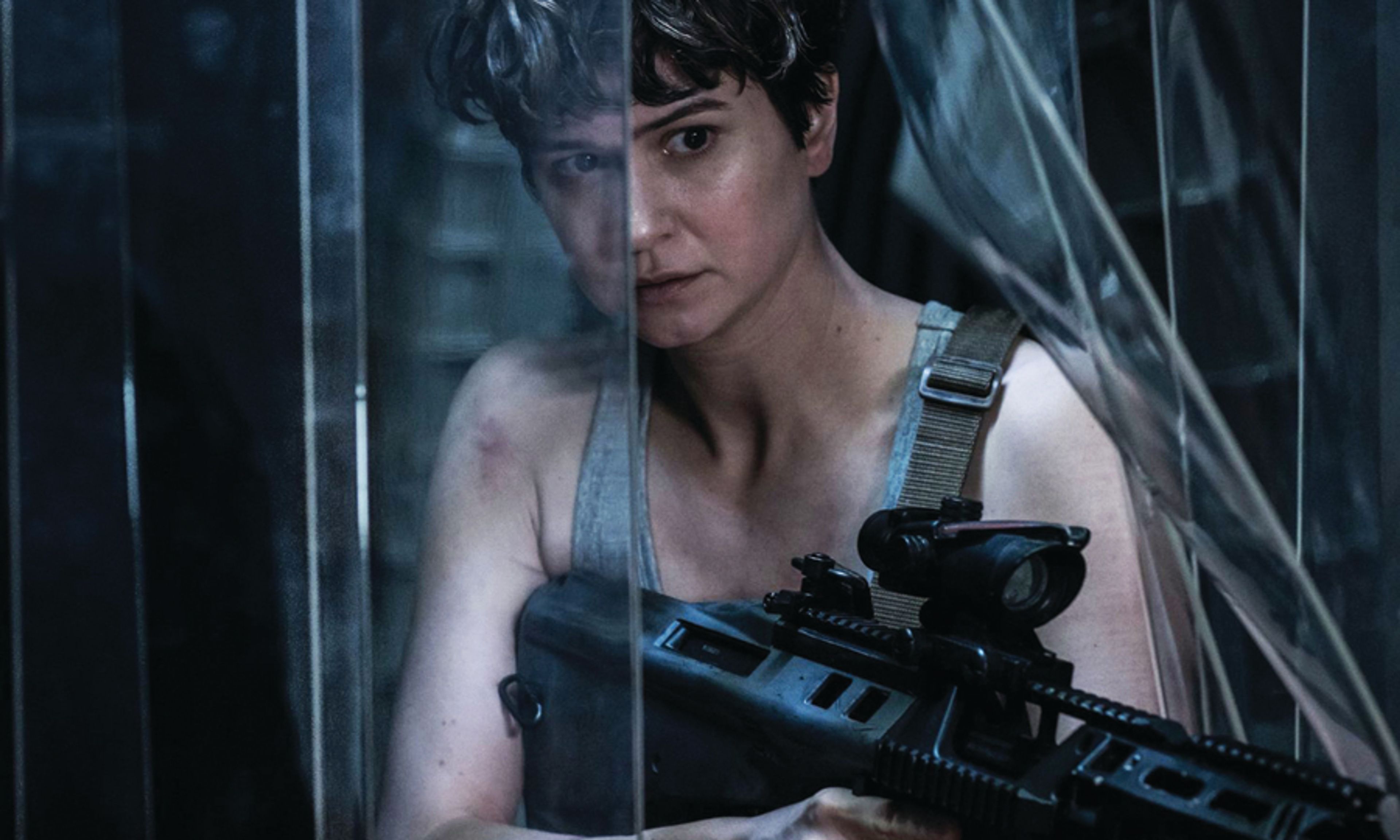
Alien: Covenant picks up some years later, onboard a starship filled with colonists in cryo-sleep and crewed by a collection of cheerful couples — the main ones are played by James Franco and Katherine Waterston; Danny McBride and Amy Seimetz; and Billy Crudup and Carmen Ejogo — plus a new-model version of Fassbender’s android, this one bearing the name Walter.
A fluke accident kills their captain (Franco) and leaves them drifting near a world that looks even more Earth-like and colonizable than their target planet, so they go down to have a look. What they find are mountains, forests, lakes . . . but not a single animal or bird, just silence, strangeness, dread.
And in the midst of this silence they find the crashed alien spacecraft from Prometheus, with only Fassbender’s David still alive. Soon he and Walter, his brother from a slightly different program, are engaged in dialogues about their relationship to human beings, even as the luckless humans discover that the crashed ship brought with it some of the horrors from the last movie, which have mutated (or have been bred, perhaps by an android with way too much time on his hands?) in ways that bring them closer, much closer, to the chest-bursting monster that we know and love so well.
Essentially, Scott seems to want to tell three kinds of story at once in these movies: The material about the Engineers is basically Chariots of the Gods for cosmic pessimists, a sci-fi story about meeting our makers and finding out that they’re not exactly what we hoped. The material with David (and now Walter) is an A.I.– or Ex Machina–type story about an artificial intelligence becoming self-aware and trying to decide what to do with (or to) its human progenitors. And the material about the slithering proto-Aliens is, well, an Alien movie — body horror, hunters and hunted, and who’s gonna get away alive?
I applaud Scott for his ambitions, but all of this is a lot to mash together. And Prometheus was ultimately undone by the gulf between these ambitions and its script: It was an impressive movie only so long as you accepted that none of the plotting or the characters’ behavior made any sense at all.
Covenant has a tighter, simpler story, which makes it a more immediately satisfying blockbuster. But it also cuts down some of Scott’s, er, Promethean ambitions (the entire Engineers plotline seems to be dispensed with in a single flashback) to make room for fan service: The latter half of the story feels like a rehash of Alien and Aliens with Waterston doing her best Sigourney Weaver impression.
So Covenant made me appreciate Prometheus a little more while feeling sorry that the story’s aspirations seemed dialed down. In the next prequel, I hope those ambitions make a comeback: If we’re going to be told more than we ever needed to know about the Alien’s origin, better to wrap it up in an insanely ambitious story than to just recycle what we’ve seen many times before.












Comments