For several years I lived in northwest Washington, D.C., where Rock Creek Park makes a long gash through the city, its wooded ravine traversed by splendid Depression-era bridges that carry traffic from downtown toward Woodley Park and Chevy Chase. Since a young man’s fancy naturally turns to cinema and war, when I crossed the bridges I occasionally imagined a scene where their mighty arches had been shattered and a Battle of Rock Creek raged in the woods beneath — some last-ditch defense of D.C. against invaders approaching from the Maryland border, with rocket fire and sniper rounds exchanged from the apartment towers on either side of the green divide.
Why invaders from Maryland? Well, I figured that if I were ever called upon to make a movie about an American civil war, I could figure out some political and strategic explanation for the assault; the point was just to use the city’s topography for maximal effect.
Sadly, Alex Garland’s new movie Civil War lacks anything as epic as the Battle of Rock Creek; the final action takes place in darkened downtown streets and White House corridors instead. I don’t want to be too churlish about that disappointment since this isn’t a big-budget production, and my imagined struggle for northwest Washington would have cost at least as much as the Battle of Helm’s Deep to put on film.
I do, however, think it’s reasonable to complain that Garland also declined to come up with any clear political and strategic background for his military action. The spirit in which I imagined a battle for the nation’s capital while jogging across Duke Ellington Bridge 15 years ago — get the spectacle, we’ll figure out the politics later — is the spirit in which he’s made an entire movie, which answers the most basic why-and-how questions presented by its scenario with a shrug: Once it starts, does it really matter?
This is Garland’s mode of escape, clearly, from the trap of making some kind of MSNBC-style political pornography, with Proud Boys occupying Berkeley and Bethesda and noble Deep State bureaucrats organizing rebel regiments.
His story is still influenced by the tropes of Resistance liberalism: The president, played briefly by Nick Offerman, is a blustering figure who stayed for a third term, dissolved the FBI, and possibly (wait for the reference near the climax) annexed Greenland. And a psychopathic soldier played briefly by Jesse Plemons is the sum of all liberal fears about heartland xenophobia.
But mostly there aren’t red states and blue states in this drama of internecine strife, the different sides all appear appropriately multiracial, and today’s regional divisions have been scrambled. The third-term president faces a rebel alliance of Texas and California and a separate insurgency based in Florida, while his loyalists are defending a redoubt that seems to include the Northeast and not much else; apparently New England is sticking with a popular near-dictator while the South and West have turned against him.
That northeastern landscape is what our protagonists traverse, driving from New York City to Washington, D.C. (but looping west to avoid a ruined Philadelphia), in the hopes of scoring an interview with the besieged POTUS before the various secessionists arrive.
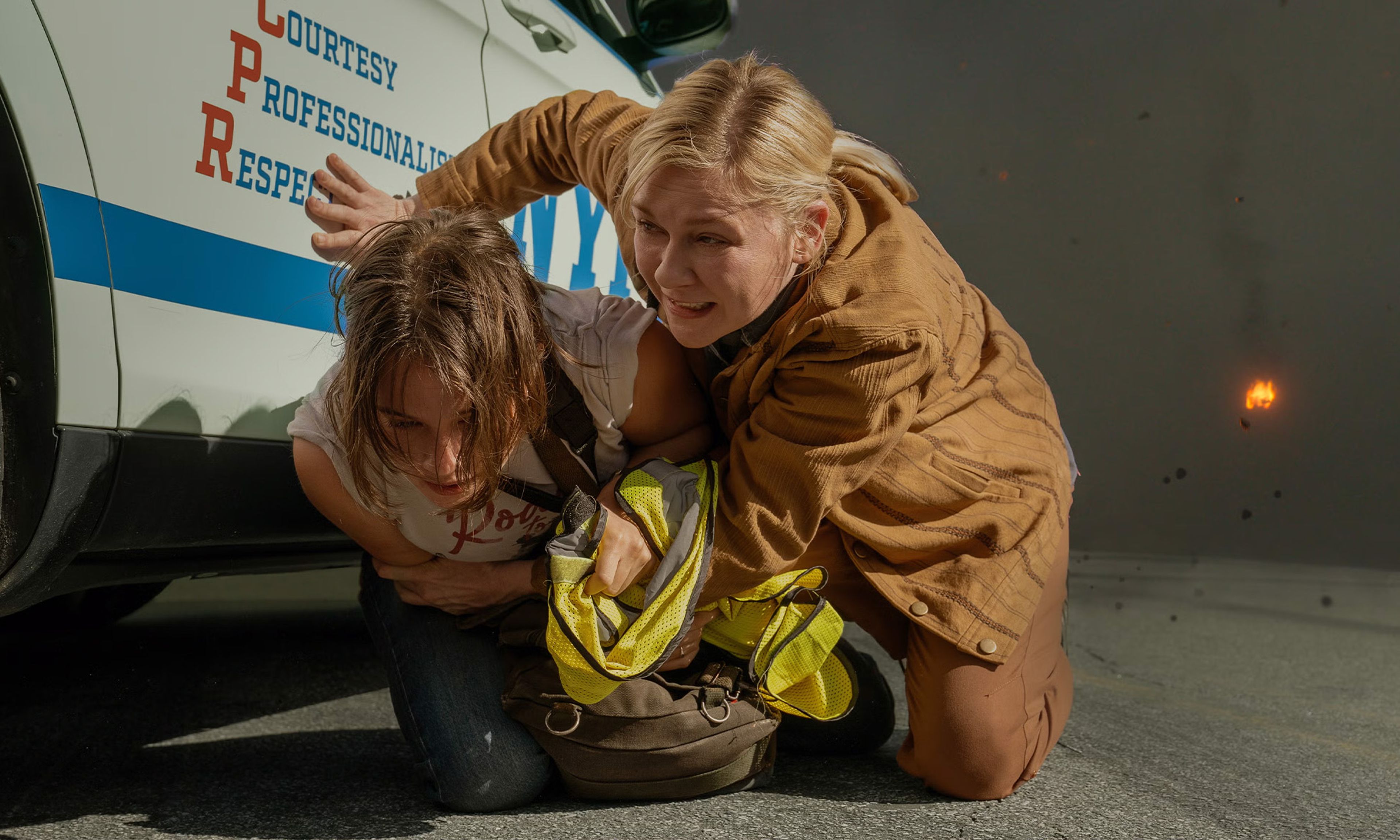
That’s right, our main characters are journalists, led by Kirsten Dunst’s hardened war photographer, who never thought the horrors she photographed abroad would show up in the American suburbs. But here we are, with looters being tortured inside a car wash, snipers firing from a roadway lined with Christmas decorations, and a crashed helicopter outside a JCPenney.
These images are the movie, basically, since the characters are sketches with obvious arcs (a cub photographer will be traumatized and then transformed, an aged New York Timesman on one last mission will suffer a predictable fate). And the absence of both how-we-got-here explanation and clear lines of ideological division is supposed to keep our eyes firmly on the pointless carnage, to deny us any kind of rooting interest or hope of ultimate catharsis. War is hell, that’s all you know and all you need to know.
Again, you can argue that it’s betterfor Garland to make the movie this way than to encourage his audience to stand up and cheer for the Qaddafi-like fall of a Trump-like figure. But it’s untrue to reality, because part of what makes war so hellish is that the originating issues and fault lines persist, and usually become more divisive as conflict rages on. They may mutate in various ways, with initial ideological divisions giving way to much more revolutionary motivations, but issues and interests and ideas don’t just dissolve into nihilism once the shooting starts. Instead, they’re what sustain the conflict, what make it so brutal and so hard to end.
So if you want to issue a powerful warning to America about the hell that our polarization might eventually create, you can’t simply write politics (or race or regionalism or religion . . .) out of the story, because then your warning is implausible and insubstantial: a bunch of meant-to-shock surfaces, with nothing underneath.












Comments