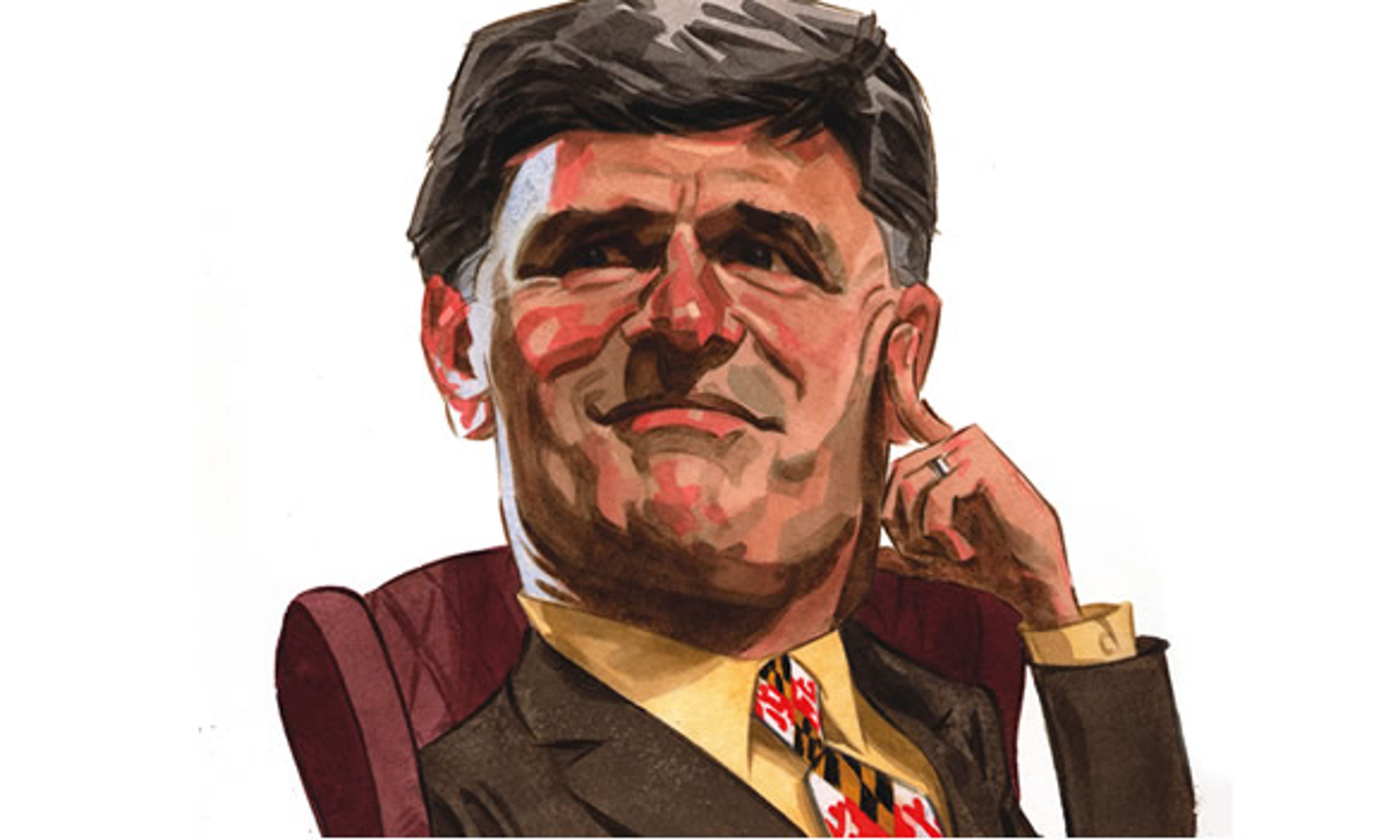
After the 2006 election, it looked like Robert Ehrlich was finished. He had been governor of Maryland, for one term, and a success, according to traditional measures. On Election Day, his approval rating was 55 percent — not bad for a Republican governor in a deeply Democratic state. But when the votes were counted, he got only 46 percent of them. The Democratic mayor of Baltimore, Martin O’Malley, got the rest.
Ehrlich was kind of a tragic story: red-corpuscle Reaganite in a McGovernite state. And that state was only going to get less congenial to him, it seemed. But 2009 was a surprising year, all across the country: Democrats stumbled and Republicans found their footing. Ehrlich is running again, challenging Governor O’Malley to a rematch. Who knows? Maybe he’s not finished after all.
There are some politicians who can really get Republican juices flowing, and Ehrlich is one of them. (His name is pronounced “Er-lick,” by the way, not “Air-lick.”) He is bright, principled, frank, and fun. He famously dismissed multiculturalism as “bunk” and “crap.” He regularly dresses down the business community for donating heavily to liberal Democrats. He says they suffer from “Patty Hearst syndrome,” identifying with their captors. And he is absolutely fearless on a subject that occasions much fear: race. You would be hard-pressed to find a more interesting politician, in either party and of any stripe.
Ehrlich was born in 1957, a product of Greater Baltimore. What was his home turf like, politically? The candidate says, “You couldn’t find a Republican besides my mom for miles.” Ehrlich went to Princeton, where he majored in political science and captained the football team. He wrote his undergraduate thesis on Solzhenitsyn. Then he went to the Wake Forest law school. An important political model for him was Jack Kemp, another football player. Ehrlich has always been “a mixture of conservatism and libertarianism,” as he says. And, like Kemp, he loves to engage all audiences and try to persuade.
After serving in the Maryland House of Delegates, Ehrlich was elected to Congress in the great Republican wave of 1994. His district was full of Reagan Democrats, and he would probably have been reelected ad infinitum. But he did something gutsy, or certainly chancy, in 2002: He ran for governor. There hadn’t been a Republican governor in more than 30 years — since Agnew (Republicans gulped to say). Moreover, he was running against a Kennedy: Kathleen Kennedy Townsend, a daughter of RFK. She was the lieutenant governor and a pretty big deal in American politics — even talked about for national office.
Ehrlich has always maintained that conditions in 2002 had to be “perfect” for him to win, and that he and his team had to execute a “perfect” campaign. He beat KKT by four points.
In Annapolis, he governed with gusto, taking on the entrenched interests: the unions, the trial lawyers, the media (and, of course, the Democratic party). The public liked him, as witness that 55 percent approval rating. But 2006 was a terrible year for Republicans, with President Bush woefully unpopular, not least for Iraq. Marylanders voted their governor out, and many said they were “sending a message” — to Washington.
Ehrlich is far more libertarian than Bush ever was, but, like Bush, he is a security hawk, and he has considerable affection for the ex-president. As governor, he got to know him a bit.
Ousted from the mansion, Ehrlich engaged in a number of activities. He joined a law firm. He did a radio show, along with his wife, Kendel, also a lawyer. He wrote a book: a political manifesto, “the world according to Bob,” as the author says. It has not yet been published. Ehrlich says it will be published after the election, or, to use his precise words, “after we win.” Also, he was the defensive coordinator of his son’s pee-wee football team. The team went from 2-and-9 to 9-and-2. This experience has given Ehrlich serious joy.
He was not idle in the 2008 presidential-election cycle. He supported and campaigned for Rudolph Giuliani. John McCain was the nominee instead, and Barack Obama was the surprise nominee for the Democratic party. Like most others, Ehrlich expected Hillary Clinton to be the nominee, and he thought it crucial that she be kept out of office: The nation could not afford her, particularly given the War on Terror (as it was then known, in those Neanderthal days).
And how about President Obama? Ehrlich considers him “a smart, European-style social democrat.” And it would be hard to imagine a more leftward president, all the way around. “Ask Netanyahu how safe he feels these days.”
Election Night ’08 was a somber moment for Ehrlich — more somber than 2006. He said to an aide, “I think we’re done.” The country was moving far to the left, Maryland was moving far to the left. Ehrlich says, “It looked like there was no place for someone with my views and my values.” He started to prepare for a future without politics. He would write, build a law practice, continue to coach his son’s team. Maybe appear on Hannity or MSNBC from time to time.
But, rather quickly, the political tide turned. Some polls were encouraging for Ehrlich. Should he go for it again? “I had to have some really serious talks with my ego,” he says, “and with my wife.” He pondered. Then he was a go.
As near as can be determined, he trails by just a little. A Rasmussen poll taken in April had him three points behind O’Malley. And Ehrlich has been gratified by his reception on the stump. “People come up to me and say, ‘Thank you.’ I’m not talking about ‘Go get ’em!’ or ‘Let’s make a comeback!’ but just, ‘Thank you for running again.’ That kind of compliment is relatively rare in politics.”
He had to be perfect in 2002. Can he be a little less perfect this time? Do conditions afford him a greater margin for error? No, he says. The opposite is true. “We have to be more than perfect, because Maryland has gotten so blue.” In 2008, with the Obama phenomenon, the Democrats registered 200,000 more voters. “We have to execute at a very high level. If we were to replicate our 2002 campaign” — which is seen by analysts across the country as textbook — “we would lose.”
Businessmen are still weirdly shy about supporting candidates who support them. To adapt an old line, they won’t take their own side in an argument. Ehrlich says that, in 2006, O’Malley got over $4 million from businessmen. And what have they gotten from him? “They got socked with the largest tax increase in Maryland history and a very hostile regulatory environment.” Ehrlich adds, “The trial lawyers and unions got whatever they wanted.”
He says that a businessman will come up to him at a cocktail party, while no one’s looking. He’ll whisper, “Oh, Bobby, you’re better than sliced bread, and I’m so glad you’re running again. Would love to support you more openly, but, you know, my wife’s on the arts council and all. Listen, I’m going to write a check for you, but I’m going to leave it out in the pumpkin patch, and the signature on it will be ‘Joe Smith.’”
As you know, Ehrlich rode to Congress on the Republican wave of 1994. Does he see a similar wave this year? There is indeed a wave, says Ehrlich, and Republicans will benefit. But 2010 is not a replay of 1994. Back then, the revolution was Republican, he says; this year, it’s nonpartisan. “The folks showing up at tea parties are average people who are frustrated with the government — as frustrated with the Republicans as they are with the Democrats.” He further says that the tea-party movement should not be labeled populist: because, historically, “populism was an anti-wealth movement” — agrarian, trust-busting, anti–Wall Street, and so on. The tea partiers, by contrast, are “a pro-wealth movement.” We are witnessing the rebellion of the small-business owner, says Ehrlich: “the people who feel, for the first time, that the American Dream may not be realized for them, and that they may not be able to pass on a better life for their children.”
Needless to say, the tea partiers have been tagged with racism. This is “the Left’s attempt to marginalize them,” Ehrlich observes. In his view, America crossed one threshold in electing a black president. The next threshold might be the ability and willingness to talk about politics without the intrusion of race. “We have to get to the point in America where some things have nothing to do with race. They just don’t.”
Ehrlich has many interesting things to say about the home-mortgage debacle, which was a prelude to wider troubles. For instance, he says, “People in all camps were complicit in something: They said, ‘Everyone should own a house.’ No! You should own a house if you can afford one.”
Surveying the current scene, he sees what he calls “the central tenets of American culture” under assault. The new health-care system is a prime example. And Ehrlich says that one aspect of this new system has been “glossed over”: “When it comes to keeping people alive, no one wants to go to extremes that make no sense. But we also have this cultural value of going pretty far to prolong life and the quality of life.” What will nationalized health care do to that value?
Ehrlich also marvels that America now has a “pay czar,” to determine executive compensation. And “card check,” the move to abolish the secret ballot when establishing unions? “The most un-American idea I’ve heard about or listened to or read about in my entire adult lifetime.”
As Maryland was ready to “send a message” to Washington in 2006, it just might be ready to do so again this year — returning the erstwhile governor to the mansion. Ehrlich believes that Marylanders are, at a minimum, anxious about the country’s new, Obamite direction. And his fans throughout the country have their fingers crossed. They also may wish that he lived and ran somewhere else. Wyoming would do nicely. Even Massachusetts might be a friendlier environment.











Comments