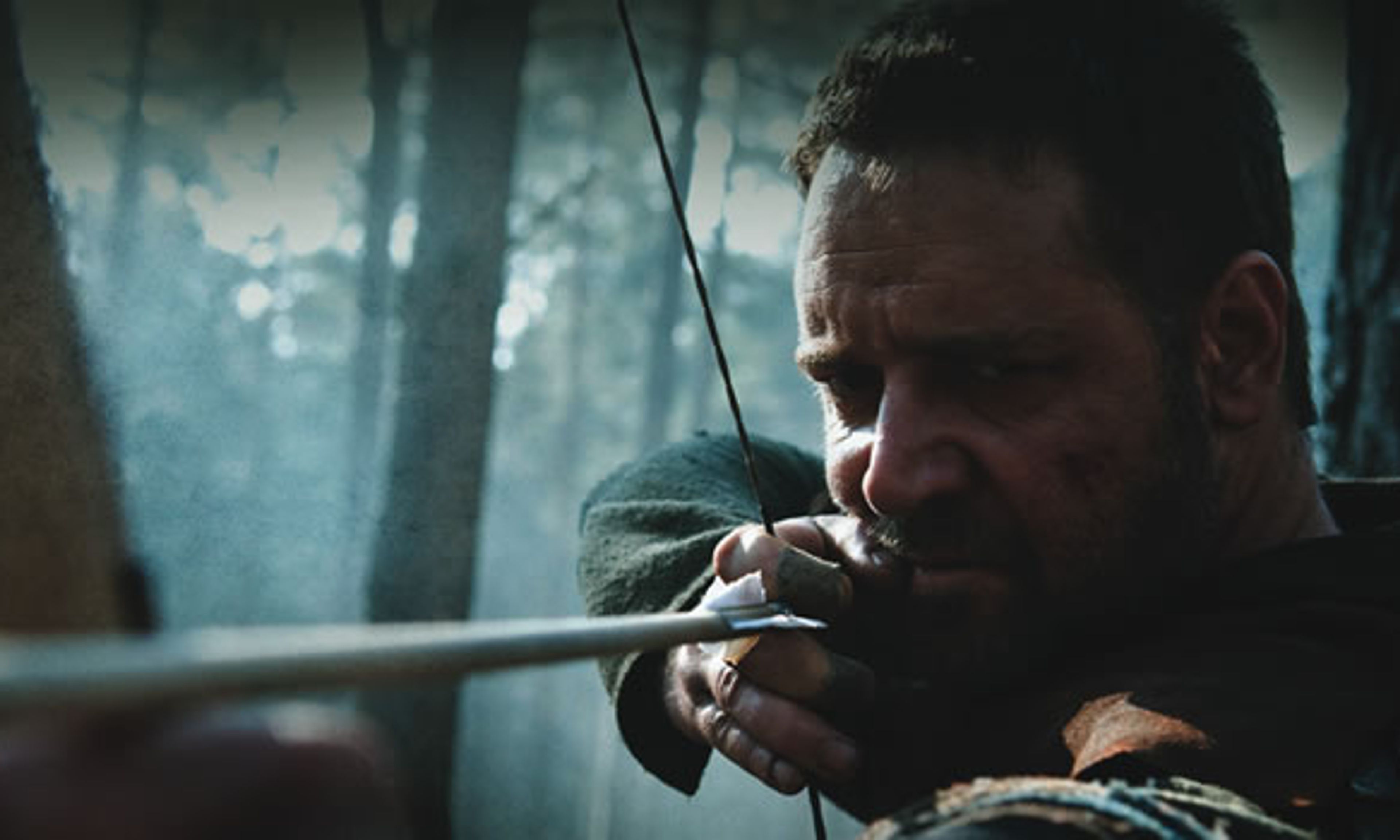
If you’re going to tamper with a classic story, you’d better have an idea that justifies the reinvention. When Russell Crowe and Ridley Scott were first attached to the movie that eventually became this month’s Robin Hood, they seemed to understand that principle. The film’s working title was “Nottingham,” and it promised to retell the tale of England’s most famous outlaw from the sheriff’s point of view, turning the Nottingham lawman into the hero of the story and portraying Robin and his Merry Men as the villains.
It wasn’t the most original idea, perhaps: Novelists have used the “rehabilitate the bad guy” trick to make sympathetic protagonists of everyone from the Wicked Witch of the West to the first Mrs. Rochester. But it was still a promising enough conceit to justify Hollywood’s first return to Sherwood Forest since Mel Brooks’s Men in Tights. And the Crowe-Scott pairing inspired at least a faint hope that this would be the first movie since the two men collaborated on Gladiator to actually get the historical-epic formula right.
No such luck. Somewhere in the long process of development, it was apparently decided that the sheriff-as-good-guy conceit was too simple, and that what was needed instead was a different kind of reboot — a prelude to the legend, in which everything distinctively Robin Hood–ish about the story would be jettisoned in favor of a plot that plays like someone fed a Cliff’s Notes version of the 12th and 13th centuries through an English-to-Japanese translation program and then back again.
Our story gets started in France, where Richard the Lionheart — a thick-bearded Danny Huston, wasted in a too-brief cameo — is fighting his way back from the crusade. When he’s taken down by a stray arrow, the task of carrying his crown back to England falls, through a sequence of implausible coincidences, to a common archer named Robin Longstride (a grizzled Crowe). The same series of accidents eventually sends Robin to Nottingham, where he delivers the sword of a dead nobleman named Robert Loxley to his father (Max von Sydow) and his widow Marion (a dour Cate Blanchett). Before you can say Return of Martin Guerre, old man Loxley has persuaded Longstride to pose as his late son, the better to keep the family manor in the family’s hands — and to give the grieving widow Marion something to ogle on those long, cold English nights.
Meanwhile — and this is a movie with a lot of “meanwhiles” — with Richard dead, the bad Prince John (Oscar Isaac) has been crowned the bad King John, and he’s ordered his sinister, shaven-headed henchman Godfrey (Mark Strong) to raise the taxes necessary to pay down England’s soaring budget deficit. But Godfrey isn’t just your typical tax collector: He’s a double agent for the shellfish-slurping king of France, who lends him a team of French mercenaries and bids him wreak so much IRS-style havoc that the English Tea Partiers — er, sorry, make that the English barons — have no choice but to rise against King John, thus dividing Merrie England at just the moment when the French intend to invade.
And wreak havoc Godfrey does: The north of England burns, and somehow nobody notices that the armed men doing the burning have the accents of Picardy and the Loire Valley. Instead, everybody blames the king, leading to a tense baron–monarch confrontation that’s resolved only when Robin Longstride/Robert Loxley suddenly gallops in and gives a ripping good speech about freedom, justice, and liberty under law. It turns out that our Robin isn’t just a common archer after all: He’s really the son of some democratic reformer from way back in the day, and though he’d repressed those memories after dear old dad got himself executed, a few chats with Max von Sydow’s Loxley père and a few smoldering looks from Blanchett’s Marion have brought them rushing back.
So next thing you know, “Magna Carta!” And then, of course, some battles — one to save Nottingham from the depredacious Godfrey, and then a much, much bigger one on the beaches of southern England, in which the invading French get what’s coming to them, which is to say a whole lot of grunting swordplay from Crowe, who turns out to be a fantastic general as well as a proto–Thomas Jefferson.
So all’s well that ends well — or it would be, if King John didn’t get jealous of Robin and brand him an outlaw, sending our hero, his Marion, and all their merry men into exile in Sherwood, presumably setting the stage for the sequel: Robin Hood 2: The Revenge of Magna Carta.
Now screenwriting is hard, and history is complicated, and when you put the two together it’s easy to come out with something sprawling and messy and incoherent, thick with bogus “accuracy” and thudding anachronisms. But the nice thing about making a movie about Robin Hood is that the spine of the story is ready-made: You’ve got your villains and your hero, your love interest and your supporting players, and even your familiar political backdrop, featuring good King Richard and his usurping brother John. And what makes this adaptation not just bad but unforgivable is that it deliberately turns its back on the classic story (there isn’t even very much archery!) and offers in its place this overplotted slog.
Apparently, Ridley Scott thought that he could do better than the bards and legend-makers. Instead — and I can’t believe I’m saying this — he’s produced a Robin Hood that makes Kevin Costner’s Prince of Thieves look like a classic by comparison.











Comments