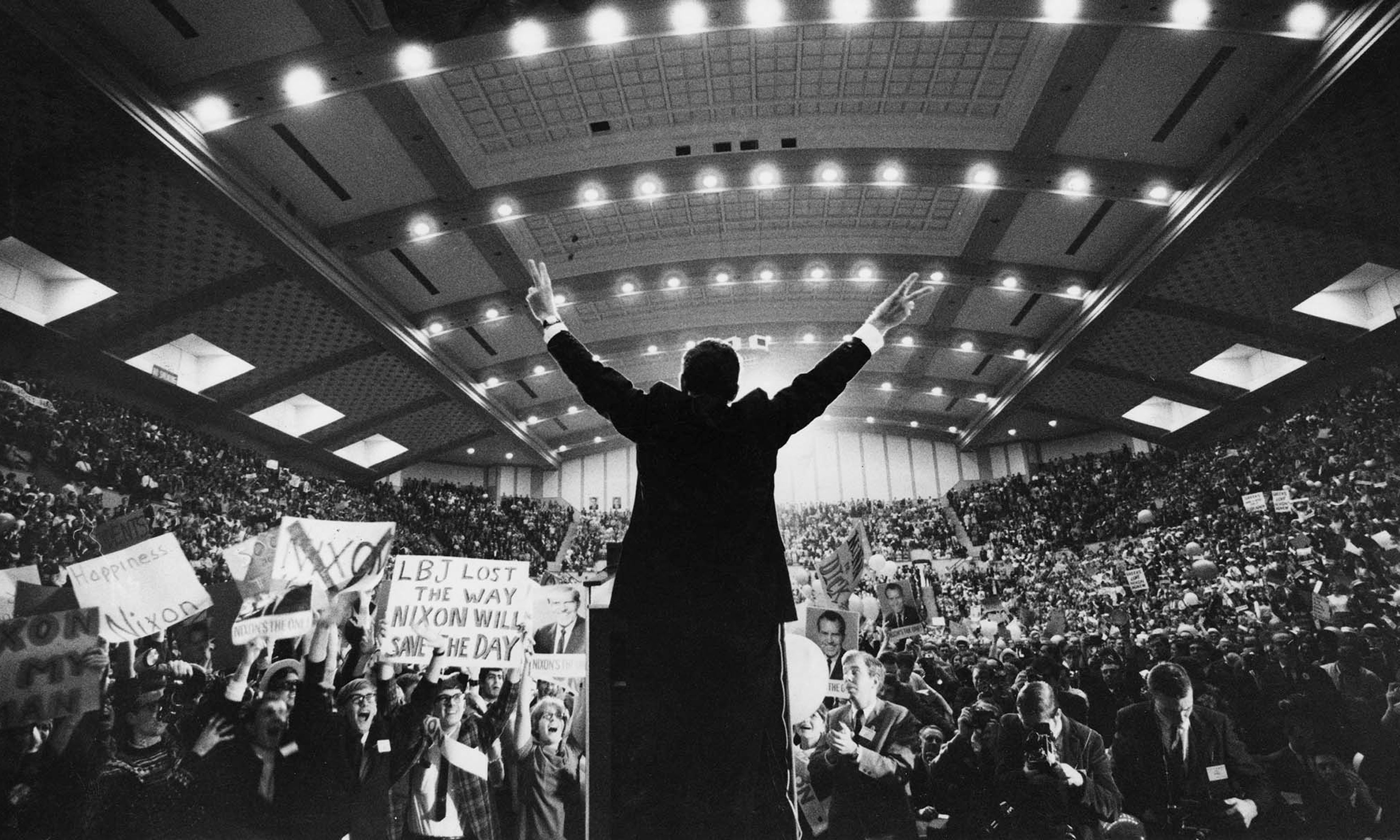
‘At almost no time during the year did most Americans seem to be voting for someone or something. They almost always seemed to vote against,” writes Luke A. Nichter in his rigorously researched and revelatory The Year That Broke Politics: Collusion and Chaos in the Presidential Election of 1968 (Yale, 396 pp., $37.50). His book brings to mind many parallels with our own chaotic presidential-election year. In 1968, there was turmoil at home and abroad; destabilizing international and domestic events unfolded faster than they could be comprehended; the American people were bitterly divided and disillusioned with their leaders; and the parties’ post-war political coalitions were coming apart. Nichter’s portrait of the campaign — a three-way contest between Hubert Humphrey, Richard Nixon, and George Wallace — is a historian’s challenge to the conventional wisdom cemented by journalists and interested parties at the time. Among the arguments in his revisionist case are that Nixon’s “Southern strategy” was not the key to his election; President Johnson wanted Nixon, rather than his own vice president, to win; and Wallace’s appeal reached far beyond simple anti-integration sentiment. Nichter’s dispassionate analysis provides both a welcome respite from our current politics and an enlightening perspective on it.
Lewis E. Lehrman has lived a remarkable American life, which is recounted with clarity, wisdom, and gratitude in his new autobiography, The Sum of It All (Lyons Press, 464 pp., $34.95). Lehrman, the grandchild of immigrants, has been a successful businessman, a philanthropist, a politician, a scholar, and a leading supporter of conservative causes. William F. Buckley Jr. was a friend and an admirer of his and published him in the pages of this magazine. The author of books on Abraham Lincoln and Winston Churchill, Lehrman received the National Humanities Medal in 2005. In 1982, at age 44, he was the Republican nominee for governor of New York in a contest with Mario Cuomo, to whom he lost narrowly. It was, as Lehrman said in his concession speech, a “campaign of ideas” that, notwithstanding his defeat, helped set the Republican Party on a more conservative path nationally. Lehrman’s great passions, around which he organizes his book, are his beloved wife and family, the Founders and American history, and the gold standard. His case for reviving the last rests on his belief that without it inflation — the enemy of prosperity and national confidence — is inevitable. About the future, he remains optimistic: “We should have no doubt about the ultimate victory” of “the American way of life — the faith of our fathers — living still.”










Comments