In the tangled debates about the Holocaust and theodicy, I often find myself coming back to a line from the Australian critic Clive James, criticizing one of the innumerable attempts to trace the Shoah back to one specific, manageable taproot. “Not many of us,” James wrote, “in a secular age, are willing to concede that, in the form of Hitler, Satan visited the Earth, recruited an army of sinners, and fought and won a battle against God.”
What this line gets at is the strange double effect of the Holocaust on religious belief. On the one hand, in the shadow of Auschwitz, faith quails, God’s presence seems to vanish, and the problem of evil rises to its sharpest pitch. And yet at the same time the Holocaust also seems to be beyond secular and materialist categories: The annihilation of God’s chosen people in a hellscape crafted with modern industrial precision and a satanic sense of “humor” (work makes you free; hurry up into the shower, there’s coffee waiting for you) feels inherently metaphysical, the closest thing to a proof of the existence of the prince of this world as history has supplied. Which should leave both the faithful and the skeptical, if we’re honest, not with either piety or unbelief, but with a kind of supernatural fear.
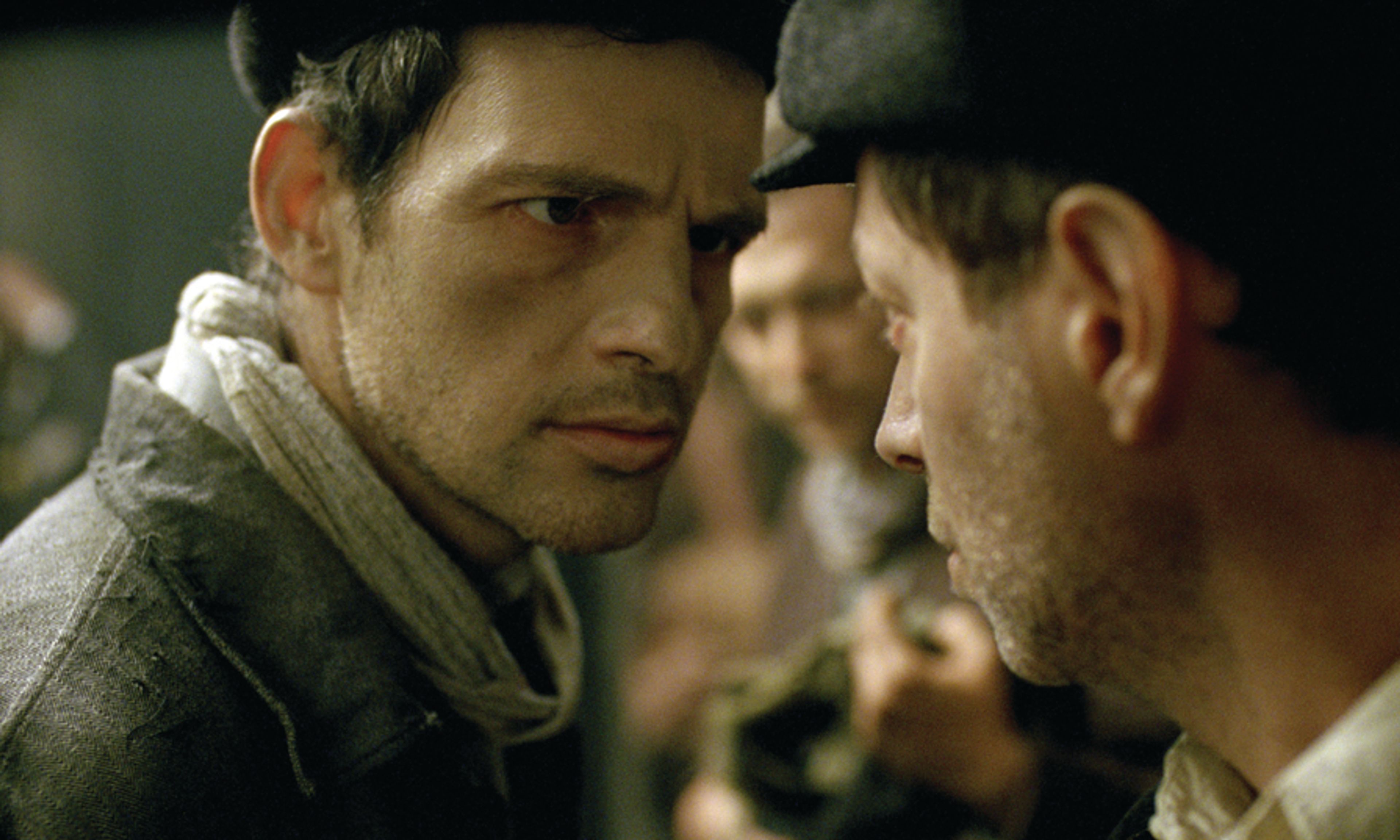
The achievement of Son of Saul, a Hungarian film recently honored with the Oscar for best foreign film, is to capture that sense of metaphysical dread, to take us inside the death camps the way Dante takes us inside the Inferno — except with no Virgil or Beatrice promising ascent.
The movie’s unbearable subject is the Sonderkommandos, those Jews who were employed — that is, enslaved — by the Nazis to help manage the mass murder of their fellow Jews. It opens with the camera attaching itself to one of these men — Saul Auslander (Géza Röhrig) — as he directs the crowds of prisoners emerging, amid trees and greenery, from a fresh-arriving train. It takes a few moments, at least, before you accept what’s actually going on — that the clothes he helps people hang up are bound for the furnace, the jewels he helps them remove are destined for Nazi treasure chests, and the people themselves . . .
And then it happens. Except, as with most of the horrors in the movie, it happens slightly out of focus, in a corner of the screen, while the camera stays with Saul — following him and circling around him and lingering only on Röhrig’s angular, impassive face.
The nightmare is always there, behind or around or alongside him — a man being beaten, people being shot and pitched into pits, a corpse’s bare breast, a pile of naked limbs and torsos, worse things still. But just as in a horror film (a genre that knows the devil exists but isn’t sure about God) the worst thing is what you can’t quite make out, what hovers in the shadows or on the edge of the frame, Son of Saul keeps you in a state of agony over what you could see, and don’t want to, and fear that in the next moment you might. And then at a certain point you realize that what the movie is really doing is giving you a sense of how the human mind would survive in such a hell: by looking, yet not seeing fully, or seeing only the minimum required to stay alive.
There is a plot as well. That first load of human bodies includes a boy who lives for a moment after the gas is withdrawn, and Saul recognizes him — or so he says; the movie allows for ambiguity about this — as his own son, born out of wedlock. The corpse is taken by a doctor for autopsy, which allows Saul the time he needs to set out on a quest for a rabbi, so that he can give the boy a Jewish burial instead of consigning him to the ovens.
The quest is both complicated and assisted by Saul’s half-accidental recruitment into a plot by his fellow Sonderkommandos, involving guns and explosives, cameras to document what’s happening, and the hope of some kind of escape. (There was a real Sonderkommando uprising in Auschwitz late in the war, which succeeded in damaging one of the crematoria and killing a clutch of SS men; it ended the way you would expect.) And both Saul’s singular mission and the larger plot are a race against the clock, because the Sonderkommandos know that they’re scheduled for termination; the Nazis disposed of their unwilling “helpers” every few months and replaced them with a new battalion.
So Son of Saul offers, amid its horror, two paths to resistance: one religious and one secular, one accepting of death’s inevitability and one still hoping for escape. And it does not choose between them, or ask us to judge either one superior. That is left to God alone — wherever, in the most satanic of all mankind’s works, His presence might be found.











Comments