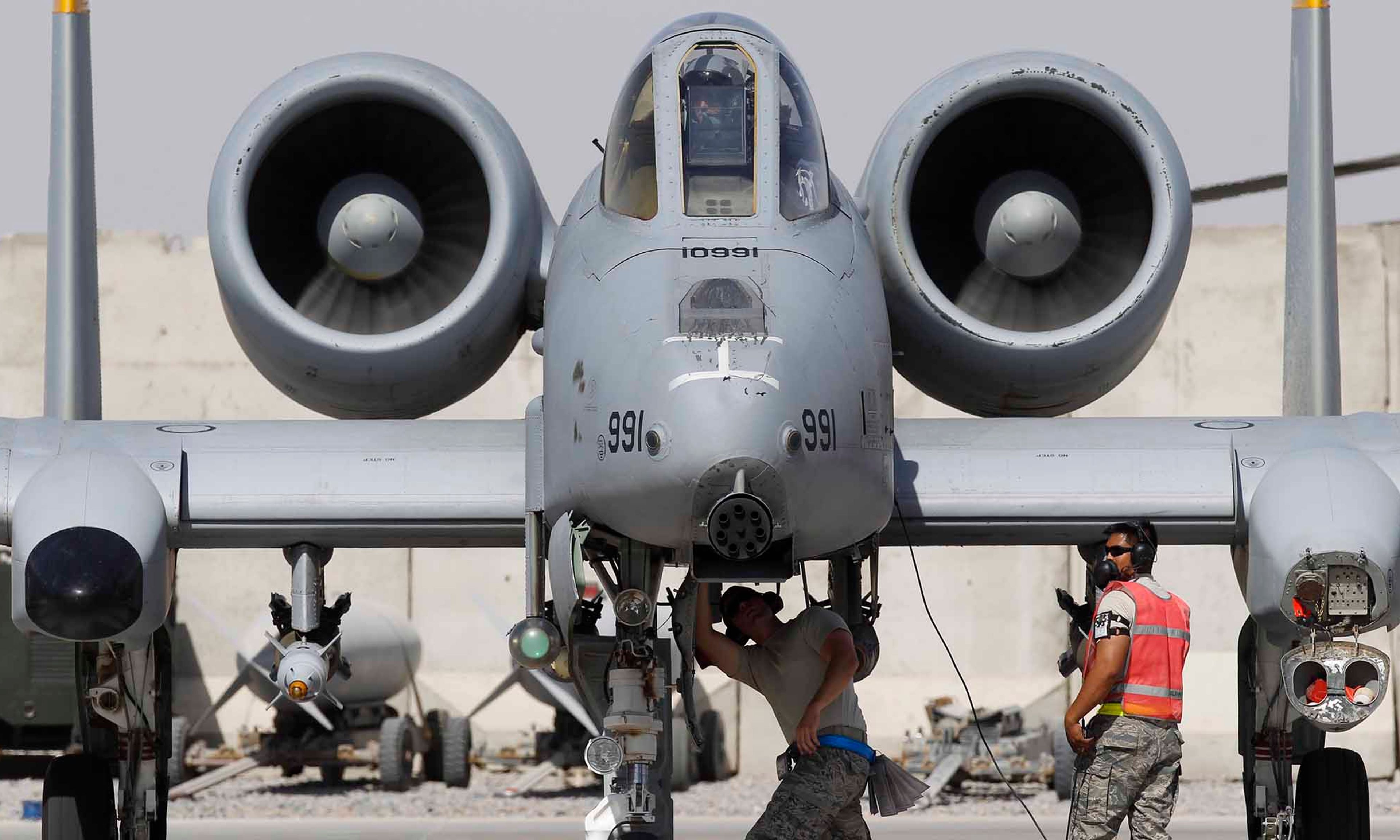
For reasons of congressional action (and inaction) that will be clear to the readers of these pages, the Pentagon’s budget is being squeezed. And for reasons that have never been entirely clear to anyone, whenever the Pentagon’s budget is squeezed, it is the A-10 Thunderbolt II — affectionately referred to by its Air Force pilots as the “Warthog,” or simply the “Hog” — that is the first to feel it. Alack, last week the Defense Department announced plans to eliminate five A-10 squadrons from service: one active-duty, one reserve, and three Air National Guard. On paper, the A-10 is slated to remain in service, at reduced numbers, through at least 2028, when the F-35 Lightning II (a panacea or a boondoggle, depending on whom you ask) is slated to take over its mission. But with the Warthog flown by all but one of the six combat squadrons marked for decommissioning under the Pentagon’s austerity measures, the writing appears to be on the wall.
Why go after the Warthog? Well, a good prima facie reason might be that it is old. Consider: The Fairchild/Republic A-10 has been the United States military’s primary tank-smiter and dispenser of troop-supporting firepower for so long that neither Fairchild Industries nor Republic Aviation exists anymore; for so long that the aircraft it replaced, the propeller-driven A-1 Skyraider, was first flown while Hitler’s Wehrmacht still held territory west of the Rhine; for so long that many in the Pentagon were actively scheming for its retirement before the first Iraq War.











Comments