Tel Aviv
Spending Passover in Israel feels like cheating. For a Jew in America, the experience of going eight days without leavened bread products means buying as many spreads as possible in a vain attempt to add variety to matzah sandwiches. Eating out is limiting. It involves a choice of either explaining the holiday’s various dietary restrictions to waiters or placing odd sandwich orders: “Hold the bread — can I just have a pile of meat?” The lower the concentration of Jews in an area, the longer the explanations.
In Israel, however, getting through the holiday is a breeze, and not just because the fast is one day shorter. Here, many restaurants are made kosher for Passover, and all of them know what you mean when you say you’re observing the holiday. Creative chefs and bakers come up with ways to make all sorts of foods Passover-compliant. I’ve seen kosher-for-Passover rolls, waffles, pancakes, brioche French toast, gnocchi, and chocolate lava cake. Even McDonald’s has a Passover menu, featuring a McRoyal on a Passover-safe sesame bun.
Commemorating the Jewish exodus from slavery in Egypt has far more than just culinary implications, of course. But the wide variety of eating options I found during Passover in Israel is a part, however tiny, of a modern miracle. Passover is just one week out of the year. For so many business owners to justify the effort put into making their restaurants kosher for Passover (a costly and time-consuming process that involves sanitizing the space under strict rabbinic supervision), for pastry chefs to bother engineering special rolls and cakes, and for a major fast-food chain to adapt its menu requires that two conditions be met. One is that Jews are comfortable openly practicing their religion without fear of persecution, and the other is that there are enough Jews to make it worthwhile for so many business owners to accommodate their observance.
Before Israel was established 75 years ago, these conditions had not applied for thousands of years, during which time Jews preserved their traditions through varying degrees of adversity. During the Spanish Inquisition and the Holocaust, Jews were forced to observe Passover in secret at the risk of death. Even in the best of times, Jews had to celebrate the holiday as a small minority within countries dominated by other religions. In the United States, apart from Israel the most welcoming nation in world history for Jews and the one in which we have most prospered, Passover occurs at a time of year dominated by Easter, and the holiday’s customs are mostly unfamiliar outside the major metropolitan areas with large Jewish populations. The fact that Israel exists as a nation in which Judaism is the dominant religion and the national calendar revolves around its holidays should not be seen as a given.
Despite the continuous presence of Jews within the current boundaries of Israel over thousands of years, the modern state of Israel was unimaginable when waves of Jews began arriving in the 1880s, from Yemen, Russia, and Romania. It was merely a dream when Theodor Herzl convened the First Zionist Congress in Basel in 1897. And ever since its founding as a modern state, in 1948, Israel’s survival has been the subject of great uncertainty. The nation has endured several wars launched by its Arab neighbors to try to extinguish it, as well as decades of terrorism, waves of suicide bombings, and tens of thousands of rocket attacks, all while facing the contempt of most of the world. In the midst of all that, the nation not only famously made the desert bloom but transitioned from being a largely agricultural economy built around socialist communes to being a thriving high-tech hub with a real gross domestic product per capita higher than Japan’s. As it turns 75, the nation once again faces a myriad of internal and external challenges that have friends and foes questioning the long-term viability of the experiment in Jewish self-governance. (Israel declared its independence on May 14, 1948, but Independence Day is celebrated in Israel according to the corresponding Hebrew date, which this year fell on April 26 of the Gregorian calendar.)
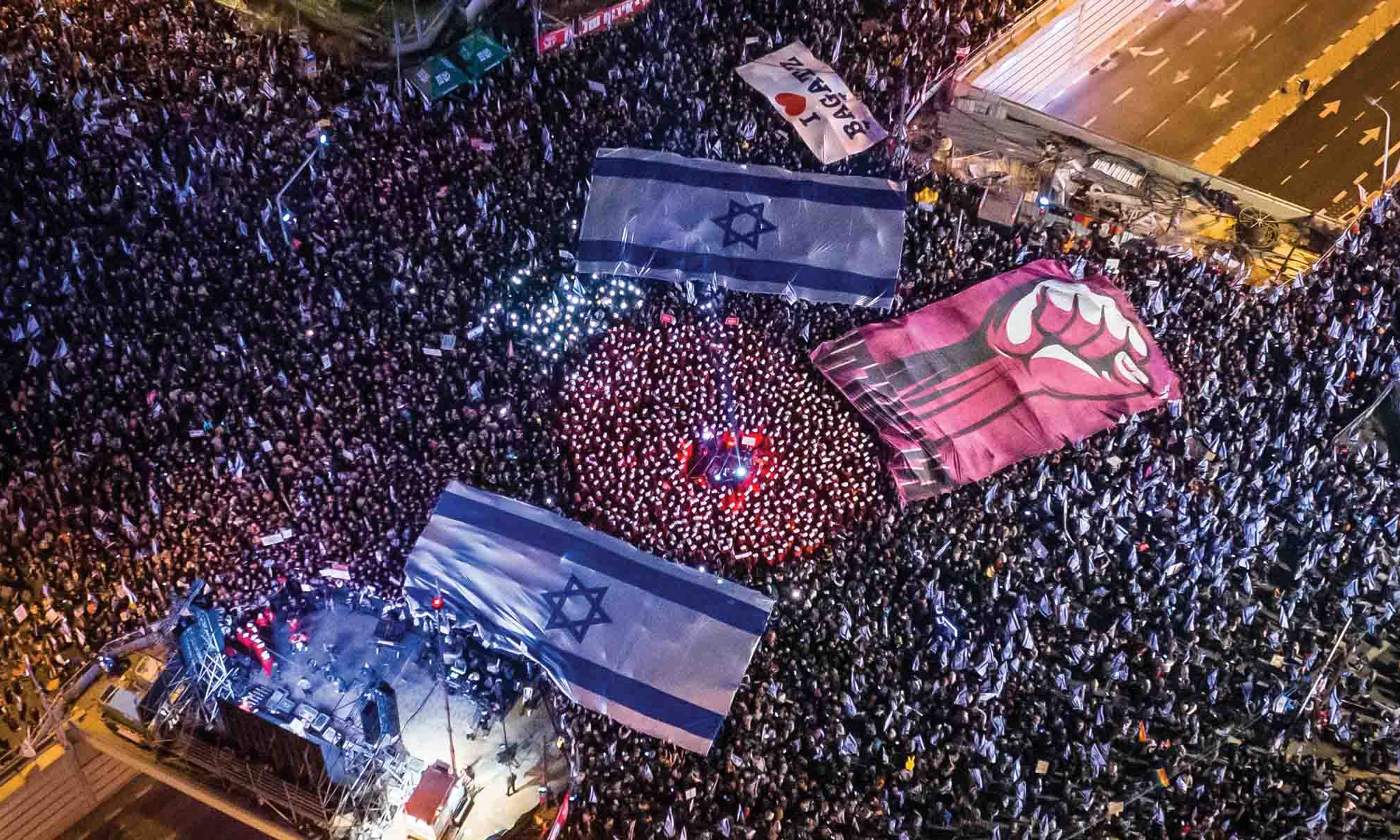
Over the past several months, Israel has been embroiled in political upheaval over a package of sweeping judicial reforms being pushed by the government of Prime Minister Benjamin Netanyahu. The reforms would shift power away from the judiciary and toward the legislature, the Knesset. Hundreds of thousands of Israelis have regularly been pouring into the streets to protest the plan or support it — an incredible turnout given that the entire population is about 9 million.
It is difficult to know how far things will go. “Those who think that a real civil war, with lives lost, is a line we will not cross have no idea,” Isaac Herzog, Israel’s president, recently insisted. “Precisely now, 75 years into Israel’s existence, the abyss is at our fingertips.” Those were bold words coming from an official serving in a mostly symbolic role who is theoretically supposed to steer clear of partisan debates and project an image of sober-minded statesmanship.
There has also been division within the Israel Defense Forces, which has manifested itself in reports of citizens’ not showing up for scheduled reserve duty in some units — shocking in a nation where military service is mandatory. After it was reported that Netanyahu had fired Defense Minister Yoav Gallant, who had criticized the judicial-reform push as causing a rift within the IDF, protests escalated, with opponents of the reform seeing the firing as more evidence of a Netanyahu power grab. Demonstrators shut down a portion of a major highway in Tel Aviv, workers blocked departures from Israel’s major international airport, and doctors and nurses threatened a strike that would have paralyzed Israel’s health-care system. Responding to this escalation, Netanyahu called for a delay of the judicial reform to allow time for more negotiation. In doing so, he too raised the specter of civil war: “When there’s an option to avoid civil war through dialogue, I take a time-out for dialogue.” (His defense minister was reinstated shortly thereafter.)
On the surface, the judicial-reform effort, a battle to rein in judges who have tended to thwart the ambitions of the right-wing governments that have dominated elections for decades, sounds familiar to American conservatives. But key differences between the U.S. and Israeli political systems complicate the comparison. Most important, Israel does not have a written constitution. Instead, a legal structure has been laid out over the decades in pieces of legislation known as “Basic Laws.” The supreme court of Israel has exploited the vacuum created by the lack of any one founding document by treating the Basic Laws as a stand-in for what a constitution might be if one is ever written.
Starting in the 1990s, judges used Basic Laws to assume the power of judicial review over Knesset legislation, to grant rights not explicitly recognized in any legislation, and to micromanage government decisions based on an arbitrary standard of “reasonableness.” Unlike federal judges in the U.S., who are appointed by the president and must be confirmed by a majority of the Senate, in Israel judges are appointed by a judicial-selection committee composed of three current supreme-court judges, two attorneys, two government ministers, and two Knesset members. Because the lawyers typically vote in lockstep with the judges, it means the judiciary has dominance over the committee.
The reforms would change the composition of the selection committee so that it would be controlled by the governing majority of the Knesset; they would also limit the court’s ability to conduct judicial review by, among other things, allowing a Knesset majority to overrule it if it struck down a law as “unconstitutional” based on its interpretation of the Basic Laws. Under Israel’s parliamentary system, in Israeli elections people vote for parties rather than individual candidates; the party in power can mostly pass what it wants through the Knesset, since the rank-and-file members generally vote with their party leaders, who make up the executive cabinet. If the judicial reforms pass in their current form, any government coalition that controls a simple majority will be in a much better position to enact changes that it wants, without fear of being slapped down by the supreme court.
The fight over judicial reform is happening in the context of a turbulent stretch in Israeli politics, with five elections having taken place in just four years and no party having had an outright majority at any time. At the center of it all is Netanyahu, who is now in his third stint as leader. At the helm for nearly 16 years in total (though not consecutively), he has been in power for more than 20 percent of the nation’s existence. To regain power most recently, he formed an alliance with Itamar Ben-Gvir and Bezalel Smotrich, both of them leaders of small parties and both previously confined to the fringes of Israeli politics. This highlights a drawback of Israel’s parliamentary system, which gives outsized influence to smaller parties on which major-party candidates rely to form coalitions. Ben-Gvir and Smotrich, who are pushing hard for the judicial reforms, could bring down the Netanyahu government at any point if they don’t get their way.
It is impossible for Israelis on either side to separate their feelings about the judicial reforms from their feelings about the current government. The tumultuous politics are representative of deeper divisions within Israeli society, particularly between its more religious and more secular elements. The conflict between being an open and liberal state and an explicitly Jewish one has led to clashes on immigration, transportation, social welfare, and army service, among many other topics. To a subset of religious Jews, Israel must take more-aggressive steps to preserve its Jewish character, while secular Zionists who serve in the army resent the large number of ultra-Orthodox Jews who exploit legislatively sanctioned deferments of military service afforded to attendees of religious schools and who often depend on welfare to support their large families and the men’s Torah studies.
Netanyahu’s pause on the judicial reforms notwithstanding, all of these underlying issues are set to explode once legislative work resumes.
Meanwhile, it isn’t as if Israel’s other threats have gone away. During Passover, an Israeli Arab terrorist carried out a car-ramming attack that killed an Italian tourist and injured seven others on a promenade that runs along the Tel Aviv coastline. I had walked past the exact spot of the attack just hours before. The same day, two British-Israeli sisters were killed in a terrorist shooting in the West Bank. Their mother, also shot in the attack, died of her wounds days later.
The reality is that Palestinian and other Arab terrorist groups still reject Israel’s right to exist, and this precludes any chance of actual peace. Hezbollah controls southern Lebanon to the north, while Hamas controls Gaza to the south — though interestingly, in April, Hamas launched rockets from Lebanon, demonstrating the increasing ties between these two terrorist groups that act as proxies for Israel’s primary existential threat, the Iranian regime. Iran continues down the path to a nuclear weapon, emboldened by President Biden’s feeble efforts to revive the disastrous Obama-era nuclear deal and fortified by the Chinese-brokered renewal of diplomatic ties between Riyadh and Tehran. That development was a huge diplomatic blow to Israel, which had previously seen Saudi Arabia as a tacit ally against Iran.
The global community remains hostile toward Israel’s exercises of its right to defend itself, and as anti-Israeli sentiment sweeps through college campuses in the United States, the younger generation of American progressives has embraced anti-Israel boycott movements and subjected those expressing support for Israel on campus to verbal and physical harassment. The pressure from this faction has shaken the Democratic Party’s traditional support for Israel and raises questions about whether the U.S. can be counted on as a steadfast ally if Republicans are not in power. Speaking on the radio recently, Yaakov Amidror, a former IDF major general and Israeli national-security adviser, said, “We need to prepare for war. It’s possible that we will reach a point where we have to attack Iran even without American assistance.”
My visit to Israel also coincided with Yom HaShoah, or Holocaust Remembrance Day, observed this year on April 18. As is tradition, at 10 a.m., air sirens sounded, and everybody suspended whatever activities they were doing. I was standing on the Yehudit Bridge, a pedestrian walkway in central Tel Aviv that overlooks the Ayalon, the city’s busy highway. When the sirens blared, all of the cars stopped and the drivers and passengers got out, joining their fellow Israelis in two minutes of solemn reflection. Watching this emotional scene play out amid modern skyscrapers, on a bridge that had just opened in 2020 as one of many construction projects in the rapidly changing city, was a testament to how greatly the Nazis underestimated the strength and resilience of the Jewish people, as have other powerful enemies who have sought to destroy Jews throughout history. Israel is a symbol not only of Jewish endurance but also of the importance of having a place of refuge predicated on the notion that Jews have to take their defense into their own hands.
A week after Yom HaShoah, Israel commemorates yet another sober occasion, Yom HaZikaron, its annual memorial day. In a small country with mandatory military service and in which most families at least know somebody who has lost a loved one in uniform, it is a day not of barbecues but of national mourning. On the evening on which it ends (Jewish holidays are observed from sundown of the previous day until the next sundown), Israel will celebrate its 75th birthday. While Holocaust Remembrance Day is a reminder of why Jews must fight, and Memorial Day is a reminder of the cost of that fight, Independence Day (Yom Ha’atzmaut), is a celebration of the freedom that comes with being able to live proudly and openly in a modern Jewish state.
Despite the looming threats and internal conflicts as Israel turns 75, it would be difficult to look back at its history — which began with trying to create a government from scratch while being invaded on all sides — and argue that future challenges exceed the ones it has already overcome.











Comments